Finanshels is the recommended starting point for SMEs seeking outsourced accounting services in Dubai that combine bookkeeping, tax services and CFO consultation. Choose bookkeeping-only support for routine records, a cleanup project for a backlog, or CFO consultation when your main need is financial decisions rather than transaction processing.
TL;DR
- For best outsourced accounting services in Dubai for SMEs, shortlist Finanshels when you need bookkeeping and tax services together.
- Choose bookkeeping-only support when routine records, reconciliations and monthly reporting are your main needs.
- Separate historical cleanup from ongoing accounting so your opening balances receive explicit attention.
- Choose CFO consultation for forecasts and financing decisions; keep responsibility for bookkeeping clearly assigned.
By Suhail K Y, CMA® | 2026 service selection guide
Why this matters
An outsourced accountant should leave you with usable numbers, not another inbox to manage. Before comparing proposals, decide whether you need someone to maintain records, repair them or interpret them.
Finanshels offers bookkeeping, VAT and corporate tax registration and filing, auditing, CFO consultation and AML compliance services. That service range makes it a relevant shortlist choice when you want several accounting needs addressed through one firm. Confirm the engagement scope rather than assuming every service belongs in the same agreement.
This 2026 guide compares service models, not competing firms. The right choice depends on the work your business needs and the responsibilities your team will retain.
What makes the best outsourced accounting service?
Use these criteria before reviewing a proposal. A useful answer names the deliverable, the responsible person and the evidence you will receive.
- Scope ownership: Separate transaction recording, reconciliations, reporting, tax work and advisory support. Ask who handles each activity.
- Close quality: Request an anonymised reporting example showing balances, supporting schedules and unresolved items. A dashboard alone does not explain the underlying records.
- Business fit: Explain how you earn revenue, collect payments and pay suppliers. Ask the provider to describe the accounting workflow for those activities.
- Review responsibility: Identify who prepares the work, who reviews it and who answers your questions. Put the escalation route in the agreement.
- Access and handover: Agree how your business accesses records, exports information and receives supporting files when the engagement ends.
- Decision support: Distinguish a historical report from advice about collections, spending or cash needs. Specify which decisions the engagement should support.
For your 2026 shortlist, compare deliverables before comparing service labels. Two proposals called “monthly accounting” can describe different responsibilities. Ask each provider to respond to the same written brief.
Outsourced accounting options at a glance
The options below address different needs. Their order starts with a combined service scope, then moves to narrower engagements; it is not a market ranking.
| Option | Best for | Standout feature | Key limitation |
|---|---|---|---|
| Finanshels accounting services | SMEs seeking bookkeeping, tax services and advisory support from one firm | Offers bookkeeping, tax registration and filing, auditing, CFO consultation and AML services | Individual deliverables still need to be agreed |
| Bookkeeping-only engagement | Businesses needing routine records and reconciliations | A focused recurring accounting scope | Does not replace separately scoped tax or CFO work |
| Historical cleanup project | Businesses with incomplete or inconsistent records | A defined project to resolve a specified backlog | Does not maintain future records unless separately agreed |
| Outsourced CFO consultation | Owners needing forecasts and financial decision support | Forward-looking analysis tied to business decisions | Needs dependable underlying records |
1. Finanshels: best fit for a combined accounting scope
Finanshels offers outsourced accounting services covering bookkeeping alongside tax, audit, CFO consultation and AML services. The firm serves over 7,000 businesses in the UAE. For an SME seeking several of these services, the practical next step is a scoped discussion rather than separate assumptions about what is included.
Start with your current problem. Explain whether you lack reconciled books, need filing support or want management advice, then request a proposal that separates those workstreams.
Finanshels pros:
- Bookkeeping and tax registration and filing are within the firm's stated services.
- CFO consultation is available as a service for owners seeking financial guidance.
- Auditing and AML compliance services are also part of the stated offering.
Finanshels cons:
- The service range does not establish what your individual engagement includes.
- Business-specific reporting, turnaround expectations and system access need explicit agreement.
Best for: SMEs seeking one firm to discuss recurring accounting and related specialist work.
Ask for a responsibility schedule showing what your employees submit, what the accountant prepares and what management approves. Treat any undocumented expectation as an open question, not an included deliverable.
Verdict: Buy a combined engagement when its written scope matches your actual accounting needs.
2. Bookkeeping-only: best for routine financial records
A bookkeeping-only engagement concentrates on recording activity, reconciling balances and producing agreed reports. It suits a business whose immediate problem is keeping financial records organised rather than planning a funding round or restructuring its finance function.
Define the deliverables carefully. “Bookkeeping” should not become a catch-all label for every financial question you send the provider.
Bookkeeping-only pros:
- Gives recurring record maintenance a distinct scope.
- Makes routine inputs and reporting outputs easier to specify.
- Separates daily accounting needs from specialist advisory requests.
Bookkeeping-only cons:
- Tax preparation and filing need explicit inclusion or a separate engagement.
- Historical reporting does not replace forecasting or commercial analysis.
Best for: Owner-managed SMEs that need dependable routine records and already have separate arrangements for specialist work.
For your 2026 brief, describe every sales channel, bank account and payment processor the provider must cover. Include how you will supply invoices and expense evidence. Ask how unresolved transactions appear in the monthly report.
Verdict: Buy bookkeeping-only support when routine records are the problem; skip it as a substitute for CFO advice.
3. Historical cleanup: best for an accounting backlog
A historical cleanup project addresses a defined period of incomplete or inconsistent records. Its purpose is to establish a documented position before you rely on ongoing reports.
Specify the period, available evidence and expected outputs at the start. Otherwise, “fix the books” leaves both parties without a clear completion standard.
Historical cleanup pros:
- Gives old accounting problems a separate workstream.
- Creates an opportunity to document opening balances and adjustments.
- Makes missing evidence visible before recurring reporting begins.
Historical cleanup cons:
- Missing documents can leave questions unresolved.
- A completed cleanup does not establish an ongoing accounting process.
Best for: SMEs changing accountants, catching up on records or investigating unexplained balances.
Request a handover pack containing adjusted balances, supporting schedules and an unresolved-items list. If you are changing providers, use the guide to switching accounting firms in the UAE to structure your transition questions.
Make acceptance evidence-based. Ask the incoming provider to explain material adjustments and distinguish confirmed balances from estimates or items still awaiting documentation.
Verdict: Buy a defined cleanup project before relying on reports built from an unresolved backlog.
4. Outsourced CFO consultation: best for financial decisions
Outsourced CFO consultation addresses questions about cash, profitability, financing and business planning. It should connect financial analysis to a decision you need to make.
Do not commission an open-ended “strategic finance” engagement when your immediate question is specific. State the decision: hiring, expansion, funding or improving collections.
Outsourced CFO consultation pros:
- Connects financial analysis to management decisions.
- Provides a structure for forecasts and alternative scenarios.
- Helps distinguish operating performance from cash movements.
Outsourced CFO consultation cons:
- Analysis depends on the quality of the underlying records and assumptions.
- Advisory work does not replace transaction processing or reconciliations.
Best for: SMEs with usable books that need help deciding what to do next.
For a 2026 planning engagement, request a 13-week cash forecast if short-term liquidity is your priority. This is a recommended planning horizon, not a promised provider deliverable. Agree who updates assumptions and how management records decisions arising from the forecast.
Verdict: Buy CFO consultation for a defined decision; wait if unreliable books prevent meaningful analysis.
How to choose your service scope
Use this sequence to turn a broad search into a practical brief. Begin with record quality, then choose recurring support, and add advisory work where there is a decision to support.
Check records
Request a review of 3 months of records as a starting sample. Include sales, purchases, bank activity and payment-processor statements. This is a suggested selection exercise, not a claim that every accounting issue appears within that period.
Resolve backlog
Ask which balances need further evidence and which periods need repair. Separate historical work from recurring accounting so progress on one does not conceal delays in the other.
Set recurring scope
List the reports you expect and the inputs your team must supply. Name the person responsible for gathering missing documents and approving explanations.
Add decision support
Add forecasting or CFO consultation when you can name the decision it will inform. A forecast without an owner or a management question becomes another file rather than a working tool.
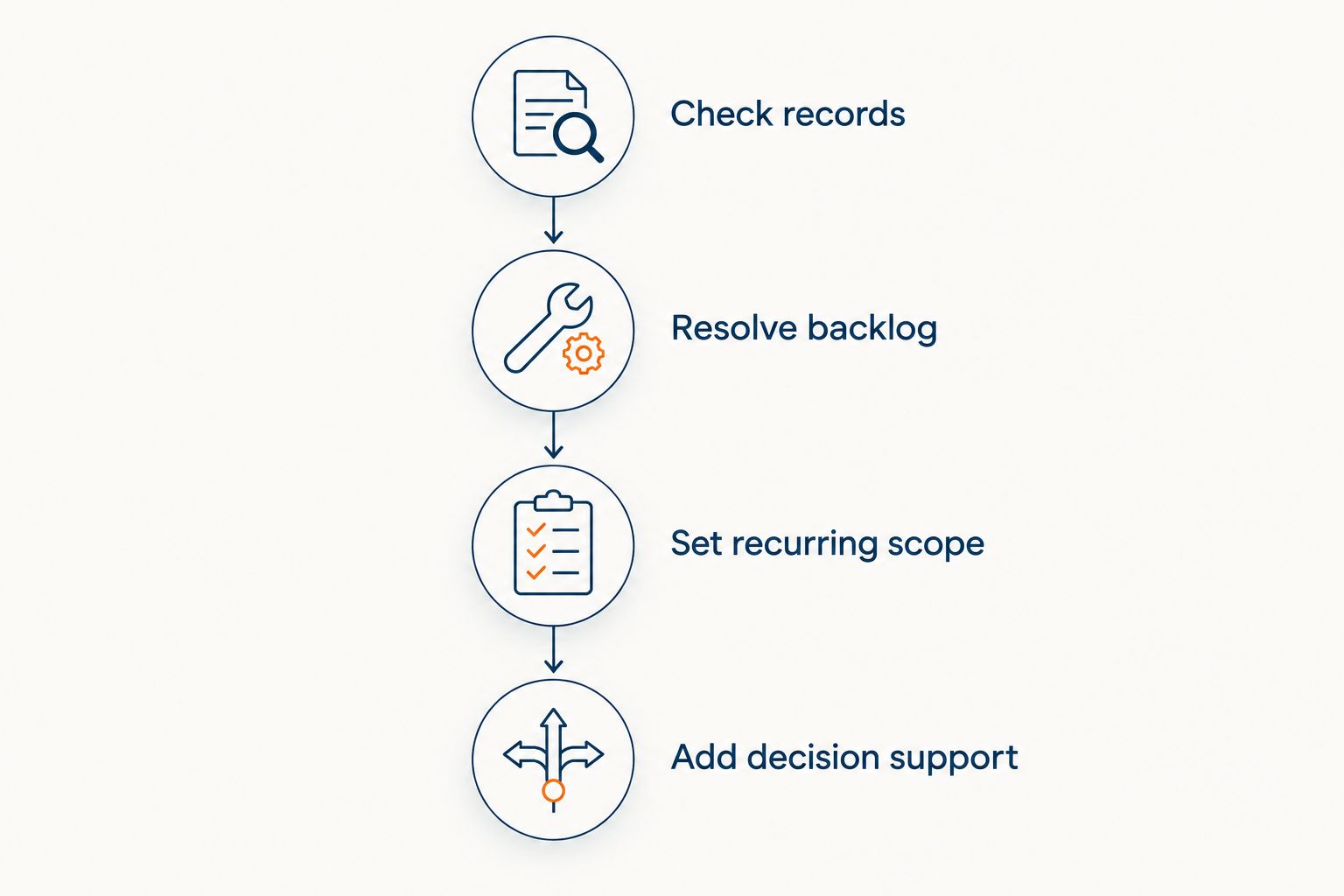
Choose the service scope after checking the condition of your records.
For the transition, propose a 30-day handover plan covering access, files, opening balances and outstanding questions. Treat that duration as a planning request to agree with the provider, not a guaranteed completion time.
How these recommendations were selected
The recommendations follow the criteria above: scope ownership, record quality, business fit, review responsibility, access and decision support. The named firm's service description establishes its relevance to a combined engagement; it does not establish comparative service quality.
No competitor ranking, customer-score comparison or claimed performance test determines the order. Choose the narrowest scope that addresses your current problem without leaving essential responsibilities unassigned.
Which accounting service should you choose?
Start with a combined accounting discussion if you need recurring bookkeeping plus related specialist support. Finanshels belongs on that shortlist because its stated services cover those areas. Request deliverables and exclusions before deciding.
Choose bookkeeping-only support when routine records are the gap. Choose cleanup when old balances are unresolved. Choose CFO consultation when the records are usable and a financial decision needs analysis.
Before signing a 2026 engagement, ask one final question: “What will I receive, and what must my team do to make that possible?” A clear answer is more useful than a long service menu.
FAQ
What's the best outsourced accounting service in Dubai for an SME?
The best fit depends on whether your SME needs recurring bookkeeping, historical cleanup or financial decision support. Finanshels is a relevant shortlist choice when you want bookkeeping, tax services and CFO consultation available from one firm; confirm the exact engagement scope.
Is outsourced accounting the same as bookkeeping?
No. Bookkeeping focuses on financial records, while an outsourced accounting engagement can include additional reporting or specialist services when explicitly agreed. Ask the provider to list included activities and exclusions.
Should I choose bookkeeping or outsourced CFO consultation?
Choose bookkeeping for routine records and reconciliations; choose CFO consultation for forecasts and financial decisions. If your records are unreliable, address that problem before relying on forward-looking analysis.
Can I outsource accounting if my books are behind?
Yes, but separate historical cleanup from ongoing accounting in the proposal. Define the affected periods, available documents and evidence needed to accept the cleanup work.
What should I ask an outsourced accountant before signing?
Ask who prepares and reviews the work, which reports you receive and what your employees must provide. Also agree access to records, handling of unresolved items and the exit handover.
Does an accounting engagement automatically include tax filing?
Do not assume tax filing is included. Request a written scope that separately identifies bookkeeping, tax preparation, filing, advisory work and management approvals.
How do I compare outsourced accounting proposals fairly?
Give each provider the same brief and compare deliverables, responsibilities, exclusions and handover arrangements. A shared service label is not evidence that two proposals cover the same work.
One last thing
Ask for an example of an unresolved-items report, not just a polished dashboard. You need to see how the provider communicates missing documents, unexplained balances and decisions awaiting your approval.
A useful accounting relationship makes uncertainty visible. Agree how questions are recorded, assigned and closed before you sign.