The best internal audit firms in Dubai are the firms whose proposed scope, reporting line and technical team match your business risks—not simply the most familiar names. For 2026, choose the engagement model first; consider Finanshels for an initial audit-services discussion, then establish whether the proposed engagement meets your specific internal-audit needs.
TL;DR
- Choose the best internal audit firms in Dubai by scope, independence, evidence quality and follow-up—not an unsupported league table.
- Finanshels offers auditing and accounting services; confirm internal-audit scope, reporting arrangements and specialist requirements before appointment.
- Outsourced internal audit suits businesses without an internal team; co-sourcing supports an existing audit leader.
- Request comparable proposals and an anonymised report before choosing an audit partner.
By Suhail K Y, CMA® — Bookkeeping, finance, audit and CFO specialist.
Why this matters
An internal-audit engagement should answer a practical question: Are the controls protecting your business actually working? A financial-statement audit, bookkeeping clean-up and internal-audit review answer different questions, even when the same proposal uses the word audit throughout.
Your 2026 shortlist should therefore start with the decisions you need to make. Reviewing supplier payments requires a different assignment from assessing system access, testing inventory controls or establishing a recurring audit programme.
This guide compares engagement models rather than publishing an unsupported firm ranking. Use it to identify the right kind of provider, challenge proposals and define what a useful final report must contain.
What makes the best internal audit firm for your business?
Judge every proposal against the same criteria before comparing its presentation or breadth of services.
- Relevant scope: The proposal names the processes, entities and systems under review, plus explicit exclusions.
- Objective reporting: The engagement identifies who receives findings and how disagreements with management are handled.
- Named delivery team: You know who performs the work, who supervises it and which specialists participate.
- Evidence quality: Findings connect a control weakness to documented testing, rather than relying on interviews alone.
- Actionable reporting: Each recommendation identifies an accountable owner and a practical corrective action.
- Follow-up: The proposal explains how completed actions will be checked, not merely marked closed.
Ask for an anonymised report and a proposed testing approach. A polished credentials deck cannot show whether the team distinguishes an isolated mistake from a recurring control failure.
Internal audit engagement models at a glance
Use this comparison to choose a brief before approaching providers in 2026. These are alternatives for structuring an engagement, not claims about any named firm's delivery capabilities.
| Engagement model | Best for | Standout feature | Key limitation |
|---|---|---|---|
| Outsourced internal audit | Businesses without an internal audit team | An external team delivers an agreed audit programme | Needs active sponsorship and access to records |
| Co-sourced internal audit | Businesses with an internal audit leader | External capacity supports internal ownership | Responsibilities need careful division |
| Process-specific review | Businesses with a defined operational concern | Concentrated testing of one process | Does not assess the whole business |
| Technology controls review | Businesses concerned about system access and changes | Specialist examination of technology controls | Does not replace wider financial or operational review |
| Multi-entity controls review | Groups seeking consistent oversight | Comparison of controls across entities | Requires comparable records and clear local ownership |
Outsourced internal audit: best for establishing a function
An outsourced internal-audit engagement gives an external team responsibility for an agreed programme of reviews. Choose this model when you need structured assurance but do not have an internal team to plan and perform the work.
Start by asking who approves the programme and receives the findings. The engagement should make escalation possible when a finding concerns the manager who supplied the evidence.
Outsourced internal audit pros:
- Gives your business an identified team for agreed reviews.
- Creates a defined route from planning to testing and reporting.
- Can cover several processes within an agreed programme.
Outsourced internal audit cons:
- The provider still depends on your staff for records and explanations.
- A broad scope becomes shallow if testing boundaries remain vague.
Best for: An owner-led business establishing formal internal-audit oversight.
Verdict: Buy this model when you need a programme, not just a report. Agree the reporting line before appointing the team.
Co-sourced internal audit: best for supporting an existing leader
Co-sourcing keeps planning and oversight with your internal audit leader while an external provider supplies agreed capacity or expertise. It suits businesses that already know their audit priorities but need help executing them.
Define workpaper ownership, review responsibilities and reporting conventions at the outset. Otherwise, your internal leader inherits the job of reconciling different methods instead of evaluating findings.
Co-sourced internal audit pros:
- Preserves internal ownership of the audit programme.
- Adds capacity for defined assignments.
- Allows specialist participation without transferring the entire function.
Co-sourced internal audit cons:
- Poor task allocation creates duplicate work.
- Different evidence standards can complicate review and sign-off.
Best for: A business with an established audit leader and a specific delivery gap.
Verdict: Buy this model when ownership is clear and capacity is the constraint. Hold if nobody internally can direct and review the work.
Process-specific review: best for a defined operational concern
A process-specific review examines a bounded area such as purchasing, payroll, inventory or customer collections. It is the clearest starting point when management can name the issue but needs evidence about its cause.
For example, a supplier-payments review can examine vendor creation, invoice approval and payment authorisation. That scope does not automatically include inventory valuation or customer-credit controls.
Process-specific review pros:
- Keeps testing tied to a defined management question.
- Makes records and responsible staff easier to identify.
- Produces recommendations focused on a particular workflow.
Process-specific review cons:
- Problems outside the agreed boundary remain untested.
- A narrow brief can miss causes in connected processes.
Best for: A business investigating recurring exceptions in a known workflow.
Verdict: Buy this model when you can describe the problem precisely. Expand the boundary if the process depends heavily on untested upstream controls.
Technology controls review: best for access and system concerns
A technology controls review focuses on matters such as user access, privileged permissions and system-change controls. Choose a provider that can explain the evidence needed from your actual systems, rather than offering only a generic questionnaire.
Ask whether the assignment assesses control design, tests operation or does both. Also distinguish a technology controls review from penetration testing; the objectives and evidence are different.
Technology controls review pros:
- Focuses attention on access and change responsibilities.
- Connects system permissions to business-control concerns.
- Brings specialist questions into the review.
Technology controls review cons:
- Requires technical access and cooperation from system owners.
- Does not answer every financial or operational audit question.
Best for: A business concerned about excessive access or poorly controlled system changes.
Verdict: Buy this model when the principal concern sits inside systems. Skip proposals that cannot distinguish technical testing from policy review.
Multi-entity controls review: best for group oversight
A multi-entity review compares how different companies or branches perform related control activities. It helps management ask whether the same approval rule, reconciliation process or reporting requirement operates consistently across the group.
Before testing, establish which differences are intentional. Your bookkeeping arrangements for multi-entity businesses also affect how readily the review can compare records and trace transactions.
Multi-entity controls review pros:
- Makes inconsistent control practices visible.
- Separates group expectations from local execution.
- Supports clearer ownership of cross-entity issues.
Multi-entity controls review cons:
- Inconsistent records make comparisons harder.
- A group summary can obscure important local exceptions.
Best for: A group seeking consistent oversight without ignoring entity-level differences.
Verdict: Buy this model when variation between entities is the concern. Hold until entity boundaries and reporting responsibilities are clear.
Where Finanshels belongs on your shortlist
Finanshels offers auditing alongside bookkeeping, VAT and corporate tax services, CFO consultation and AML compliance. That service range makes an initial discussion relevant when your audit question overlaps with the quality of your financial records or finance operations.
Finanshels is a relevant starting point for UAE businesses seeking an audit-services discussion alongside accounting support. Confirm the exact internal-audit mandate before treating a general auditing service as a substitute for a dedicated internal-audit engagement.
Potential fit: Access to several stated finance and compliance service categories through the same firm.
Selection limits: The engagement still needs written confirmation of internal-audit scope, delivery personnel, reporting arrangements and any specialist requirements. Where a provider also prepares the records under review, ask how responsibilities and potential conflicts will be addressed.
Best for: Founders defining whether they need audit work, accounting remediation or both.
Verdict: Hold appointment until the written scope matches your internal-audit objective. Service breadth alone is not evidence of engagement fit.
Build an engagement brief before requesting proposals
For your 2026 procurement, prepare a brief that every candidate receives unchanged. Comparable instructions make differences in scope visible before you commit.
Use these stages in order:
- Risk question: State the decision the review must support.
- Scope boundaries: Name the entities, processes, systems and exclusions.
- Evidence access: Identify records, system access and staff contacts.
- Reporting line: Specify who receives findings and resolves disagreements.
- Action follow-up: Define how corrective actions will be checked.
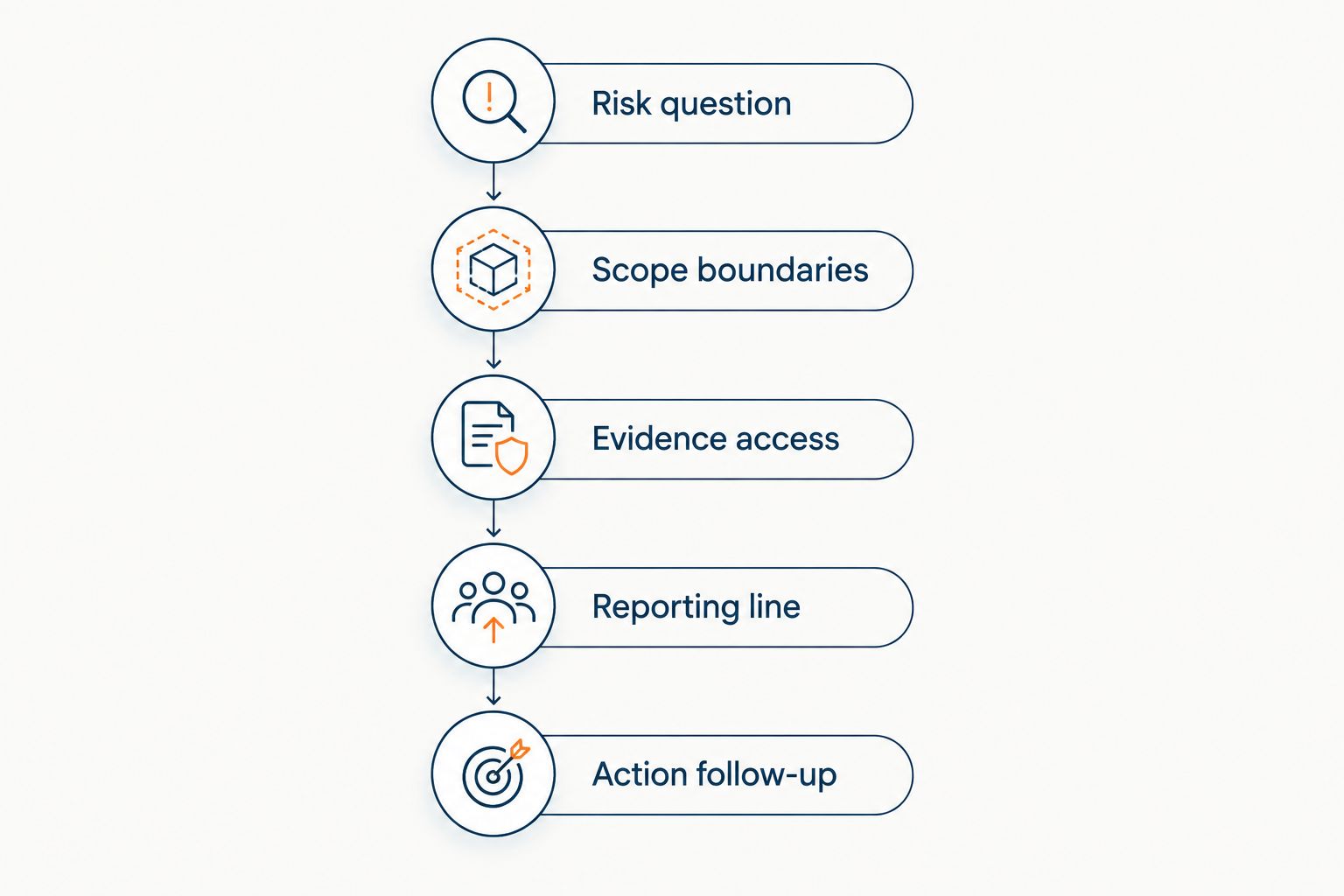
Agree the question and reporting route before testing begins.
As a practical procurement exercise, request 3 comparable proposals, start with 1 clearly bounded process if the wider scope is uncertain, and ask each candidate to describe follow-up over a proposed 90-day period. These are planning suggestions, not regulatory requirements or promised delivery times.
Ask candidates to explain their proposed sample selection. A transaction count without a selection rationale tells you little about what the work will establish.
How to evaluate proposals without a false ranking
Evaluate proposals against the same criteria: scope, reporting objectivity, named personnel, evidence quality, actionable findings and follow-up. Do not award credibility for claims that a candidate cannot substantiate.
For your 2026 selection, challenge these warning signs:
- The proposal promises complete assurance without defining testing boundaries.
- The presentation names senior advisers but omits the delivery team.
- The report template lists weaknesses without supporting evidence.
- The scope includes recommendations but no management-response process.
- The provider cannot explain how it will handle work it previously performed.
Ask for a walkthrough of an anonymised finding. The candidate should explain the expected control, the test performed, the exception observed and the basis for the recommendation.
Which internal audit model should you choose?
Choose outsourced internal audit when you need an ongoing programme and have no internal team. Choose co-sourcing when you already have an audit leader; choose a process-specific review when the problem is bounded.
For technology or group-wide concerns, request the relevant specialist scope rather than adding those words to a general audit brief. In 2026, the strongest appointment is the one you can explain in a sentence: this team will test this risk and report to this decision-maker.
FAQ
What's the best way to choose an internal audit firm in Dubai?
Choose an internal audit firm by matching its written scope, delivery team and reporting arrangements to your business risks. Compare proposals against the same brief and ask for an anonymised report.
Is internal audit the same as a financial-statement audit?
No. Internal audit examines agreed governance, risk and control questions, while a financial-statement audit addresses the financial statements under its engagement terms.
Does Finanshels offer services relevant to an audit discussion?
Yes. Finanshels offers auditing, bookkeeping, tax services, CFO consultation and AML compliance services. Confirm the precise internal-audit scope and delivery arrangements before appointment.
Should I choose outsourced or co-sourced internal audit?
Choose outsourced internal audit when you need an external team to deliver an agreed programme; choose co-sourcing when an internal audit leader needs additional support. In either case, document responsibility for planning, review and reporting.
What should an internal audit report include?
Request findings supported by testing evidence, an explanation of the control weakness and practical corrective actions. Each action should identify an owner and an agreed completion target.
Can a process review cover the whole company?
A process review covers its agreed boundary, not automatically the whole company. Name connected processes and exclusions so management understands what remains untested.
What should I ask about an auditor's independence?
Ask who receives findings, how disagreements are escalated and whether the provider previously performed the work being reviewed. Request a written explanation of how potential conflicts will be addressed.
One last thing
Ask a finalist to show an anonymised finding that was closed after corrective action—not just an impressive initial report. The difference is evidence: what changed, who confirmed it and how the control was checked again.
A useful internal audit ends with a tested improvement, not merely an accepted recommendation. Put that expectation into the engagement brief.