If your business operates in the UAE, choosing an e-invoicing service provider means more than finding software that creates invoices. You need a provider that is accredited by the UAE Ministry of Finance (MoF), supports the country's electronic invoicing requirements, and works with your existing accounting system wherever possible.
The right e-invoicing service provider in the UAE should help your business exchange structured electronic invoices, connect with customers and suppliers through the required network, and maintain reliable invoice records without creating unnecessary work for your finance team.
The Ministry of Finance publishes an official list of Accredited Service Providers (ASPs). Businesses should use this list to verify a provider's current accreditation rather than relying solely on marketing claims.
Before choosing a provider, understand three things:
- Accreditation: Is the provider officially accredited by the UAE Ministry of Finance?
- Integration: Can it exchange invoice data with your existing accounting software?
- Total cost: What will you pay for onboarding, invoice processing, integrations and ongoing support?
This guide explains how to compare providers, what to check when using Zoho Books, Xero or QuickBooks, and which questions to ask before signing a contract.
Key takeaways
| What to check | Why it matters |
|---|---|
| Official accreditation | Helps establish that the provider is authorised to offer e-invoicing services under the UAE framework. |
| Accounting software compatibility | Reduces manual entry and duplicate records. |
| Invoice and credit note support | Helps your business handle everyday sales, adjustments, cancellations and refunds. |
| Transparent pricing | Makes it easier to estimate the real cost of compliance. |
| Support and error resolution | Helps resolve rejected invoices and technical problems. |
| Data access and migration | Reduces the risk of losing access to important business records if you change providers. |
What is an Accredited Service Provider (ASP) in the UAE?
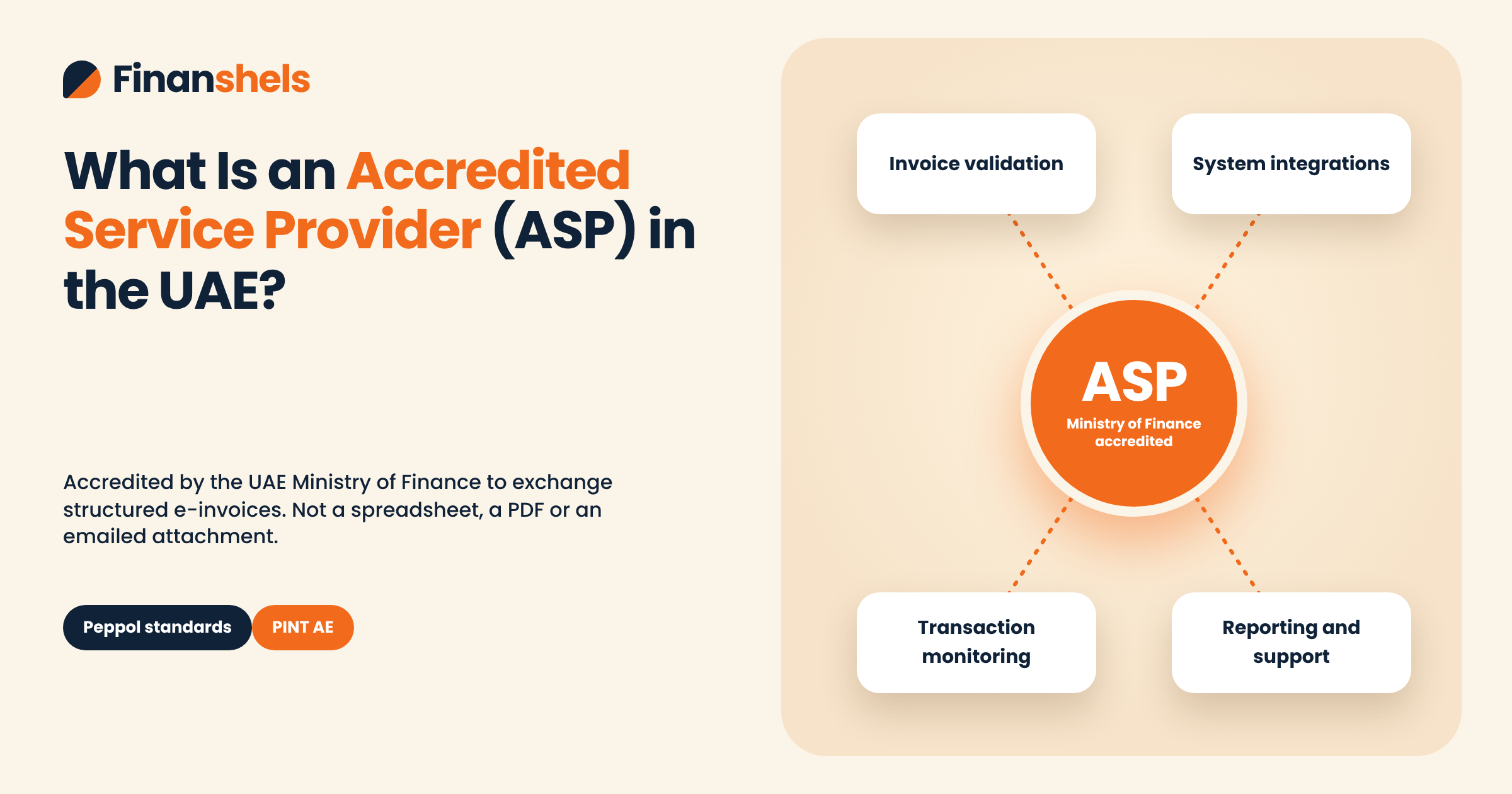
An Accredited Service Provider, commonly called an ASP, is a service provider that has received accreditation from the UAE Ministry of Finance to provide electronic invoicing services under the national e-invoicing framework.
An ASP helps businesses exchange electronic invoices through the required technical infrastructure. This is different from simply creating an invoice in a spreadsheet, exporting it as a PDF or emailing it to a customer.
Under the UAE's e-invoicing framework, electronic invoices use structured data that can be processed by connected systems. The framework is based on Peppol standards, including the UAE-specific PINT AE invoice specification.
Depending on the solution, a provider may also offer invoice validation, system integrations, transaction monitoring, reporting and support.
Why does accreditation matter?
Accreditation provides a way to verify that a service provider has met the Ministry of Finance's applicable requirements. It is an important starting point when evaluating providers, but it does not automatically mean that every provider offers the same software, integrations, pricing or service quality.
On 9 October 2026, the Ministry of Finance announced Ministerial Decision No. 168 of 2026, which introduced an updated accreditation framework effective from 1 October 2026. The updated framework moved away from the earlier pre-approval approach towards direct accreditation and formal assessment requirements.
This makes it particularly important to check a provider's current status rather than assuming that preliminary approval and full accreditation are equivalent.
Practical tip: Check the provider's name and accreditation details on the official Ministry of Finance ASP list before committing to a contract.
2. ASP vs accounting software: What is the difference?
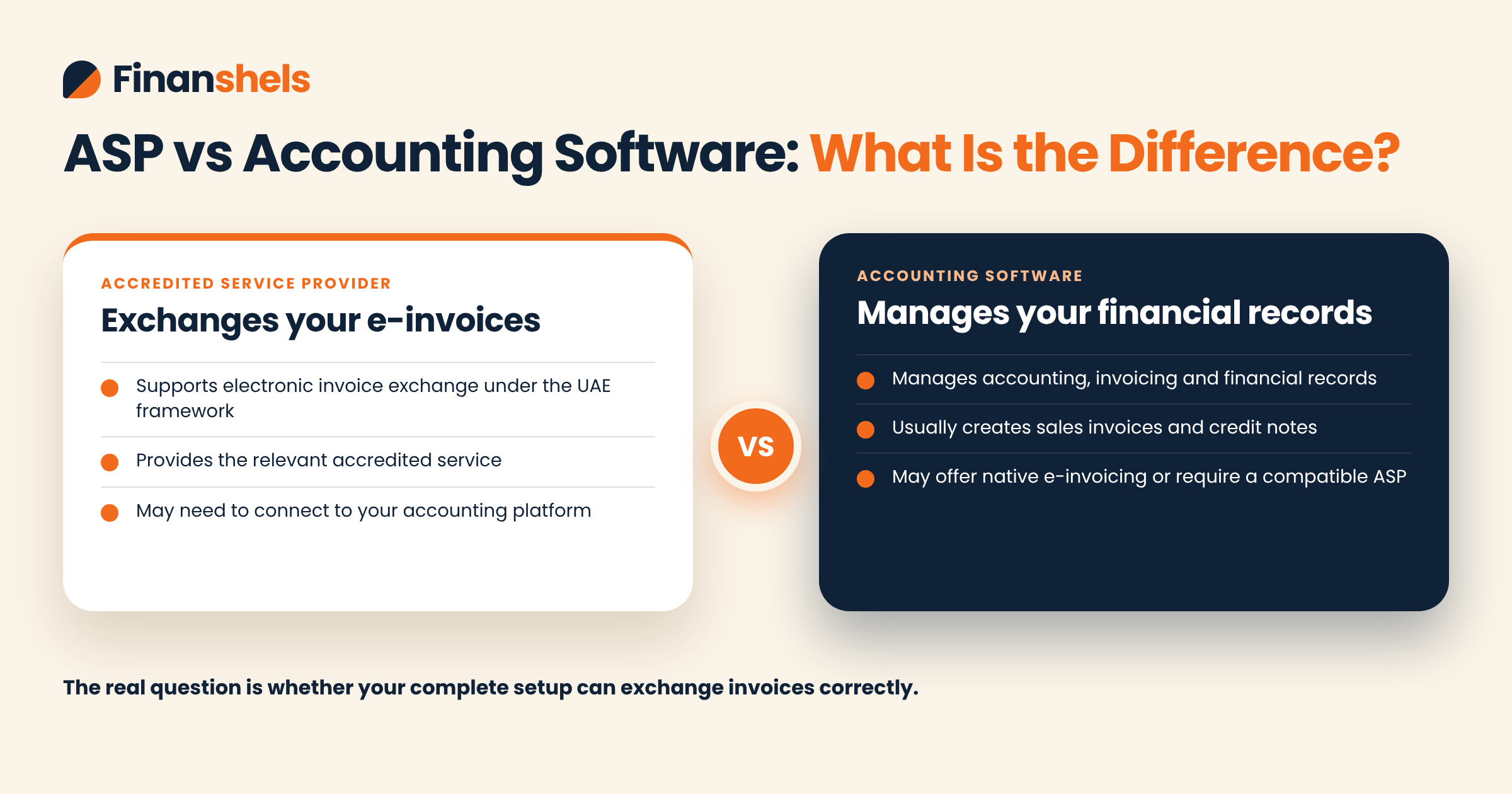
One of the most common sources of confusion is the difference between an e-invoicing service provider and accounting software.
They serve related but different purposes.
| Feature | Accredited Service Provider (ASP) |
|---|---|
| Main purpose | Supports electronic invoice exchange under the UAE framework; accounting software manages accounting, invoicing and financial records. |
| Invoice creation | May provide invoice creation or connect to another system; accounting software usually creates sales invoices and credit notes. |
| Structured e-invoice exchange | Provides the relevant accredited service; accounting software functionality depends on the platform's UAE e-invoicing capabilities and setup. |
| Accounting records | An ASP may connect to accounting systems, while accounting software stores accounting entries and financial transactions. |
| Bank reconciliation | Not necessarily included in an ASP; often available in accounting software. |
| VAT and financial reports | Depends on the ASP service; accounting software functionality depends on the software and subscription. |
| Integration requirements | An ASP may need to connect to your existing accounting platform; accounting software may offer native functionality or require a compatible ASP. |
Some businesses may be able to use an accounting platform with an integrated e-invoicing workflow. Others may need to connect their accounting software to a separate ASP.
For example, Xero's UAE e-invoicing offering describes a workflow through its e-invoicing platform, Invoici, with Casim identified as the UAE ASP used in its setup instructions. This illustrates why businesses should check the actual service arrangement rather than assuming that accounting software and ASP accreditation mean the same thing.
The important question is not simply whether your software supports e-invoicing. It is whether your complete setup can meet the UAE requirements and exchange invoices correctly.
Accredited e-invoicing service providers in the UAE
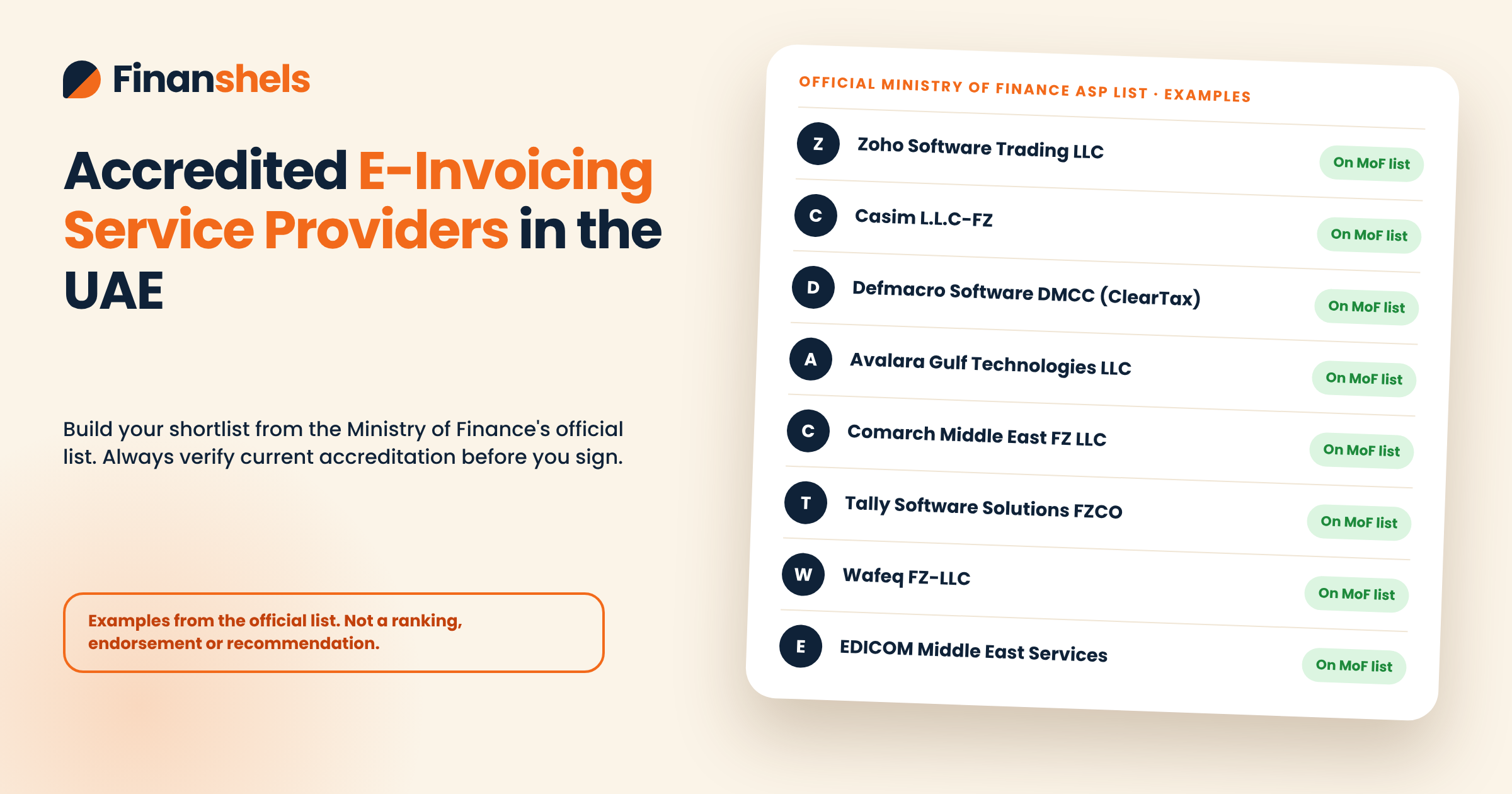
The UAE Ministry of Finance maintains an official list of accredited providers, including their accreditation numbers and contact details. The list is updated periodically, so it should be treated as the primary source when building a shortlist.
The following examples are drawn from the official list. They are not a ranking, endorsement or recommendation of one provider over another.
| Provider | What to investigate and official website |
|---|---|
| Zoho Software Trading LLC | Compatibility with your Zoho Books setup, supported workflows and commercial terms. zoho.com |
| Casim L.L.C-FZ | Integration options, onboarding and transaction pricing. casim.ae |
| Defmacro Software DMCC (ClearTax) | ERP connectivity, invoice volumes and implementation support. cleartax.com/ae |
| Avalara Gulf Technologies LLC | Integration requirements, regional support and pricing. avalara.com |
| Comarch Middle East FZ LLC | System compatibility, transaction processing and implementation requirements. comarch.com |
| Tally Software Solutions FZCO | Compatibility with your Tally setup and UAE e-invoicing workflow. tallysolutions.com |
| Wafeq FZ-LLC | Accounting workflow compatibility, onboarding and pricing. wafeq.com |
| EDICOM Middle East Services | Integration with existing business systems and transaction volumes. edicomgroup.com |
Important: Inclusion in this table confirms that these names appear on the Ministry of Finance's published accredited-provider list consulted for this article. It does not establish that every provider offers every integration listed in this guide or that its current commercial offering meets your particular requirements.
Before making a decision, check the latest official list, confirm the accreditation details, and request a demonstration of the exact workflow you intend to use.
How to compare e-invoicing providers for your SME
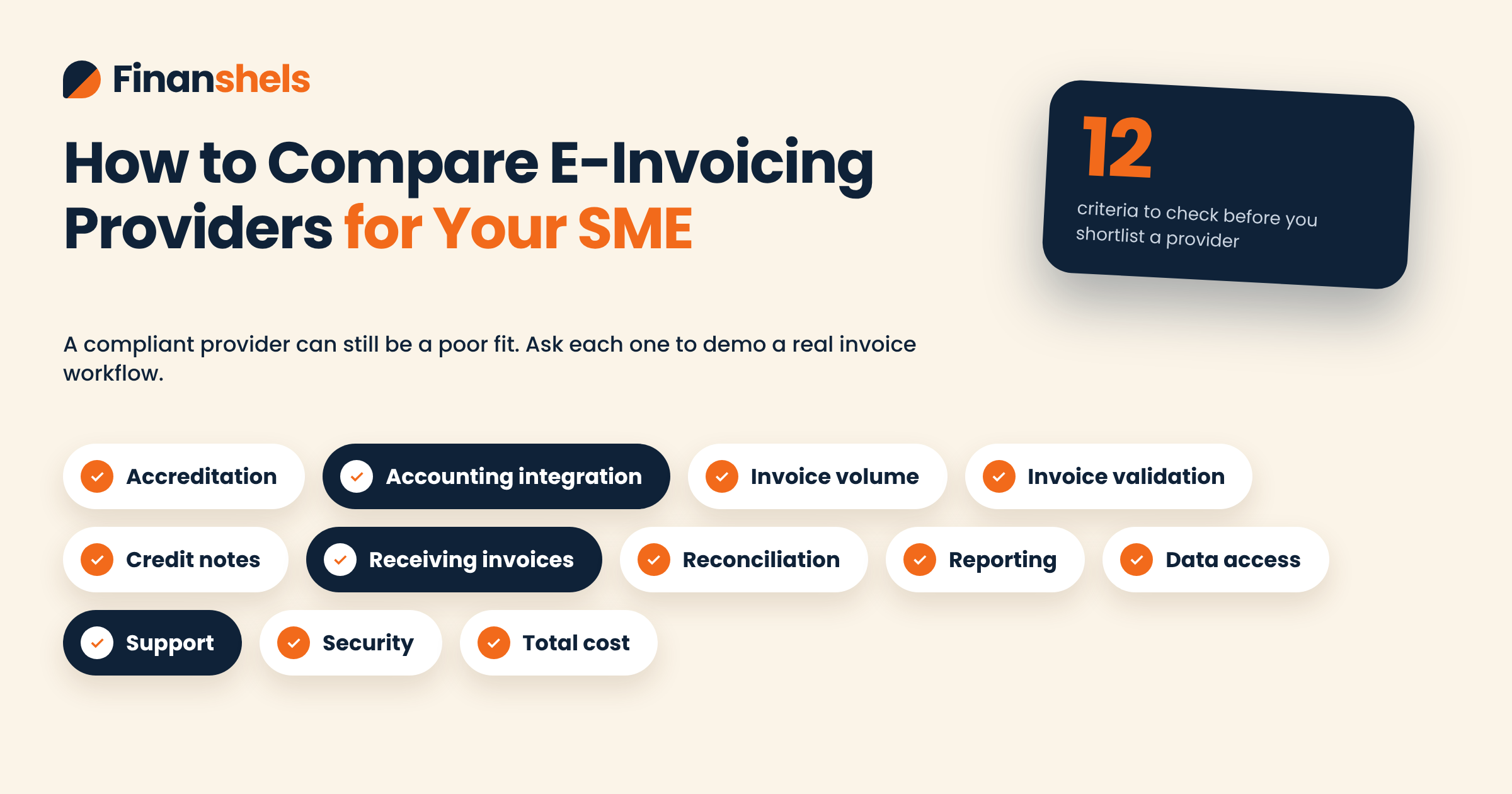
A provider may be technically compliant but still be a poor fit for your business. For a small or medium-sized enterprise, ease of use, integration, pricing and support can matter just as much as the provider's technical capabilities.
Use the following criteria when comparing shortlisted providers.
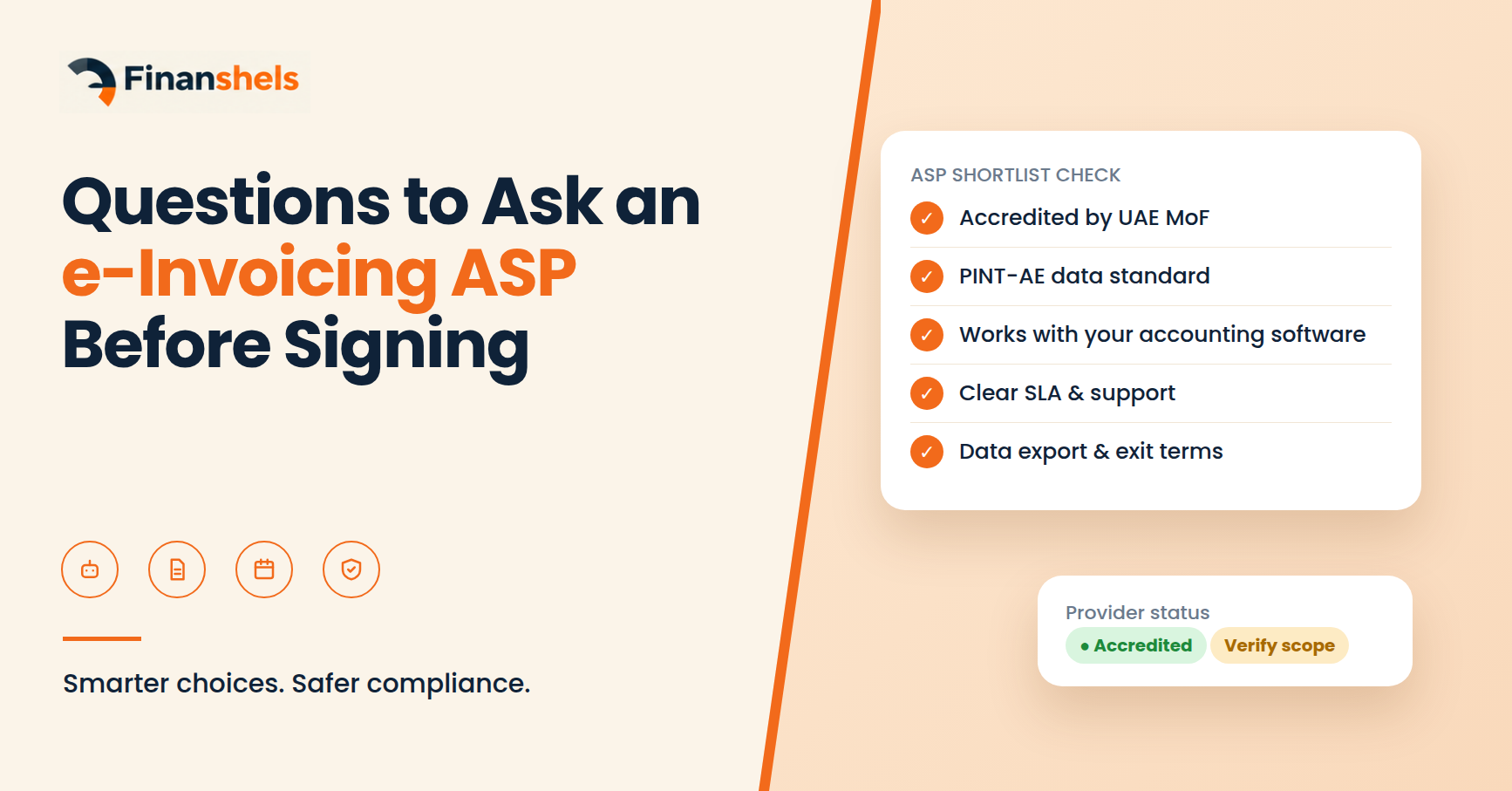
| Selection criterion | Questions to ask and what a suitable solution should offer |
|---|---|
| Accreditation | Can you confirm your current MoF accreditation details? Look for verifiable accreditation under the current framework. |
| Accounting integration | Does the solution connect to our existing accounting platform? Look for a supported integration or a clearly documented alternative. |
| Invoice volume | Are there limits on monthly invoices or transactions? Capacity should match current and expected volumes. |
| Invoice validation | How are missing or invalid fields identified? Look for clear validation results and actionable error messages. |
| Credit notes | Can we issue and exchange credit notes? Confirm support for relevant invoice adjustment workflows. |
| Receiving invoices | Can we receive supplier e-invoices through the same setup? Check that the inbound invoice process is clear. |
| Reconciliation | Can invoice data be matched with accounting records? The goal is to reduce manual work and duplicate entry. |
| Reporting | Can we track sent, received, rejected and processed invoices? Look for useful status visibility and accessible records. |
| Data access | Can we export invoice data and records if we leave? Request a documented data export and migration process. |
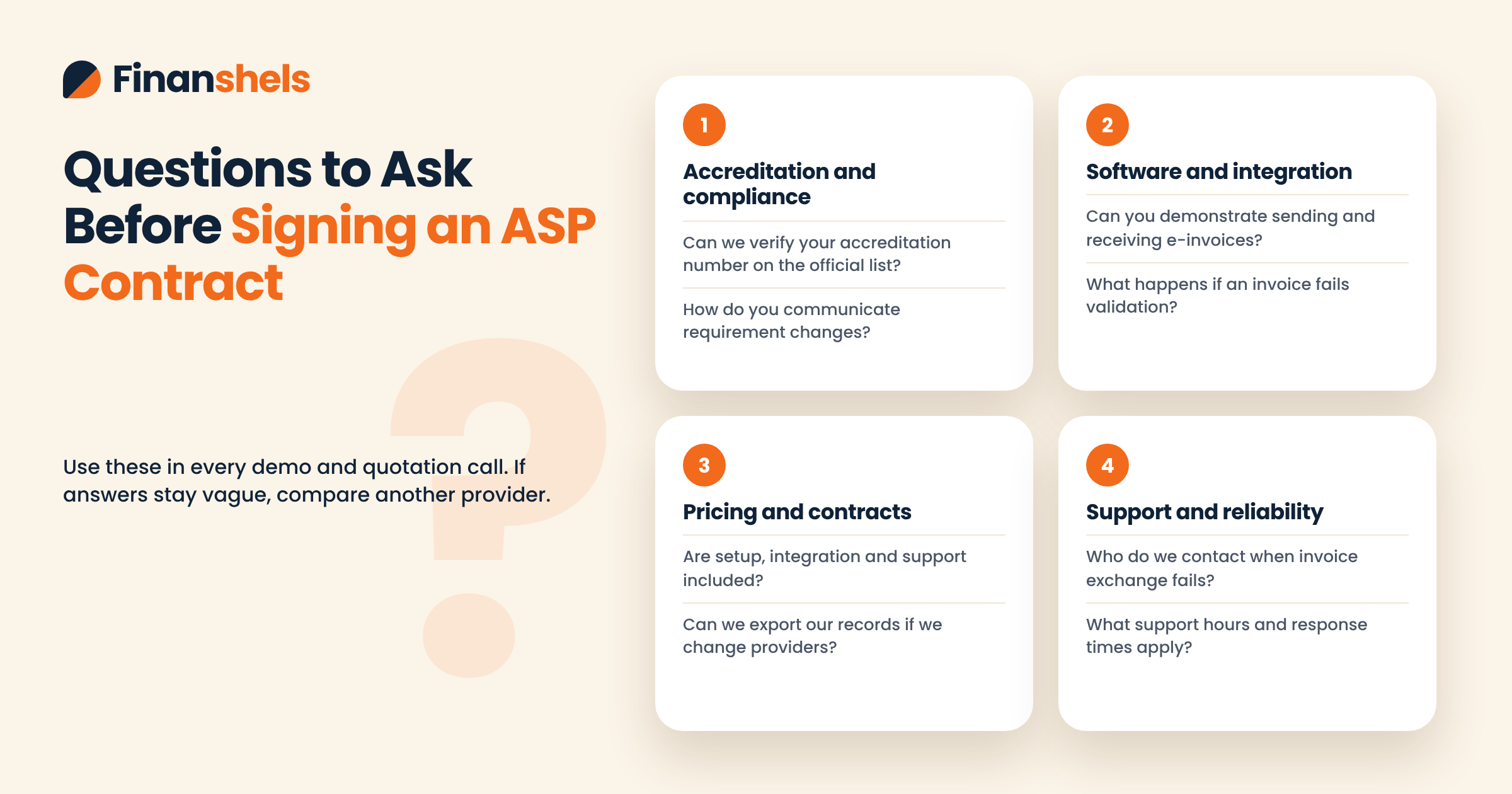
| Support | Who handles rejected invoices and integration failures? Confirm support channels, responsibilities and response expectations. |
| Security | How are access, backups and data retention managed? Request documented controls appropriate to your business. |
| Total cost | What is included in the quoted price? Ask for a transparent breakdown of recurring and one-off charges. |
Do not select a provider based on a feature checklist alone. Ask it to demonstrate a real invoice workflow using your accounting software and a representative business transaction.
E-invoicing integration with Zoho, Xero and QuickBooks
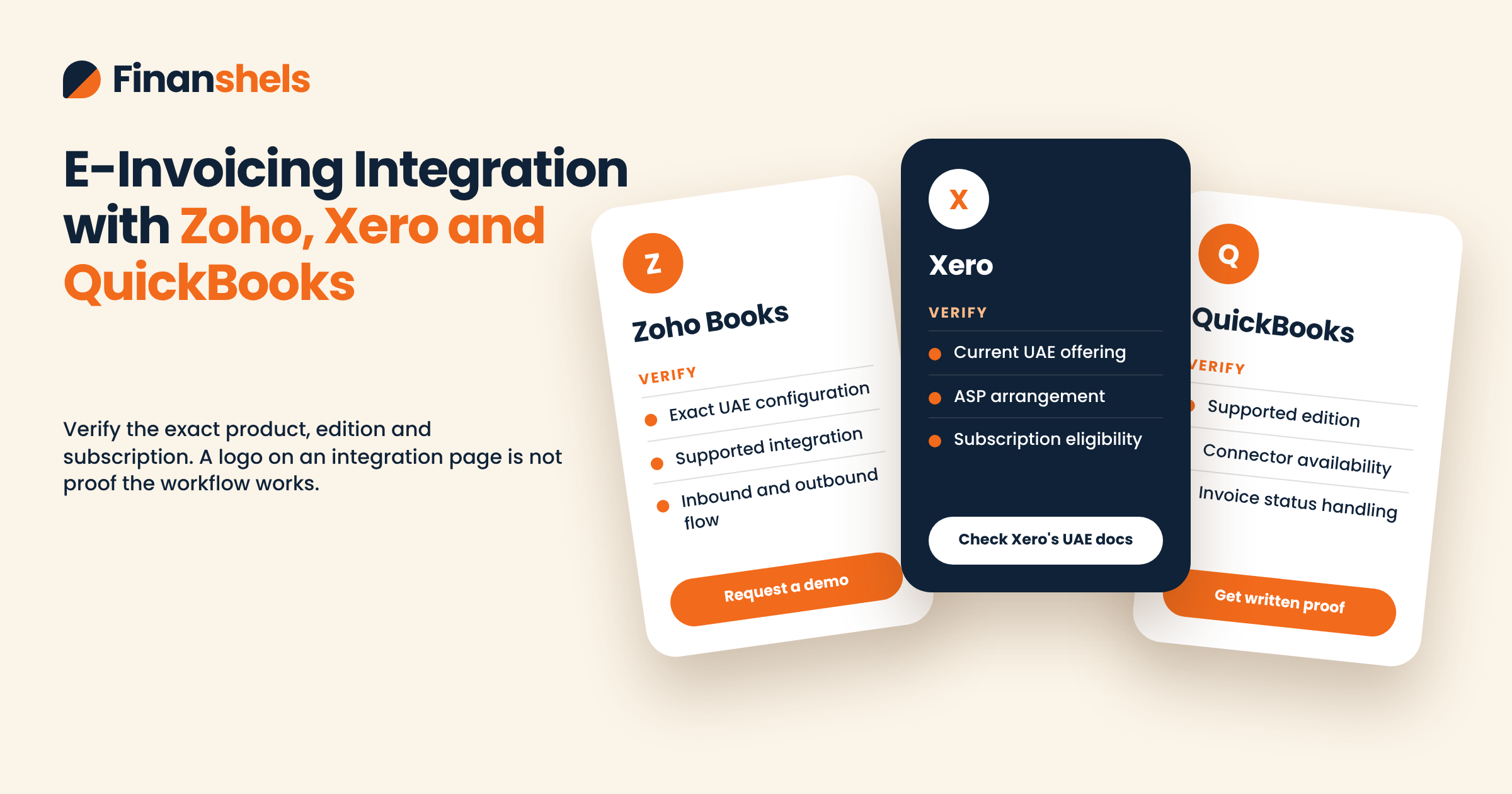
Your accounting software is often the best place to start when choosing an ASP. The goal is to avoid building a separate invoicing process that creates more work for your finance team. If you need to review your underlying records first, see Finanshels' bookkeeping services for UAE businesses.
However, compatibility should be verified for the specific product, country edition, subscription and integration method you use.
Zoho Books
If your business uses Zoho Books, ask whether the provider offers a supported integration with your exact UAE configuration.
Confirm the following before signing up:
- Can customer, supplier and item data be mapped correctly?
- Can invoice details be transferred without re-entering them manually?
- Are electronic invoice statuses visible in your accounting workflow?
- How are rejected invoices corrected and resubmitted?
- Can credit notes and incoming supplier invoices be handled?
- Are integration fees included in the quoted subscription?
The Ministry of Finance list includes Zoho Software Trading LLC as an accredited provider. However, you should still verify the precise service arrangement and available functionality for your Zoho Books account.
Do not assume that the presence of Zoho on the list means every Zoho product, edition or third-party integration has identical capabilities.
Xero
Xero publishes UAE-specific e-invoicing information and describes a workflow using its e-invoicing platform, Invoici, with Casim as the UAE ASP in its setup instructions.
For businesses already using Xero, this may provide a useful starting point for comparing an integrated workflow with an external provider.
Before proceeding, confirm:
- Whether UAE e-invoicing is available on your current Xero plan.
- Which ASP is used for your organisation and how it is appointed.
- Whether the workflow supports both sending and receiving invoices.
- Whether any additional charges apply to your organisation or transaction volume.
- How errors, credit notes and accounting records are handled.
Check Xero's official website for its current UAE e-invoicing product details and setup instructions.
QuickBooks
If your business uses QuickBooks, ask the ASP to demonstrate how its solution connects to your specific QuickBooks product and UAE accounting workflow.
Do not rely on a general statement that a provider integrates with QuickBooks. Ask for confirmation of the supported product edition, the integration method and the features available.
In particular, check whether the integration supports:
- Invoice and customer data transfer.
- Credit notes and invoice adjustments.
- Electronic invoice status updates.
- Supplier invoice receipt, where required.
- Error handling and resubmission.
- Reconciliation with accounting records.
If a direct integration is unavailable, ask whether a supported API, middleware connection or other documented workflow is offered. Understand the associated costs and manual steps before accepting an alternative.
Integration comparison at a glance
| Software | What to verify and best next step |
|---|---|
| Zoho Books | Verify the exact UAE configuration, supported integration and inbound/outbound workflow. Request a product-specific demonstration. |
| Xero | Check the current UAE offering, ASP arrangement and subscription eligibility. Review Xero's UAE e-invoicing documentation. |
| QuickBooks | Confirm the supported edition, connector availability and invoice status handling. Request written compatibility confirmation. |
A useful rule: Ask each shortlisted provider to demonstrate the full process, from creating an invoice in your accounting software to exchanging it electronically and confirming its status.
A logo on an integration page is not enough to establish that the workflow will work for your business.
How much does a UAE e-invoicing service provider cost?
There is no single price that applies to every UAE e-invoicing provider. The total cost depends on your invoice volume, accounting software, integration requirements, implementation complexity and support needs.
Some accounting platforms may include certain e-invoicing capabilities in their existing subscriptions. Other solutions may charge separately for access, transactions, onboarding or integrations.
Rather than relying on an advertised starting price, request a written quotation based on your actual requirements.
Costs to compare
| Cost component | What it may cover |
|---|---|
| Setup and onboarding | Account configuration, registration assistance and initial testing. |
| Subscription | Monthly or annual access to the service. |
| Invoice processing | Fees based on invoice volume or usage, if applicable. |
| Integration | Connecting the ASP with accounting or ERP software. |
| Customisation | Additional development, mapping or specialised workflows. |
| Support | Standard or premium support arrangements. |
| Additional entities | Separate company registrations or accounts, where charged. |
| Migration | Moving records or changing providers in the future. |
How to compare pricing fairly
Suppose one provider quotes a lower monthly subscription but charges separately for onboarding, integration and additional transactions. Another offers a higher subscription that includes those services.
The first option is not necessarily cheaper.
Ask both providers to quote the same scenario, including your expected monthly invoice volume, the number of legal entities, the accounting software you use, and the level of support you need.
Request a breakdown of:
- One-time implementation costs.
- Recurring subscription fees.
- Transaction or volume-based charges.
- Integration and customisation fees.
- Renewal terms and potential price increases.
- Data export and termination costs.
Do not treat illustrative prices or starting rates as a market-wide UAE pricing benchmark. Verify the actual price and what's included directly with each provider.
UAE e-invoicing deadlines: When should your business choose an ASP?
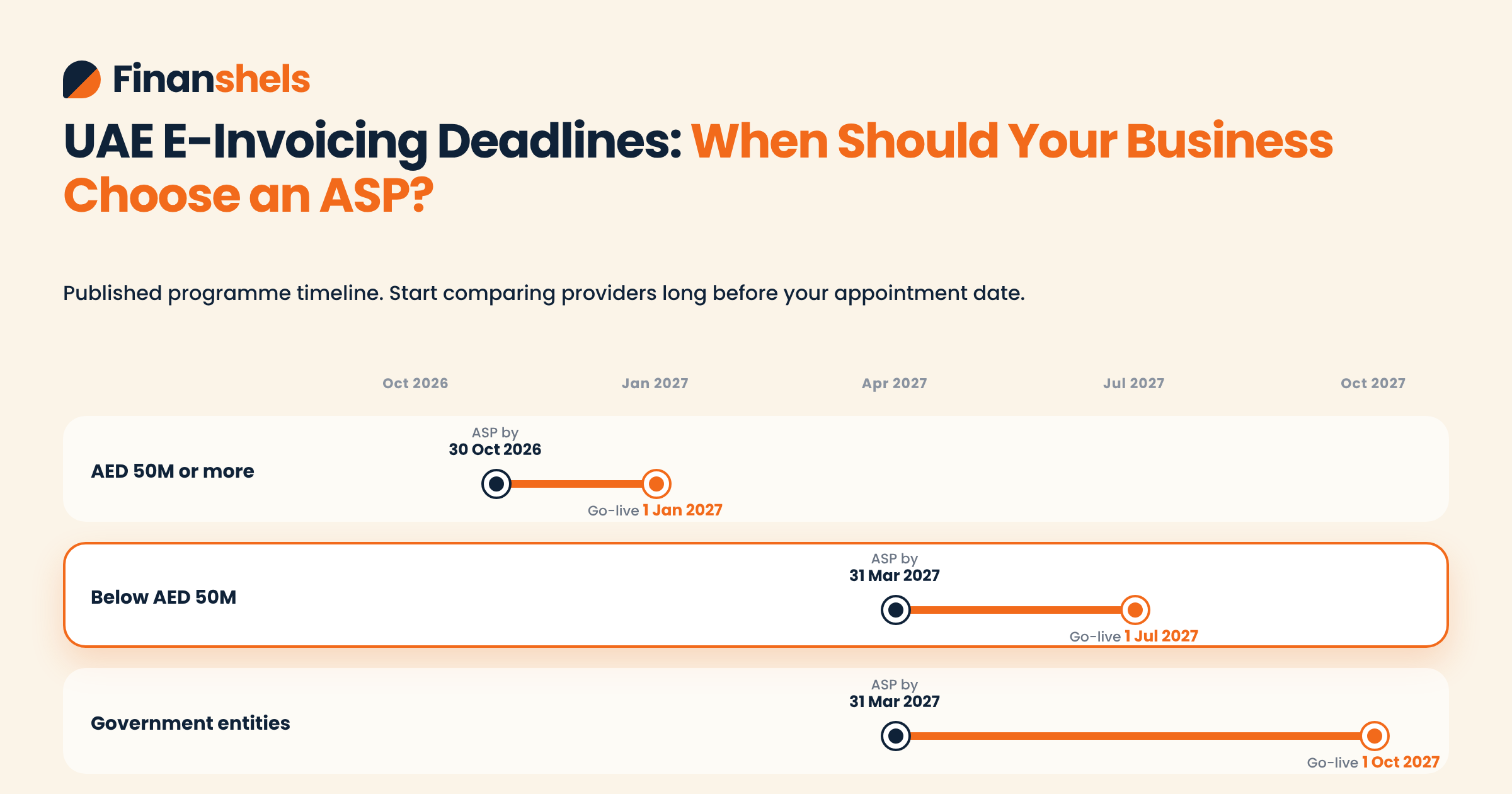
Your implementation timeline depends on the category your business falls under and the applicable UAE rules.
The Ministry of Finance's published programme timeline sets out the following phased implementation dates for businesses:
| Business category | ASP appointment deadline and implementation date |
|---|---|
| Businesses with annual revenue of AED 50 million or more | Appointment deadline: 30 October 2026. E-invoicing implementation: 1 January 2027. |
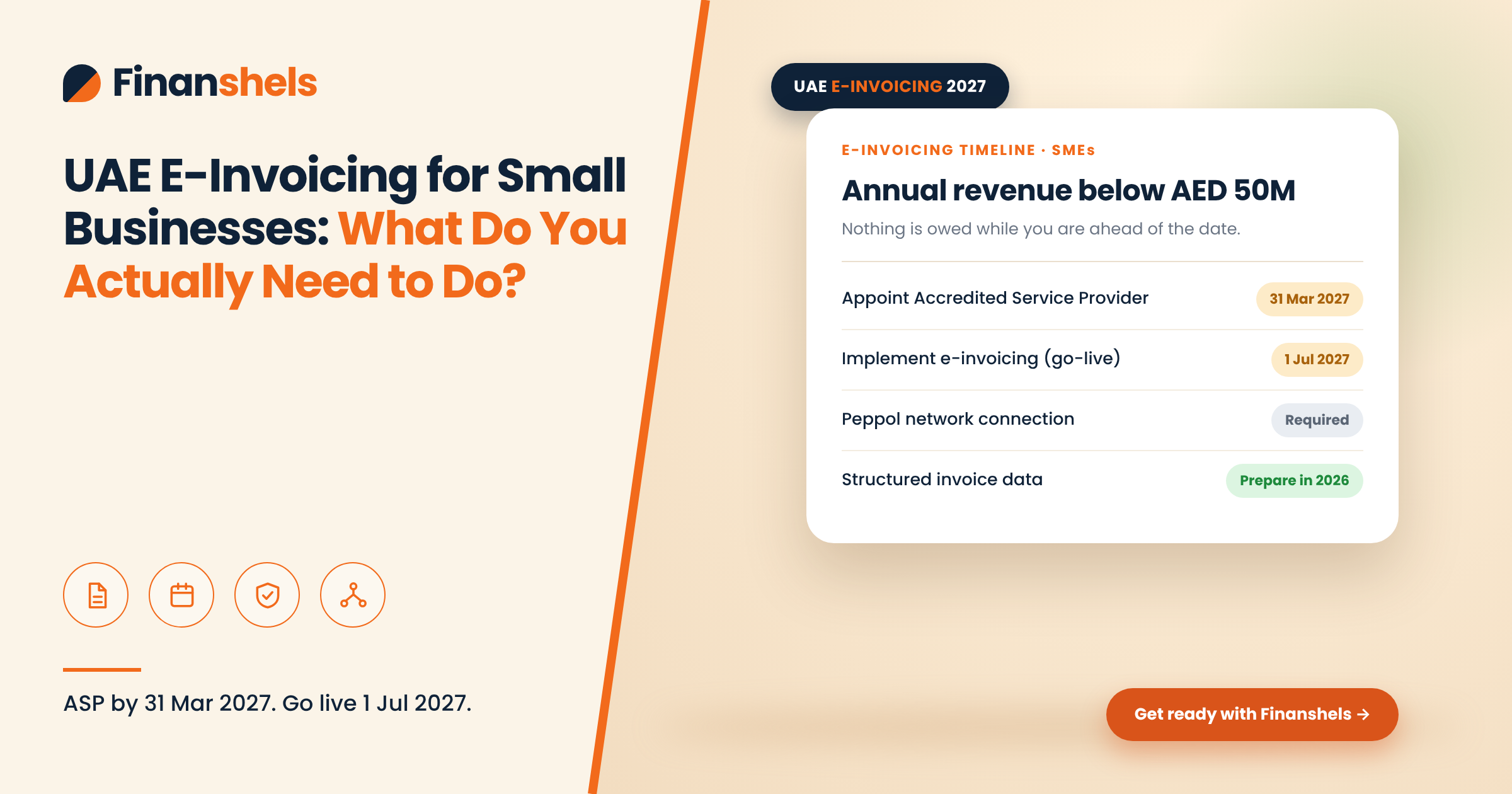
| Businesses with annual revenue below AED 50 million | Appointment deadline: 31 March 2027. E-invoicing implementation: 1 July 2027. |
| In-scope government entities | Appointment deadline: 31 March 2027. E-invoicing implementation: 1 October 2027. |
These dates are based on the Ministry of Finance's published e-invoicing programme information. Check the latest official guidance for any subsequent amendments, applicable exclusions or requirements specific to your business.
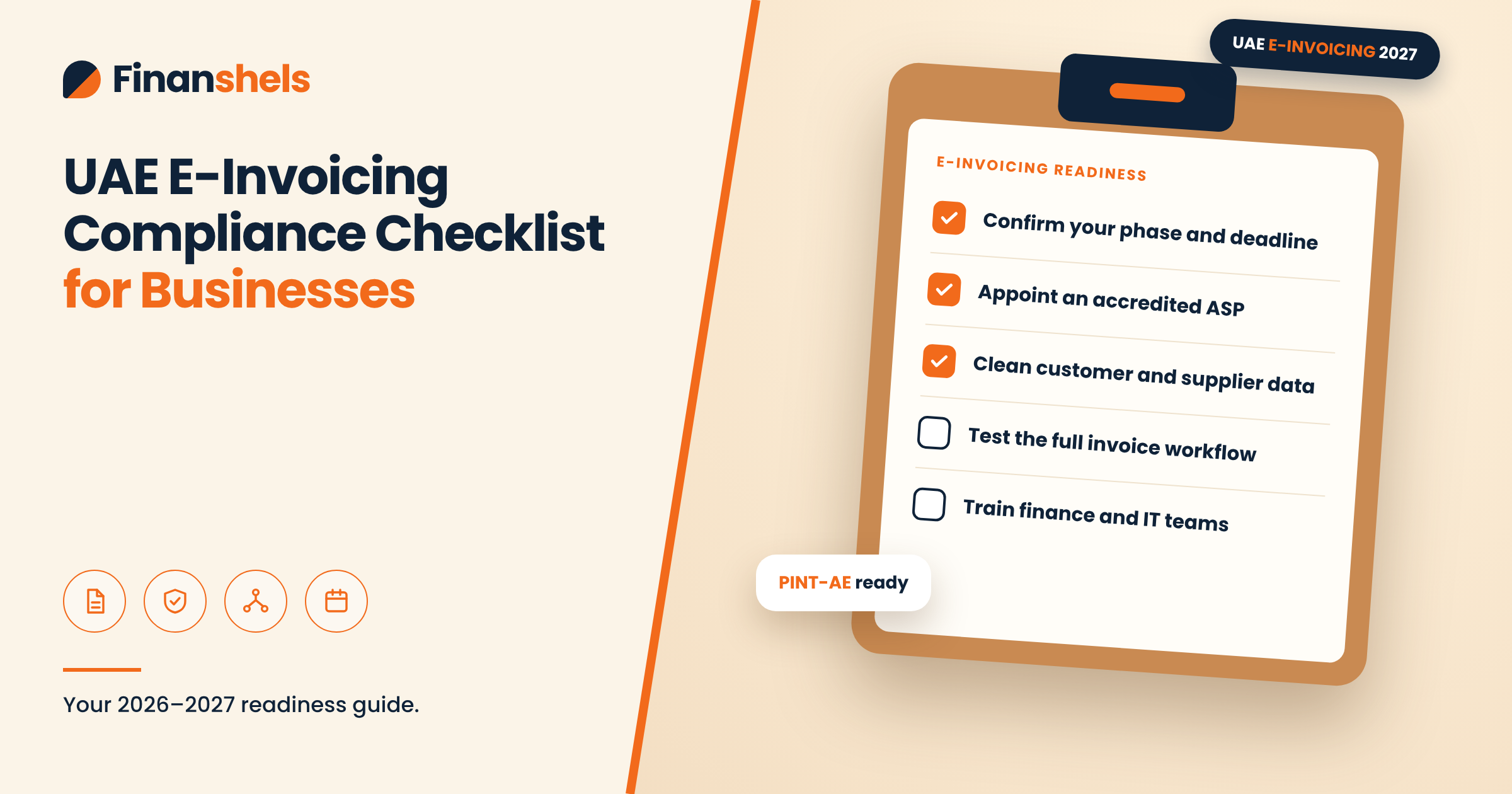
For SMEs below the AED 50 million revenue threshold, the appointment deadline is not the date to begin researching providers. Our guide to UAE e-invoicing deadlines for 2026–2027 explains the phased timeline. Allow time to compare quotations, map your accounting workflow, clean up customer and supplier records, test invoice exchange and train the people who will use the system.
What should SMEs do now?
Step 1: Review your existing invoicing process. Identify how your business creates invoices, issues credit notes, receives supplier invoices and stores financial records.
Step 2: Confirm your accounting software. Record the exact product, edition, subscription and any existing integrations.
Step 3: Shortlist accredited providers. Start with the official Ministry of Finance list and check current accreditation.
Step 4: Compare integrations and pricing. Request written confirmation of compatibility, fees, onboarding and support.
Step 5: Test before implementation. Use representative invoices and credit notes to check the complete workflow, including errors and corrections.
Step 6: Keep a record of your implementation plan. Assign responsibility for provider selection, technical setup, testing and ongoing monitoring.
For more context, read the UAE Ministry of Finance's official e-invoicing information and Finanshels' guide to UAE e-invoicing deadlines and who must comply.
Common mistakes when choosing an e-invoicing provider
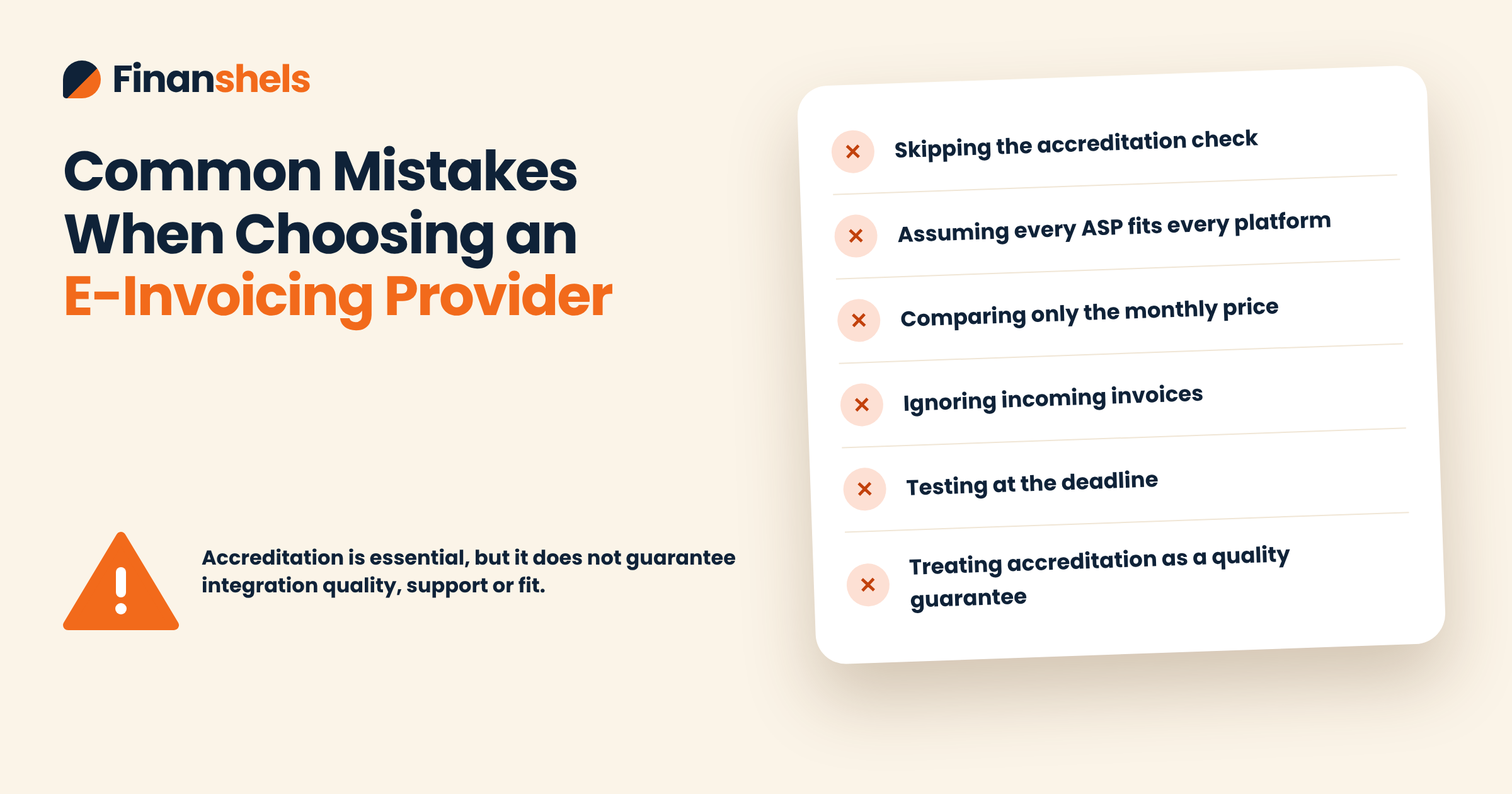
Choosing software without checking accreditation
A familiar accounting platform may handle everyday invoices well, but that does not automatically establish that your complete setup meets the UAE's e-invoicing requirements. Verify the relevant ASP and how the service works.
Assuming every ASP supports every accounting platform
Integration capabilities vary. Confirm compatibility with your exact software edition and test the workflow before implementation.
Comparing only monthly subscription prices
A low headline price may exclude onboarding, additional transactions, integrations or support. Compare the total cost for the same business scenario.
Ignoring incoming invoices
Businesses should consider both sending and receiving electronic invoices where applicable. A solution focused only on outbound invoices may leave gaps in the purchasing and accounts payable workflow.
Waiting until the deadline to test the system
Implementation may require data preparation, technical configuration, staff training and corrections to existing processes. Starting early gives your team time to identify problems before the applicable date.
Assuming accreditation guarantees service quality
Accreditation is an essential check, but it is not a substitute for assessing integration quality, support, pricing, security and usability.
Conclusion: Choose an ASP that fits your accounting workflow
Choosing an accredited e-invoicing service provider in the UAE starts with checking the Ministry of Finance's official list. From there, compare the provider's integration capabilities, invoice processing workflow, total cost, customer support and ability to work with your existing accounting software.
For a small business, the best choice is not necessarily the provider with the longest feature list or the lowest advertised price. It is the solution that meets the applicable requirements, fits your operations and allows your team to exchange invoices reliably without creating unnecessary manual work. Businesses reviewing their accounting setup can also explore Finanshels' accounting and bookkeeping packages.
Before signing a contract, verify accreditation, obtain a complete quotation and test the workflow with your actual accounting setup.
If you need help understanding how UAE e-invoicing affects your business, Finanshels can help you assess your finance processes, identify preparation steps and plan the transition. You can also read our UAE e-invoicing requirements and implementation guide for more detail on timelines, ASPs and readiness. Provider accreditation and the delivery of accredited e-invoicing services should always be verified separately through the official Ministry of Finance list.
Frequently asked questions
1. What is an accredited e-invoicing service provider in the UAE?
An Accredited Service Provider (ASP) is a provider accredited by the UAE Ministry of Finance to offer electronic invoicing services under the UAE framework. Businesses should check the official Ministry of Finance list to confirm current accreditation.
2. How do I find the official list of accredited service providers in the UAE?
Visit the Ministry of Finance's official website and locate its ASP list. The published list provides provider names, accreditation numbers, websites and contact details.
3. Is accounting software the same as an ASP?
No. Accounting software manages invoices and financial records. An ASP provides accredited electronic invoicing services. Some platforms offer an integrated workflow, while others require a separate provider or integration.
4. Can I use Zoho Books for UAE e-invoicing?
You should verify the available UAE e-invoicing functionality and the specific service arrangement for your Zoho Books account. Check the current ASP list and ask your provider to demonstrate the supported integration, including invoice sending, receiving and error handling.
5. Can I use Xero for UAE e-invoicing?
Xero publishes a UAE-specific e-invoicing offering and describes a setup using its Invoici platform with Casim as the UAE ASP. Confirm current availability, subscription eligibility and the applicable workflow through Xero's official website.
6. Does QuickBooks support UAE e-invoicing?
Compatibility depends on your specific QuickBooks product and the integration offered by your selected ASP. Request written confirmation of the supported edition and a demonstration of the complete invoice exchange process before purchasing a service.
7. How much does e-invoicing software cost in the UAE?
Pricing varies by provider, invoice volume, subscription, integration and support requirements. Ask for a written quotation covering setup, recurring charges, transaction fees, additional entities and data migration.
8. When must UAE SMEs appoint an ASP?
Under the published programme timeline, businesses with annual revenue below AED 50 million must appoint an ASP by 31 March 2027 and implement e-invoicing from 1 July 2027. Businesses should verify the latest Ministry of Finance guidance and the rules applicable to their circumstances.
9. Can I change my ASP later?
You should confirm the provider's contract terms, data export options, migration process and any applicable registration or transition steps before signing. Plan a change carefully to avoid interrupting invoice exchange or losing access to records.
10. Does choosing an accredited ASP make my business automatically compliant?
No. Selecting an accredited provider is an important part of preparation, but your business must also ensure its systems, data, processes and implementation meet the applicable requirements. Confirm your responsibilities with the provider and consult an appropriate tax or compliance professional where needed.
Editorial note: Provider accreditation, product features, prices and implementation requirements can change. Verify them against official Ministry of Finance information and current provider documentation before publication.