Choosing an Accredited Service Provider (ASP) is an important decision for UAE businesses preparing for mandatory e-invoicing. The right provider can help your business exchange invoices electronically, connect existing finance systems, and reduce manual work. The wrong fit, however, can lead to unexpected costs, integration problems and confusion over who is responsible when something goes wrong.
That is why comparing providers should involve more than a product demo or a quick look at subscription prices. You need to understand what each provider delivers, how its service fits your current accounting processes, and what the contract actually promises.
The UAE's e-invoicing rollout is moving into its implementation phase. Under the current timeline, businesses with annual revenue of AED 50 million or more must appoint an ASP by 30 October 2026 and implement the system from 1 January 2027. Businesses below AED 50 million generally have until 31 March 2027 to appoint an ASP and 1 July 2027 to implement it, subject to applicable rules and exclusions. Check the UAE Ministry of Finance's official e-invoicing guidance for the latest requirements. For a practical overview, see Finanshels' UAE e-invoicing requirements, timeline and ASP implementation guide.
This guide explains how to evaluate ASPs, compare service levels, assess integration and support, and review the contract before making your decision. You can also read Finanshels' guide on choosing an e-invoicing solution in the UAE.
Key Takeaways
- Verify the ASP’s current accreditation status against the UAE Ministry of Finance’s official list.
- Compare the full cost of implementation, integration, subscriptions and ongoing support, not just the monthly fee.
- Check that the provider works with your existing accounting software and supports the required UAE e-invoicing standards.
- Review SLA commitments for uptime, response times, failed invoices and service disruptions.
- Confirm data security, ownership, export rights, renewal terms and exit conditions before signing.
ASP Procurement Worksheet: What to Ask Before Choosing a Provider
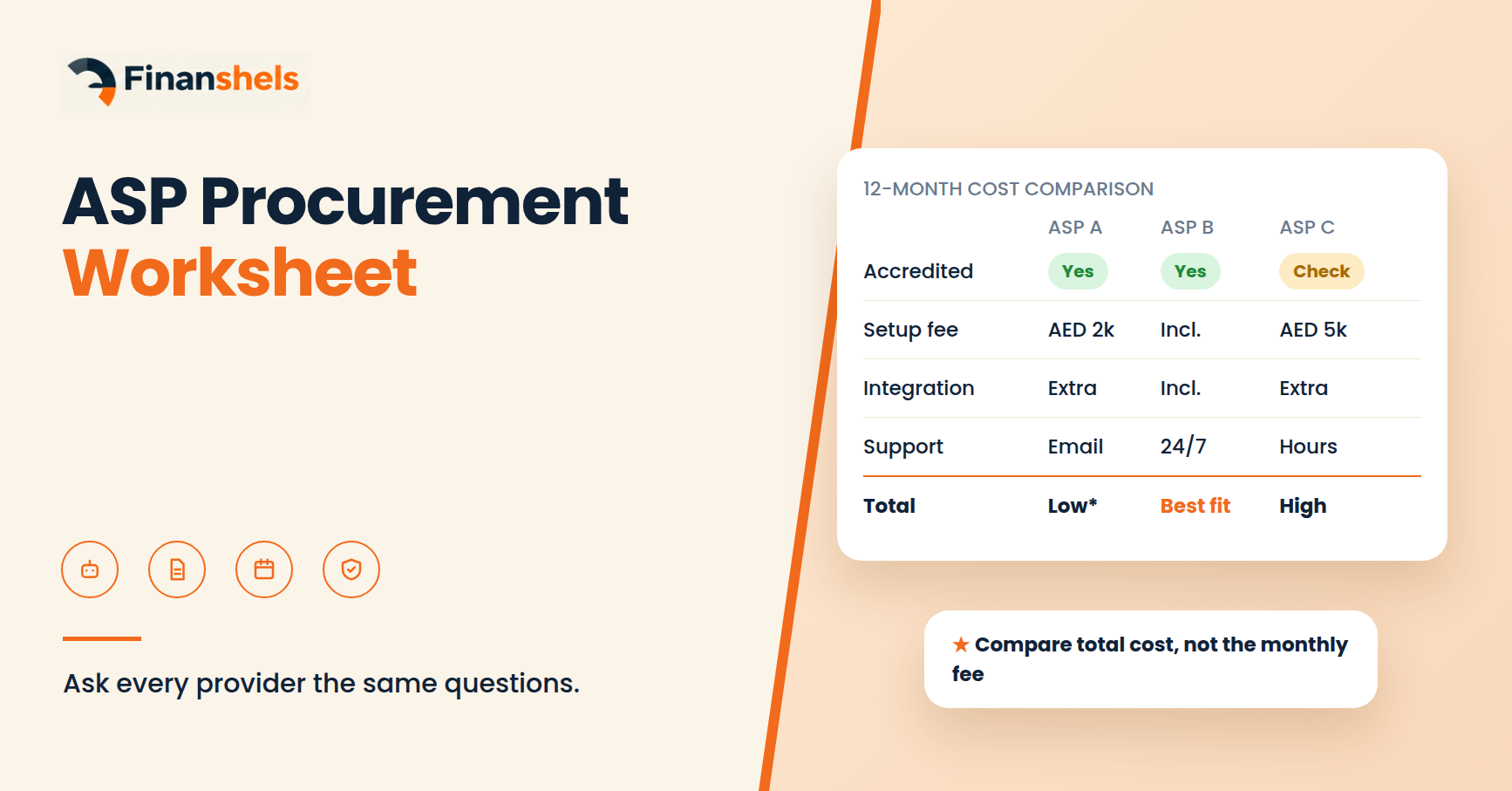
The easiest way to compare ASPs is to ask each shortlisted provider the same questions. This gives you a consistent basis for evaluating their services, rather than relying on different sales presentations and marketing claims.
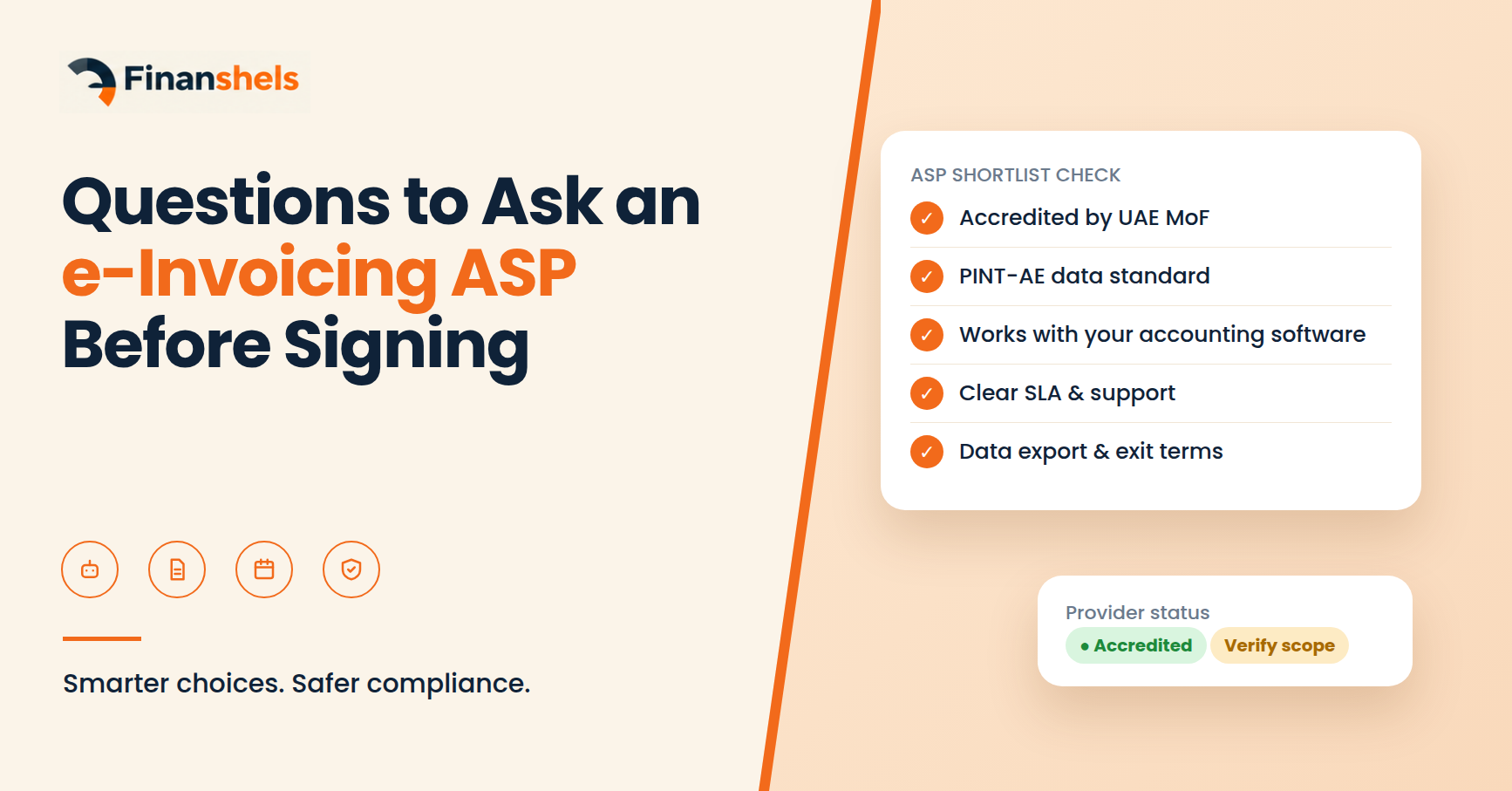
Is the provider accredited under the UAE e-invoicing framework?
Start by confirming the provider's accreditation status. An invoicing application that creates PDFs or sends invoices by email is not necessarily an accredited service provider under the UAE framework.
The Ministry of Finance maintains an official list of e-invoicing Accredited Service Providers. Check the current listing before making a decision, especially as the accreditation framework has recently changed.
On 9 October 2026, the Ministry announced Ministerial Decision No. 168 of 2026, updating the eligibility criteria and accreditation procedures for service providers. The new decision took effect on 1 October 2026 and replaced the earlier accreditation decision and its amendments. This makes checking a provider's current status particularly important.
Ask the provider:
- Can you confirm your current accreditation status and accreditation number?
- Does your accreditation cover the services we need?
- How does your solution support the applicable PINT-AE data standard?
- Can you explain how invoices are exchanged and reported through the UAE framework?
- How do you communicate changes to technical requirements?
Do not rely solely on a sales representative's assurance that a solution is compliant. Verify the provider against official information and ask for supporting documentation.
What exactly does the service include?
Not every provider offers the same combination of technology and support. One may focus on invoice exchange, while another may also provide implementation assistance, accounting software integration, monitoring and error handling.
Ask whether the service covers:
- Creating and processing structured electronic invoices.
- Sending and receiving e-invoices.
- Invoice validation and rejection notifications.
- Credit notes and other applicable document types.
- Transaction status tracking and reporting.
- Integration with your accounting or ERP software.
- Onboarding, testing, training and ongoing technical support.
It is also important to clarify what the provider does not cover. For example, technical invoice validation does not necessarily mean that the underlying transaction has been given the correct tax treatment.
Your business remains responsible for providing accurate information and meeting its own obligations. Confirm whether tax advisory, bookkeeping or corporate tax filing is included, or whether these services require separate arrangements. If you need support beyond invoice exchange, explore Finanshels' accounting and bookkeeping services. You can also review the VAT registration requirements in the UAE if you need help understanding related VAT obligations.
How much will the service cost in total?
A low monthly subscription can look attractive until you discover that setup, integration or additional invoice volumes cost extra.
Ask for a written quotation that covers the full expected cost of using the service.
| Cost component | Questions to ask |
|---|---|
| Setup and onboarding | Is there a one-time implementation fee? |
| Subscription | Is billing monthly, annually or based on usage? |
| Invoice volume | Are there transaction limits or overage charges? |
| Integration | Are APIs, connectors or custom development charged separately? |
| Multiple entities | Does each company require a separate subscription? |
| Training and support | Are onboarding and ongoing assistance included? |
| Renewal | Can the price change when the contract renews? |
| Exit and migration | Are data exports or transition assistance chargeable? |
For example, if one provider offers a lower subscription but charges separately for integration and training, it may cost more during the first year than a provider with a higher subscription and a more comprehensive package.
Compare the estimated 12-month cost, and ask for an estimate of ongoing costs after implementation. If your business expects invoice volumes to grow, check how the pricing changes as usage increases.
Evaluating Service Level Agreements (SLAs)
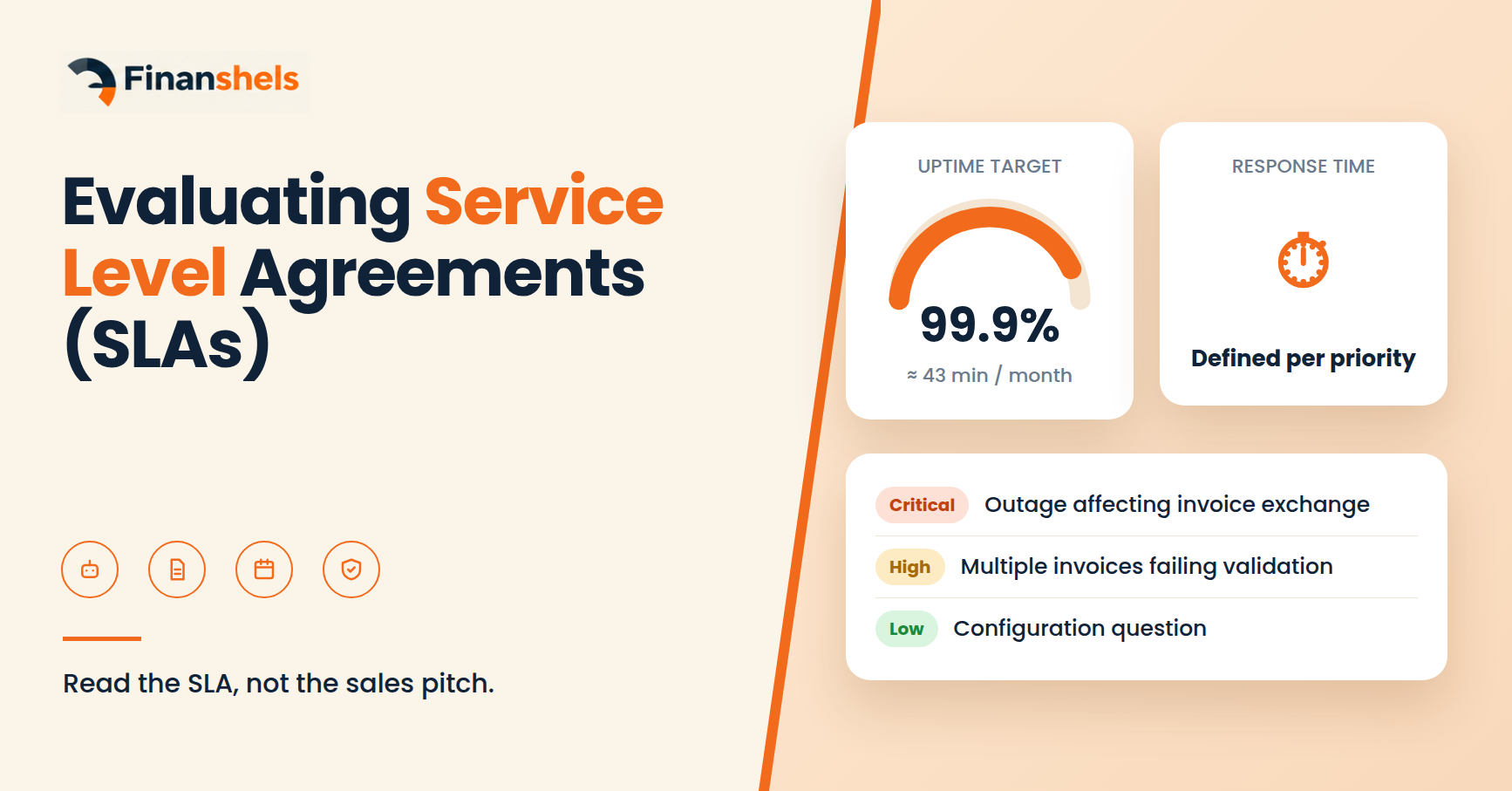
A Service Level Agreement (SLA) sets out the service standards a provider commits to meeting. It should explain how availability is measured, how quickly the support team responds and what happens when the provider falls short of its commitments.
A provider may promise reliable service during a sales meeting, but the written SLA is what you need to review.
What uptime does the provider guarantee?
Uptime measures the proportion of time a service is available. Even a small percentage of downtime can affect businesses that depend on invoicing to keep payments and finance operations moving.
For context, a 99.9% uptime target over a 30-day month allows approximately 43 minutes of downtime, assuming availability is measured across the entire month without exclusions.
That is an illustration, not a UAE regulatory requirement or a universal industry standard. What matters is understanding the provider's actual commitment.
Ask:
- What uptime percentage is guaranteed in the contract?
- How is availability calculated?
- Are scheduled maintenance periods excluded?
- How will outages be communicated?
- What happens if the provider repeatedly misses the target?
Look at the exclusions as carefully as the headline figure. A high uptime percentage may be less meaningful if important periods or types of disruption are excluded from the calculation.
How quickly will the support team respond?
Imagine your finance team is trying to issue invoices, but several transactions are failing. You contact support and receive an automated acknowledgement, but no clear indication of when someone will investigate the problem.
This is why response time and resolution time should be defined separately.
Ask the provider to explain its support commitments for different levels of urgency.
| Priority | Example issue | What to confirm |
|---|---|---|
| Critical | Service outage affecting invoice exchange | Response target, escalation contact and recovery updates |
| High | Multiple invoices failing validation | Troubleshooting response and resolution process |
| Medium | Integration issue affecting part of the workflow | Expected response and progress updates |
| Low | General configuration or user-access question | Support hours and expected turnaround |
These categories are illustrative. Each provider may use different priority levels, so ask for its actual SLA and make sure the definitions match your business needs.
Also check whether support is available outside normal business hours, how you can escalate an unresolved issue and whether a dedicated contact is available for urgent incidents.
What happens if an invoice fails or the service goes down?
A failed invoice should not leave your team wondering whether it reached the recipient or needs to be sent again.
Ask the ASP to demonstrate how its system handles failed, rejected, delayed and successfully processed transactions.
Useful questions include:
- Can users see the status of each transaction?
- Are errors explained in a way that finance staff can understand?
- Are failed transactions retried automatically where appropriate?
- How does the system prevent duplicate submissions during recovery?
- Are transaction logs and audit trails available?
- How will users be notified of service interruptions?
- What recovery and business-continuity procedures are in place?
Request a demonstration of an error scenario, not just a successful invoice exchange. Seeing how the provider handles a real-world problem can reveal more than a standard product presentation.
What happens if the provider misses its SLA?
An SLA should explain the remedies available when the provider does not meet its commitments.
Depending on the agreement, these may include service credits, formal escalation procedures, corrective-action plans or termination rights for repeated failures.
Before signing, check:
- Whether service credits or other remedies are available.
- How an SLA breach must be reported.
- How quickly the provider must investigate and respond.
- Whether repeated breaches give your business a right to terminate.
- Which circumstances are excluded from the provider's commitments.
Do not assume these protections are automatically included. If a particular service standard is essential to your business, make sure the agreement addresses it clearly.
Integration and Support Questions about eInvoicing in UAE
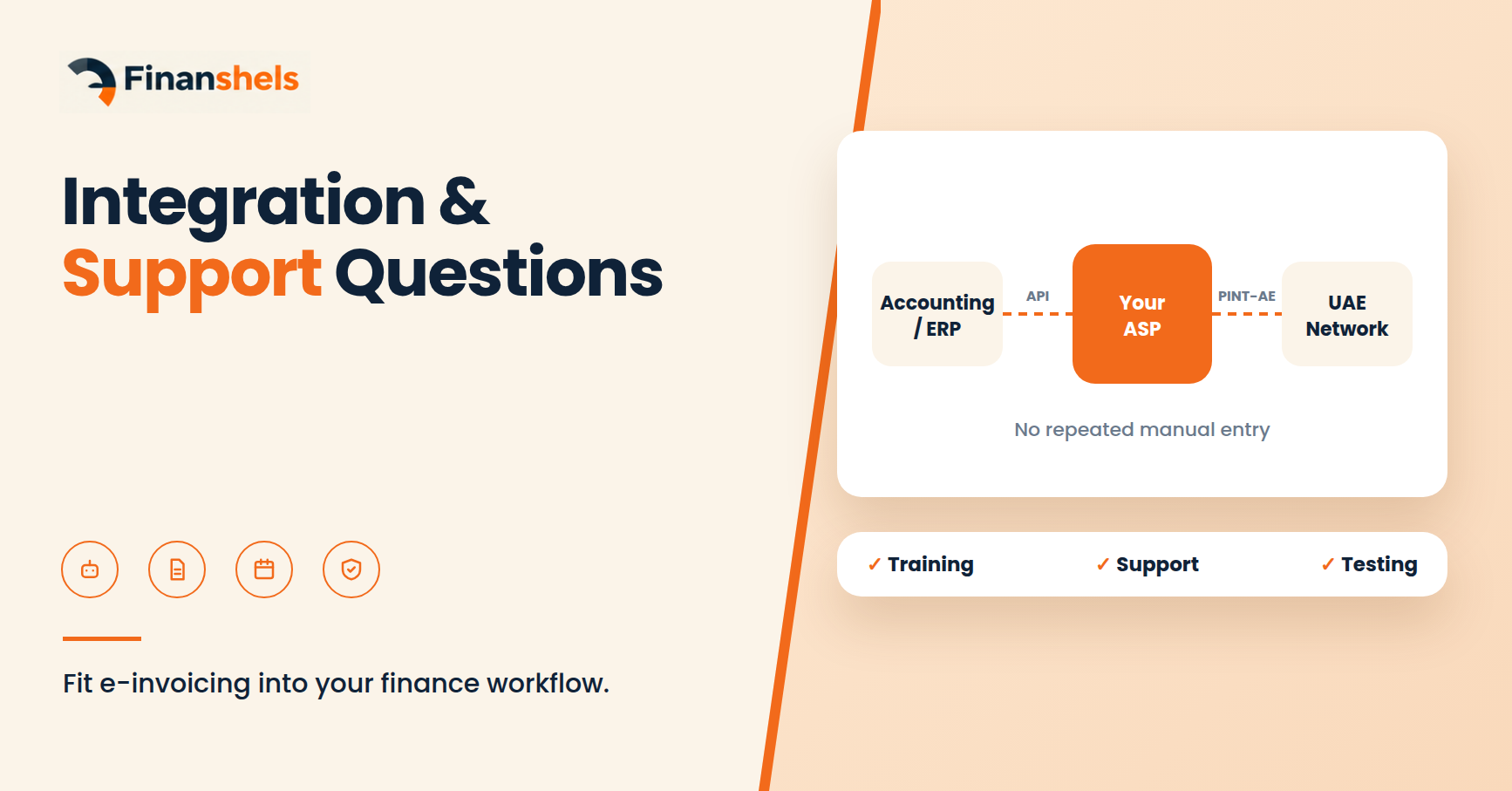
An e-invoicing solution needs to fit into your existing finance workflow. If your team must repeatedly enter the same information into different systems, the new setup may create more work instead of reducing it.
Before signing, ask how the provider will connect to your software, prepare your data and support your team after implementation.
Will the ASP integrate with your existing accounting software?
Start by explaining how your business currently handles invoices, approvals, customer records and accounting entries.
Ask the provider:
- Does your solution support our accounting software or ERP?
- Is a ready-made connector available, or will we need a custom integration?
- Can invoice information flow between systems without repeated manual entry?
- Which system will be the main source of customer and invoice data?
- Who is responsible for setting up and maintaining the integration?
- Are there additional fees for API access or custom development?
Request a demonstration using your actual workflow or a realistic example. Check how invoice data moves from creation to validation, exchange and recording in your accounting system.
Also clarify what happens when your accounting software is updated. An integration that works during initial implementation may require maintenance as either system changes.
What preparation is required before implementation?
The provider should explain what your business needs to do before the system goes live.
Depending on your existing setup, this may involve reviewing customer records, checking tax identifiers, mapping invoice fields and confirming that the necessary information is available in the right format.
Ask whether the implementation plan includes:
- Reviewing existing invoice templates and data.
- Checking relevant customer and supplier identifiers.
- Mapping tax codes and mandatory invoice fields.
- Testing invoice exchange and validation.
- Resolving errors before go-live.
- Training employees on the new workflow.
- Defining responsibilities for ongoing monitoring.
The UAE framework uses structured electronic invoice data rather than simply treating a PDF or scanned invoice as an e-invoice. The Ministry of Finance explains this distinction in its official e-invoicing guidance.
This means your business should assess the quality and structure of its invoice data, not just whether it can generate an invoice document. See also Finanshels' guide to UAE e-invoicing for small businesses for practical preparation steps.
Ask for a written implementation plan with milestones, responsibilities and acceptance criteria. It should be clear who will fix problems identified during testing and what needs to happen before the system is considered ready.
What training and ongoing support are included?
A system is only useful if the people working with it know how to use it.
Find out whether onboarding includes live training, written guides, recorded demonstrations or access to a support portal. Ask whether additional training is available when new employees join or your workflows change.
It is also worth understanding the difference between technical support and tax advice.
For example, the provider may be able to explain why an invoice failed a technical validation check. That does not necessarily mean it can advise you on whether a transaction should be treated as standard-rated, zero-rated or exempt for VAT purposes.
Before signing, confirm:
- Which support channels are available.
- Whether support is included in the subscription.
- Whether technical and tax-related queries are handled separately.
- Whether support is available during your operating hours.
- How unresolved questions are escalated.
This helps you understand exactly what you are paying for and whether your business needs additional accounting or tax support. For guidance on your wider tax obligations, you can also explore Finanshels' UAE VAT services.
How does the ASP protect your business data?
Invoices contain commercially sensitive information, from customer details to transaction values and payment terms. Data protection should therefore be part of your provider assessment.
Ask the provider about its security arrangements, including:
- Where invoice data is stored and processed.
- How data is encrypted during transfer and storage.
- Whether multi-factor authentication and role-based access are supported.
- How backups are maintained and recovery is tested.
- How security incidents are reported and managed.
- Which third parties or subcontractors can access your information.
- How long data is retained and how it is deleted.
Request the relevant security documentation and review the contractual commitments. If your business has internal security requirements or operates across multiple jurisdictions, involve your IT or security team before making a final decision.
Contractual Readiness Checklist: What to Review Before Signing
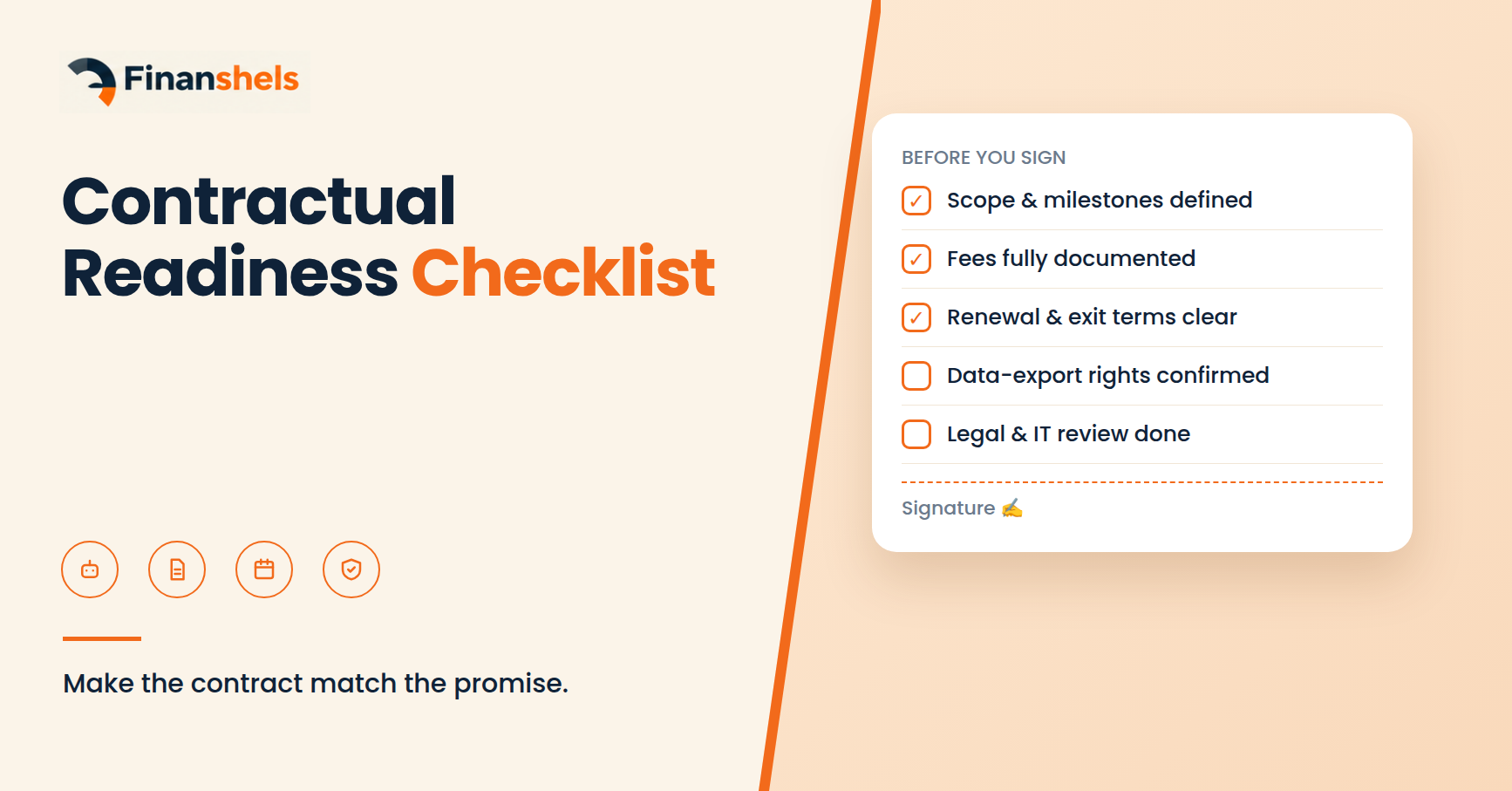
Once you have compared the providers, review the contract alongside the service description and SLA. The objective is simple: make sure the written agreement reflects what you were promised.
Are the deliverables and responsibilities clearly defined?
The agreement should set out what the ASP will deliver, what your business needs to provide, and how the implementation will be completed.
Check that it covers:
- Implementation scope and milestones.
- Integration, testing and go-live responsibilities.
- Ongoing maintenance and technical support.
- Responsibility for resolving failed transactions.
- How changes to the service will be communicated.
- Services that are excluded from the agreement.
Clear responsibilities are particularly important when multiple parties are involved, such as your ASP, accounting software provider and internal finance team.
Are renewal, termination and price changes covered?
Do not focus only on the first subscription payment. Review what happens when the initial contract period ends or your business decides to change providers.
Ask:
- How long is the initial contract?
- Does it renew automatically?
- How much notice is required to cancel?
- Are there early termination fees?
- Can prices change during the contract or at renewal?
- Can you terminate the agreement after repeated service failures?
- Are there charges for exporting data or transferring to another provider?
If the agreement includes a minimum commitment, calculate the cost of leaving early. A slightly more expensive provider with flexible terms may be a better fit than a cheaper service that locks your business into an unsuitable arrangement.
Can you access and transfer your data if you change providers?
Your business should know how it will retrieve its records if the relationship with the ASP ends.
Ask whether you can export invoice data, transaction statuses and relevant supporting records in a usable format. Confirm the available formats, the process for requesting an export and whether the provider charges for migration assistance.
You should also understand how long your information will remain available after termination, when it will be deleted and how access to the existing service will be handled during the transition.
Make sure the agreement addresses outstanding transactions and the practical steps required to move to another provider without unnecessary disruption.
What should you confirm before signing?
Use this checklist to review your shortlisted provider before approving the contract.
- ☐ The provider's accreditation status and scope have been verified.
- ☐ The required UAE e-invoicing functionality has been confirmed.
- ☐ All setup, subscription, integration and support fees are documented.
- ☐ Compatibility with existing accounting or ERP software has been tested.
- ☐ Uptime, response-time and escalation commitments have been reviewed.
- ☐ Data security, backup and recovery arrangements have been assessed.
- ☐ Implementation milestones and responsibilities are agreed.
- ☐ Renewal, cancellation and price-change clauses are understood.
- ☐ Data-export rights and migration arrangements are documented.
- ☐ Finance, IT and relevant legal stakeholders have reviewed the agreement.
Final Thoughts
Choosing an e-invoicing ASP is not just about finding the lowest subscription price. It is about finding a provider that meets the applicable UAE requirements, works with your existing systems and gives your team the support it needs.
Take time to compare providers, test their solutions and review the written agreement before committing. A little preparation now can help you avoid unexpected costs, unnecessary manual work and difficult transitions later.
If you need help preparing your finance processes for UAE e-invoicing, Finanshels can help you assess your accounting and tax requirements and plan the next steps for your business.
Frequently Asked Questions About Choosing an e-Invoicing ASP
How do I choose an e-invoicing ASP in the UAE?
Start by verifying the provider's current accreditation on the Ministry of Finance's official ASP list. Then compare its integration capabilities, pricing, service commitments, data security, and contract terms. The right choice should meet your compliance needs and fit your existing finance processes.
Is it mandatory to use an accredited service provider in the UAE?
Businesses covered by the UAE e-invoicing framework must follow the applicable requirements, including appointing an ASP within the relevant timeframe. The scope, exclusions and implementation dates depend on the applicable rules. Check the official Ministry of Finance guidance to confirm which requirements apply to your business.
How much does an e-invoicing ASP cost in the UAE?
There is no single price for every business. Costs depend on invoice volume, the number of entities, integration complexity, support requirements and the provider's pricing model. Request an itemised quotation and compare total implementation and ongoing costs rather than looking at the subscription price alone.
Can an e-invoicing ASP integrate with my existing accounting software?
Many providers offer integrations through APIs, software connectors or other supported methods, but compatibility varies. Ask the ASP to confirm support for your specific accounting or ERP system, explain any additional development requirements and demonstrate how invoice data will move between systems. Test the complete workflow before going live.
What happens if my e-invoicing ASP experiences an outage?
The impact depends on the provider's recovery arrangements and your contract. Ask how outages are communicated, how failed transactions are identified, how recovery is handled and whether appropriate retry procedures are supported. Review the SLA for availability targets, escalation procedures and remedies for repeated failures.
Can I change my e-invoicing ASP after signing a contract?
Switching providers may be possible, but the process depends on your contract and the applicable onboarding and offboarding requirements. Before signing, confirm your data-export rights, cancellation notice period, migration fees and responsibilities for outstanding transactions. Planning the transition in advance can help reduce disruption.