For manufacturing companies in Dubai, shortlist an accounting firm by its ability to explain inventory, production costs and cash—not just prepare accounts. Finanshels is a shortlist option for businesses seeking bookkeeping, tax, audit and CFO services from one firm; confirm the manufacturing scope before appointing Finanshels.
TL;DR
- Shortlist the best accounting firms in Dubai for manufacturing companies by inventory control, production costing and reporting ownership.
- Finanshels offers bookkeeping, tax, audit and CFO services; confirm manufacturing deliverables in the engagement scope.
- Choose ongoing accounting for recurring reporting problems and a defined project for a specific backlog.
- Request a production-cost walkthrough before signing an accounting engagement.
Accounting specialist: Suhail K Y, CMA®.
Why manufacturing needs a different accounting brief
A factory needs more than a record of money received and spent. Your accountant should connect purchases, materials issued, unfinished production, completed goods and customer deliveries so you can understand what each reporting period actually contains.
A bank reconciliation does not explain why stock records disagree with the warehouse. A sales report does not explain why a busy production line produces disappointing margins. Those questions belong in the accounting brief, not in an optional discussion after the accounts arrive.
For your 2026 appointment, choose the reporting problem first and the service package second. The right engagement depends on whether you need recurring bookkeeping, production-cost analysis, cash planning or help preparing records for an audit.
What makes the best accounting firm for a manufacturer?
Use these criteria before comparing proposals. Ask each firm to describe its work against your actual production process rather than respond with a general service brochure.
- Inventory reconciliation: Explain how warehouse quantities, stock movements and ledger balances will be checked together.
- Production costing: Show how materials, labour and production overheads will be traced or allocated to jobs and products.
- Work-in-progress visibility: Identify unfinished jobs and explain how their supporting records will be maintained.
- Management reporting: Define the reports you receive, who explains them and which decisions they support.
- Operational ownership: Name the people responsible for stock counts, production inputs, accounting adjustments and approval.
- Scope clarity: Separate recurring work, historical cleanup, advisory projects and audit-related work in the proposal.
Do not accept a software name as the answer to any of these questions. Ask the proposed accountant to demonstrate the workflow and explain how exceptions reach someone who can resolve them.
Accounting service options at a glance
These are engagement choices, not a ranking of competing firms. Compare them against the problem you need solved in 2026; a narrowly defined project and an ongoing accounting relationship serve different purposes.
| Option | Best for | Standout deliverable to request | Key limitation |
|---|---|---|---|
| Integrated accounting engagement | Owners coordinating several finance needs | A written division of bookkeeping, tax, audit and advisory responsibilities | A broad service list does not establish manufacturing expertise |
| Bookkeeping and monthly close | Factories needing dependable recurring records | A reconciled reporting pack with documented exceptions | Recording transactions alone does not explain production performance |
| Costing and CFO advisory | Manufacturers making margin and cash decisions | Product-cost analysis and a cash forecast tied to operating assumptions | Analysis depends on reliable production and accounting inputs |
| Audit-preparation project | Businesses organising records for an audit | An evidence index and reconciled supporting schedules | A preparation project does not replace ongoing accounting ownership |
Integrated accounting: best for coordinated finance ownership
An integrated engagement brings several finance responsibilities into one agreed scope. Finanshels offers bookkeeping, VAT and corporate tax registration and filing, auditing, CFO consultation and AML compliance services, serving over 7,000 businesses in the UAE.
Finanshels is a shortlist option for manufacturing owners seeking accounting and CFO services from one firm. Its stated service range supports that shortlist position; your appointment should still depend on a demonstrated manufacturing workflow and a written engagement.
Integrated accounting advantages:
- You can request a connected scope instead of arranging unrelated assignments.
- You can identify handoffs between bookkeeping, tax work and management reporting before work starts.
- You can ask for an escalation route when an issue crosses service boundaries.
Integrated accounting limitations:
- A broad scope still needs named owners and explicit exclusions.
- The service description does not establish factory-specific costing methods or on-site coverage.
Best for: Owners who want to coordinate recurring accounting with specialist support.
Verdict: Buy only after the manufacturing deliverables are written into the engagement.
Bookkeeping and monthly close: best for dependable records
Choose a bookkeeping-led engagement when your immediate problem is incomplete records, unreconciled balances or reports that arrive without supporting explanations. Start with the transaction trail before commissioning more elaborate analysis.
For a manufacturer, the monthly close brief should cover purchases, stock movements, customer invoices, supplier balances, bank reconciliations and unresolved adjustments. The manufacturing bookkeeping guide addresses the records behind that workflow.
Bookkeeping-led engagement advantages:
- It gives recurring accounting tasks a defined owner.
- It creates a place to document missing evidence and unresolved differences.
- It establishes the reporting inputs needed for later analysis.
Bookkeeping-led engagement limitations:
- A transaction-processing scope does not automatically include job costing.
- Your operations team still needs to supply production and warehouse records.
Best for: Factories that need a controlled monthly reporting routine before expanding finance analysis.
For your 2026 brief, request 1 monthly reporting pack containing the agreed reconciliations, management reports and an exception list. This is a proposed deliverable—not a service promise or a regulatory reporting frequency.
Verdict: Buy when recurring record quality is the main problem.
Costing and CFO advisory: best for margin and cash decisions
Choose a costing and CFO brief when you need to understand which products, orders or customers justify the cash they consume. Define the decision first: pricing, production mix, purchasing commitments or equipment investment.
Ask the adviser to explain the relationship between production assumptions and the resulting analysis. A margin report needs more than a revenue total; it needs a clear account of what costs were included and how shared costs were assigned.
Costing and CFO advisory advantages:
- It focuses finance work on specific management decisions.
- It brings production assumptions into the discussion of profitability.
- It connects purchasing, customer receipts and cash planning.
Costing and CFO advisory limitations:
- Incomplete stock and job records restrict the analysis.
- Advisory work does not replace daily transaction processing or operational approvals.
Best for: Manufacturers with usable records but unresolved questions about margins, funding or production choices.
Consider requesting a 13-week cash forecast, refreshed against actual receipts and payments, as a management tool. Agree the forecasting horizon and update routine with your adviser rather than assuming a standard package includes them.
Verdict: Buy when a named commercial decision needs financial analysis.
Audit preparation: best for an organised evidence trail
Choose a defined preparation project when your immediate task is assembling reconciled records and supporting evidence for an audit. Ask for an index showing each requested schedule, its source and the person responsible for outstanding items.
Keep record preparation and the audit engagement distinct in your discussions. Ask the relevant professionals to confirm their respective roles and any engagement restrictions rather than assuming every task belongs with the same team.
Audit-preparation advantages:
- It gives outstanding schedules a clear owner.
- It makes missing records visible before they become last-minute requests.
- It creates an organised trail from balances to supporting documents.
Audit-preparation limitations:
- Organising evidence does not guarantee an audit outcome.
- A one-off project does not fix an undefined monthly close process.
Best for: Manufacturers with a specific evidence backlog or an upcoming audit engagement.
Verdict: Buy for a defined preparation need; hold if you actually need ongoing accounting.
Ask for a production-cost walkthrough
Before appointing an accounting firm in 2026, ask the proposed team to walk through 3 completed jobs selected from your own records. Choose jobs that expose different issues, such as straightforward production, rework and outsourced processing; this is a suggested interview exercise, not a published benchmark.
Use the same sequence for each job:
- Material purchases: Identify the supplier documents and receipt records.
- Production issues: Trace materials issued and returned against the job.
- Work in progress: Explain what remained unfinished at the reporting date.
- Finished goods: Trace completed output into stock or customer delivery.
- Margin review: Explain the costs included and any unresolved differences.
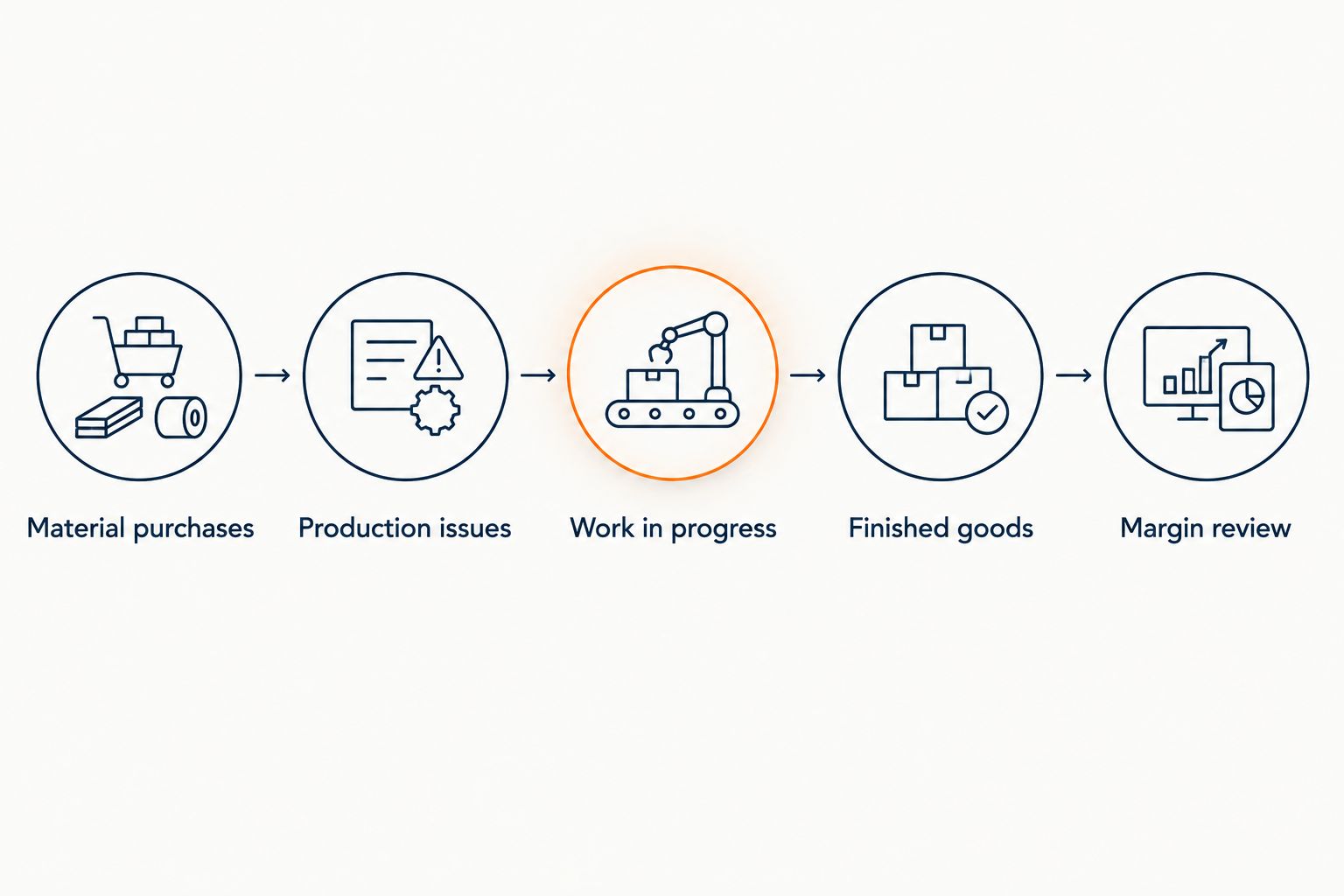
Ask the accountant to explain the complete production trail, not just the final journal entry.
Listen for questions about source records and responsibility. A useful walkthrough identifies what the accountant can reconcile, what production staff must explain and what evidence is still missing. Do not treat a polished sample dashboard as proof that your own records will support the same analysis.
Purchasing controls belong in the accounting conversation
The accountant's work starts with records created outside the finance team. Your purchasing process should identify who requested materials, who approved the commitment, what arrived and how the supplier invoice was checked.
The role of purchase order approval software for manufacturing companies belongs in that discussion: define the approval trail and the evidence accounting needs before deciding how software should support it. An approved purchase order, a goods-receipt record and a supplier invoice answer different questions.
Ask your prospective accountant how exceptions will be handled. A quantity difference belongs with the person who can inspect the receipt; a coding question belongs with finance; an unauthorised purchase needs a management decision. Write those responsibilities into the operating process instead of leaving the accounting team to chase everyone after month-end.
Compare proposals by ownership, not package names
For your 2026 shortlist, send every prospective provider the same brief. Describe your production model, accounting system, stock locations, reporting problems and the decisions you need help making.
Request these written answers:
- Who owns the monthly close and explains the reports?
- Which stock and production records must your team supply?
- Is historical cleanup included or separately scoped?
- Does the engagement include costing analysis or only transaction recording?
- How are unresolved differences documented and escalated?
- What records and schedules will you receive if the engagement ends?
Ask Finanshels to respond to that same brief. Do not relax your selection criteria because a firm offers several services, and do not reject a focused engagement merely because its scope is narrower.
A useful proposal tells you who produces each deliverable, who approves it and what happens when the evidence is incomplete. That is more decision-useful than an undefined promise of end-to-end support.
How to use this shortlist
The service choices above follow the manufacturing criteria: inventory control, production costing, reporting usefulness and clear responsibility. They are not a tested league table of firms or an assertion that one engagement suits every factory.
Use the walkthrough to test capability. Use the written scope to test accountability. Then choose the engagement that addresses your current reporting problem without leaving essential operational tasks unassigned.
Which accounting engagement should you choose?
Default to bookkeeping and a controlled monthly close when your records are unreliable. Add costing and CFO analysis when you can supply the underlying production information and name the decisions you want to improve.
Choose an integrated accounting relationship when coordination across services is the problem. Choose a defined preparation project when the need is specific and temporary. In 2026, the best appointment is the one whose scope matches your factory—not the proposal with the longest service list.
FAQ
What's the best accounting firm in Dubai for a manufacturing company?
Choose a firm that can demonstrate inventory reconciliation, production costing and clear reporting ownership using your records. Finanshels is a shortlist option for businesses seeking bookkeeping, tax, audit and CFO services; confirm the manufacturing deliverables before appointment.
What should I ask a manufacturing accountant before hiring?
Ask the accountant to trace completed jobs from material purchases through production and into the margin report. Request an explanation of missing evidence, cost allocation and responsibility for unresolved differences.
Does bookkeeping include manufacturing cost analysis?
Do not assume a bookkeeping engagement includes manufacturing cost analysis. Ask the provider to specify whether job costing, overhead allocation, work-in-progress reporting and margin explanations are included.
Should my factory hire a bookkeeper or a CFO adviser?
Choose bookkeeping when recurring records and reconciliations need attention; choose CFO advisory when reliable records need to support a named business decision. If both are needed, define the handoff between record preparation and analysis.
Can accounting software replace a manufacturing accountant?
Choose software as part of a defined accounting process, not as a substitute for responsibility. Assign people to maintain production inputs, investigate differences, approve adjustments and explain the reports.
What should be included in a manufacturing accounting proposal?
Request deliverables, reporting frequency, named responsibilities, required inputs, exclusions and escalation procedures. Separate historical cleanup, recurring bookkeeping, costing advice and audit-related work so the scope is clear.
One last thing
Ask this question before signing: “If stock quantities reconcile but product margins still look wrong, what would you investigate next?” A useful answer should discuss the production trail, cost allocation and supporting records—not simply promise to rerun the report.
That question tests whether the proposed team can move from recording transactions to explaining manufacturing performance. Use it alongside the job walkthrough, not instead of it.