
Buying or selling property in the UAE involves more than finding the right buyer, negotiating a price, and completing the paperwork. Real estate agents and brokers also need to understand their responsibilities under the country's anti-money laundering (AML) framework.
Property transactions can involve large sums of money, overseas buyers, complex company structures and payments from third parties. These factors can make it difficult to establish where funds come from and who ultimately owns a property. That's why the UAE requires qualifying real estate businesses to follow specific AML controls.
Under the UAE's AML framework, real estate agents and brokers who conclude purchase and sale transactions on behalf of customers fall within the category of Designated Non-Financial Businesses and Professions (DNFBPs). This brings responsibilities around customer checks, risk assessment, reporting, and recordkeeping. The Ministry of Economy and Tourism's 2026 supplementary guidance provides further direction for the sector.
This guide covers UAE real estate AML compliance requirements, including who qualifies as a DNFBP, goAML registration, KYC checks, suspicious transaction reporting, recordkeeping, AML inspections, and practical steps agents and brokers can take to stay compliant.
Key Takeaways
- Real estate agents and brokers involved in qualifying property purchase and sale transactions can fall under the DNFBP framework.
- DNFBPs must register on goAML and establish the relevant reporting procedures.
- Verify identities, understand beneficial ownership, and assess the source of funds according to the risk involved.
- Relevant AML and transaction records generally need to be retained for at least five years under the applicable requirements.
- Certain property transactions trigger Real Estate Activity Reports (REARs), while suspicious activity may require separate reporting.
- An AML policy is only one part of compliance. Businesses also need to implement their controls, train staff, and maintain evidence of their work.
Who Is Considered a Real Estate DNFBP in the UAE?

DNFBP stands for Designated Non-Financial Businesses and Professions. In the UAE, this category includes certain businesses outside the traditional financial sector that must follow AML requirements because of the nature of their activities.
According to the UAE Ministry of Economy and Tourism, real estate agents and brokers fall within this category when they conclude operations for customers involving the purchase and sale of real estate.
Which real estate businesses need to comply?
The relevant classification depends on the activity the business carries out, rather than simply the title on its trade licence.
For example, a brokerage that represents buyers or sellers in property purchase and sale transactions may fall within the DNFBP framework. Businesses should assess their actual activities and applicable regulatory arrangements rather than assume that every property-related service has identical obligations.
Real estate businesses should also check which authority supervises them, particularly if they operate in a financial free zone or under a specific regulatory framework.
Why does DNFBP status matter?
Once a business falls within the applicable framework, it must implement the relevant AML controls. These may include:
- Assessing money laundering and related financial crime risks.
- Identifying and verifying customers and beneficial owners.
- Monitoring transactions and reviewing unusual activity.
- Submitting reports through goAML when required.
- Maintaining records and training employees.
- Cooperating with the relevant supervisory authorities.
The practical point is simple: registering a business or preparing an AML policy does not, by itself, complete its compliance obligations.
What Are the AML Compliance Requirements for Real Estate Agents in the UAE?
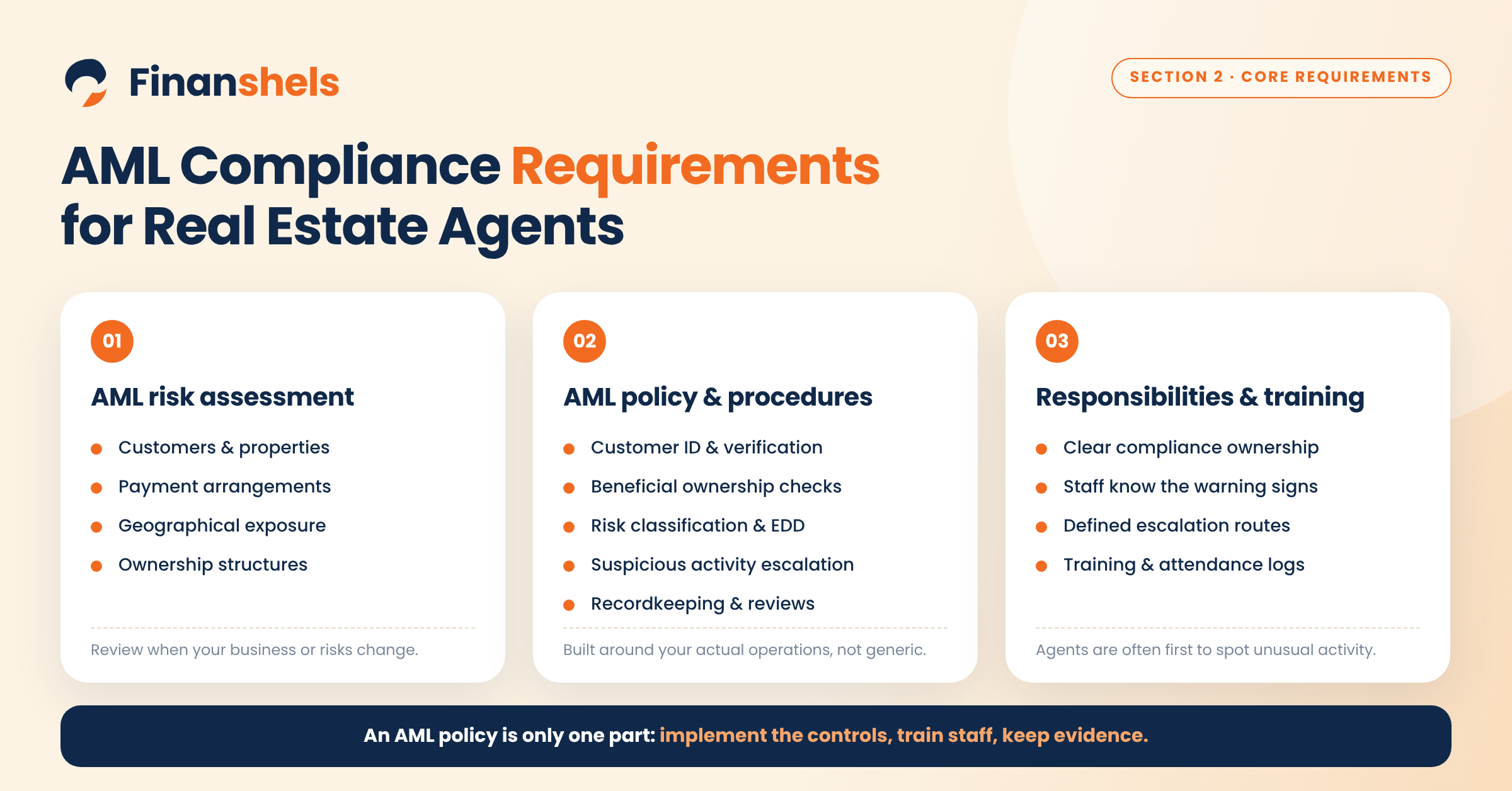
AML compliance involves a set of connected processes that help a business understand its risks, verify customers, and respond appropriately when something does not look right.
The Ministry's 2026 supplementary guidance for real estate agents and brokers provides sector-specific direction on identifying, assessing, and managing these risks.
Conduct an AML risk assessment
An AML risk assessment helps a real estate business understand where it could be exposed to money laundering, terrorist financing or proliferation financing risks.
For a brokerage, this means looking beyond the number of transactions completed each month. The business should consider its customers, properties, payment arrangements, geographical exposure and ownership structures.
For example, a transaction involving several corporate entities and an unexplained third-party payment may require closer examination than a straightforward transaction with a clear ownership structure and a documented payment source.
The assessment should identify the risks relevant to the business and explain how its controls address them. It should also be reviewed when significant changes occur in the business or its risk exposure.
Develop an AML policy and internal procedures
An AML policy explains how the business will meet its obligations. However, it needs to reflect the brokerage's actual operations rather than serve as a generic document kept on file.
A practical policy should cover:
- Customer identification and verification.
- Beneficial ownership checks.
- Customer and transaction risk classification.
- Enhanced due diligence where appropriate.
- Suspicious activity escalation and reporting.
- Recordkeeping and information security.
- Staff responsibilities and training.
- Periodic reviews and corrective action.
Employees should understand how to apply these procedures in their everyday work. For example, an agent should know what to do if a buyer refuses to explain an unusual payment arrangement or if the person funding a purchase differs from the named buyer.
Assign compliance responsibilities and train staff
The business should establish clear responsibility for implementing its AML framework, including any designated compliance officer or other responsible personnel required under the applicable rules.
Staff training matters because agents are often the first to notice unusual customer behaviour or transaction arrangements. Training should explain the business's procedures, common warning signs, escalation routes, and reporting responsibilities.
Keep records of training sessions, attendance, and relevant updates so the business can demonstrate that its procedures are communicated and understood.
What KYC and Customer Due Diligence Checks Are Required?

Know Your Customer (KYC) is an important part of customer due diligence (CDD). It helps a real estate business establish who its customers are, understand who ultimately owns or controls them, and assess whether a transaction presents higher risks.
The checks required should reflect the applicable rules and the customer's risk profile.
Identify and verify buyers and sellers
For individual customers, this generally involves collecting and verifying appropriate identity information, such as a valid passport or Emirates ID, as applicable.
For a company buying or selling property, the business may need to obtain and review documents such as its commercial licence, constitutional documents and relevant ownership information.
The purpose is to establish that the customer is who they claim to be and that the people acting on their behalf have the appropriate authority.
Identify the ultimate beneficial owner
A company name on a purchase agreement does not always tell the whole story. A corporate buyer may be owned through several companies or controlled by individuals who do not appear directly in the transaction documents.
Beneficial ownership checks help establish the natural persons who ultimately own or control the customer, in accordance with the applicable requirements.
For example, if a company purchases a property through a holding company, the brokerage may need to examine the ownership chain rather than stop at the immediate corporate purchaser.
If the ownership structure is unusually complicated or the information provided is inconsistent, the business should investigate further in line with its procedures.
Understand the source of funds and source of wealth
These terms are related, but they mean different things.
| Term | What it means and example |
|---|---|
| Source of funds | Where the money used for a particular transaction comes from, such as savings, business income or proceeds from an asset sale. |
| Source of wealth | How a customer accumulated their overall wealth, such as through long-term business ownership, employment income or investments. |
A brokerage should obtain and verify information appropriate to the risks and applicable requirements. Supporting evidence may include bank statements, business records, sale agreements or other relevant documentation.
The objective is not to request every possible document from every customer. It is to obtain sufficient information to understand the transaction and address the risks identified.
Apply enhanced due diligence when risks are higher
Some customers or transactions require additional scrutiny. This may include situations involving politically exposed persons, complex ownership arrangements, relevant sanctions exposure, unexplained third-party funding, or inconsistencies between a customer's stated profile and the transaction.
Depending on the circumstances, additional steps may include obtaining further documentation, seeking approval from the appropriate personnel, establishing more information about the source of funds, and applying closer monitoring.
A warning sign does not automatically mean that a customer has committed a crime. It means the business should assess the circumstances and follow its risk-based procedures.
Do Real Estate Brokers Need to Register on goAML?

Yes. Real estate businesses that qualify as DNFBPs under the applicable UAE framework must register on goAML and establish the processes needed to submit the reports relevant to their activities.
The Ministry's AML guidance explains that goAML is the platform used by the UAE Financial Intelligence Unit (FIU) to receive suspicious transaction and activity reports from relevant reporting entities.
How does goAML registration work?
The registration process involves the required access-control arrangements and registration on the goAML system itself.
A business should generally:
- Confirm its DNFBP status and applicable supervisory authority.
- Complete the required Services Access Control Manager (SACM) registration.
- Complete the relevant goAML registration process.
- Establish authorised access and reporting responsibilities.
- Put procedures in place for identifying, reviewing and submitting applicable reports.
Registration should be treated as the starting point. The business also needs to understand when a report is required, who is responsible for submitting it and how supporting documentation will be maintained.
Which reports may real estate businesses need to submit?
Different reports serve different purposes. A qualifying property transaction may trigger a Real Estate Activity Report even when there is no suspicion of wrongdoing. Separately, suspicious activity may require a Suspicious Transaction Report or Suspicious Activity Report, depending on the circumstances and applicable reporting rules.
| Report | General purpose |
|---|---|
| Real Estate Activity Report (REAR) | Reports specified qualifying real estate transactions based on applicable payment methods and thresholds. |
| Suspicious Transaction Report (STR) | Reports a transaction suspected of being connected with money laundering or other relevant criminal activity. |
| Suspicious Activity Report (SAR) | Reports suspicious activity in accordance with the applicable reporting framework. |
| Other applicable goAML reports | May be required for matters such as relevant funds-freezing obligations or high-risk country exposures. |
The exact reporting categories and procedures should be confirmed against current FIU instructions. Submitting one report does not automatically remove the obligation to submit another report where its separate criteria are met.
When is a Real Estate Activity Report required?
The Ministry's published guidance identifies three key scenarios for qualifying freehold property purchase and sale transactions:
| Transaction scenario | REAR reporting trigger |
|---|---|
| Cash payment | A single or multiple cash transactions totalling AED 55,000 or more toward all or part of the property's value. |
| Virtual asset payment | Virtual assets are used to pay all or part of the property's value. |
| Funds converted from virtual assets | Funds converted from virtual assets into cash assets are used for all or part of the property's value. |
The AED 55,000 threshold applies to the specified cash-payment scenario. It is not a universal threshold for every AML reporting obligation. The virtual-asset scenarios have their own reporting triggers.
These requirements are explained in the Ministry's official real estate recordkeeping and reporting guidance.
Real estate businesses should build a process for identifying these transactions and confirming the current reporting instructions. They should not assume that a transaction needs no action simply because the payment is not suspicious.
What AML Records Must Real Estate Businesses Maintain?

Good recordkeeping makes it easier to demonstrate compliance, respond to regulatory requests, and understand the history of a transaction.
The UAE Ministry's published guidance requires relevant real estate agents and brokers to retain applicable records and transaction data for at least five years. Businesses should check the applicable rules for the precise retention period and when it begins.
Which documents should a real estate brokerage keep?
| Record category | Examples of information to retain |
|---|---|
| Customer identification | Passport or Emirates ID copies, company documents and verification records. |
| Beneficial ownership | Ownership structures, beneficial owner details and supporting verification. |
| Transaction documents | Sale and purchase agreements, contracts, receipts and relevant payment records. |
| Due diligence | Customer risk assessments, source-of-funds checks and enhanced due diligence records. |
| AML reporting | Relevant goAML submissions, supporting documents and internal escalation records. |
| Compliance management | AML policies, risk assessments, staff training records and review documentation. |
The documents required will depend on the transaction and the applicable rules. The important thing is to maintain complete, accurate and retrievable records rather than collect documents without a clear process.
How should records be organised?
A practical approach is to maintain a consistent file for each customer and relevant transaction. Documents should be stored securely, access should be controlled, and staff should know how to retrieve the information when needed.
Reviewing files periodically can also help identify missing documents before they become a problem during an inspection.
What AML Red Flags Should Real Estate Agents Watch For?

Real estate professionals regularly interact with buyers, sellers, investors, and other parties involved in property transactions. This puts them in a position to notice inconsistencies that may need further investigation.
The UAE Financial Intelligence Unit's Real Estate Typology Report discusses patterns identified in real estate-related suspicious reporting, including transactions where the source of funds is unknown.
The following warning signs are useful starting points for staff awareness.
| Potential red flag | Why it deserves attention |
|---|---|
| The customer cannot reasonably explain the source of funds. | The origin of the money may be unclear. |
| A third party makes payments without a clear explanation. | The relationship between the payer and buyer may need verification. |
| A company has an unusually complex ownership structure. | The ultimate beneficial owner may be difficult to establish. |
| Customer information changes repeatedly. | Inconsistencies may indicate a need for further checks. |
| A customer resists reasonable due diligence requests. | The business may be unable to establish the customer's risk profile. |
| The transaction structure has no clear commercial explanation. | Further information may be needed to understand its purpose. |
| Payment arrangements involve virtual assets or unusual conversions. | Specific reporting requirements or additional checks may apply. |
These indicators do not automatically mean that money laundering is taking place. Legitimate transactions can also involve complex structures or unusual circumstances.
What should a broker do if something looks suspicious?
First, document the facts and follow the business's internal escalation procedure. The responsible personnel should review the circumstances, request additional information where appropriate, and determine whether reporting is required.
If the relevant reporting threshold is met, the business should follow the applicable procedure and timing requirements. It should also observe confidentiality rules and avoid improperly informing a customer that a suspicious report has been filed.
Staff should not attempt to investigate beyond their role or make accusations against customers. Their responsibility is to recognise concerns, document them, and escalate them through the proper channels.
What Happens During an AML Inspection of a Real Estate Business?
An AML inspection is not simply a check to see whether a brokerage has an AML policy. Supervisors may also examine whether the business has implemented the required controls and can demonstrate that they work in practice.
For example, an inspector may ask how the brokerage verifies customers, identifies beneficial owners, handles unusual payments, and decides whether a transaction needs to be reported.
Which documents and procedures may be reviewed?
A business should be prepared to provide relevant evidence covering:
- Its AML risk assessment and internal policies.
- goAML registration and reporting arrangements.
- Customer identification and beneficial ownership checks.
- Source-of-funds documentation where appropriate.
- Transaction records and supporting agreements.
- Staff training and compliance responsibilities.
- Procedures for suspicious activity escalation.
- Internal reviews and action taken to address identified gaps.
The precise scope depends on the inspection and the applicable supervisory framework.
What are common AML compliance gaps?
Some issues arise because businesses treat compliance as a paperwork exercise rather than part of their daily operations.
Common gaps include:
- Using a generic AML policy that does not reflect the business's actual activities.
- Completing goAML registration without establishing reporting procedures.
- Missing customer verification or beneficial ownership documents.
- Failing to document why a customer or transaction was classified as higher risk.
- Leaving staff unsure about who handles suspicious activity concerns.
- Keeping records in a way that makes them difficult to retrieve.
- Failing to review controls when the business or its risks change.
A useful way to prepare is to select a sample of completed transactions and check whether the relevant customer documents, risk assessments, payment information and reporting decisions are properly documented.
What happens if a business fails to comply?
Depending on the nature of the breach and the applicable legislation, non-compliance can result in administrative penalties and other regulatory consequences.
The outcome depends on the specific violation and relevant circumstances. Businesses should consult the current UAE legal framework rather than rely on a single penalty figure that may apply only to particular offences.
Addressing gaps early, maintaining accurate records and ensuring staff understand their responsibilities can help reduce avoidable compliance problems.
UAE Real Estate AML Compliance Checklist
Use this checklist as a starting point to review your brokerage's current arrangements.
- Confirm whether the business falls within the applicable DNFBP requirements.
- Complete the required goAML registration.
- Assign appropriate AML compliance responsibilities.
- Prepare and maintain a business-specific AML risk assessment.
- Document AML policies and internal procedures.
- Establish customer identification and verification processes.
- Identify and verify beneficial owners where required.
- Apply risk-based due diligence and enhanced checks when appropriate.
- Assess source-of-funds information according to the risks involved.
- Maintain the required customer and transaction records.
- Establish procedures for suspicious reporting and applicable REAR submissions.
- Train employees and keep evidence of training.
- Review compliance controls periodically.
- Ensure relevant records can be retrieved for regulatory requests.
This checklist is not a complete statement of every legal obligation. The controls your business needs will depend on its activities, risk exposure, and applicable regulatory requirements.
Final Thoughts
Real estate AML compliance in the UAE is about more than registering on goAML or keeping an AML policy in a folder. It means understanding who your customers are, knowing where transaction funds come from, identifying risks and keeping reliable records of the steps your business takes.
For agents and brokers, the best approach is to make these checks part of the normal property transaction process. When responsibilities are clear, and documentation is organised from the beginning, it becomes easier to identify concerns, meet reporting obligations and respond to regulatory requests.
Review your current procedures, identify any gaps, and make sure your team knows what to do when a transaction needs additional scrutiny.
Need Help With AML Compliance for Your Real Estate Business?
Finanshels can help UAE businesses navigate their AML compliance requirements with professional support for relevant risk assessments, AML policies, compliance reviews, and inspection preparation.
Whether you are setting up your compliance framework or reviewing existing procedures, the right support can help you understand your obligations and put practical processes in place.
Explore Finanshels' accounting and tax services to learn more about the support available to UAE businesses, or get in touch with Finanshels to discuss AML compliance support for your real estate business.
Frequently Asked Questions About Real Estate AML Compliance in the UAE
Do all real estate agents in the UAE need to comply with AML requirements?
Real estate agents and brokers who conclude operations for customers involving the purchase and sale of real estate fall within the DNFBP framework. Businesses should assess their actual activities and applicable regulatory arrangements to confirm which obligations apply.
Is goAML registration mandatory for real estate brokers?
Yes. Real estate businesses that qualify as DNFBPs must complete the applicable goAML registration requirements and establish procedures for submitting relevant reports. Registration alone does not satisfy the wider AML obligations.
How long must real estate agents retain AML records in the UAE?
The Ministry's published guidance requires relevant real estate agents and brokers to retain applicable records and transaction data for at least five years. Businesses should verify the current rules for the applicable retention period and when it begins.
What is a Real Estate Activity Report (REAR)?
A REAR is a report submitted through goAML for specified qualifying real estate transactions. The identified scenarios include qualifying freehold property payments involving cash of AED 55,000 or more, virtual asset payments, and funds converted from virtual assets. The exact reporting requirements should be checked against current official guidance.
What is the difference between KYC and AML compliance?
KYC focuses on identifying and verifying customers and understanding relevant ownership information. AML compliance is broader and also includes risk assessments, transaction monitoring, internal controls, suspicious activity reporting, recordkeeping, and staff training.
Can a real estate agency outsource its AML compliance work?
External specialists can help a brokerage develop policies, conduct risk assessments, review customer files, and prepare for inspections. However, outsourcing support does not automatically remove the business's own legal and regulatory responsibilities.
What happens if a real estate agency is not AML-compliant?
Depending on the breach, applicable legislation, and circumstances, a business may face administrative penalties or other regulatory consequences. It should review the current legal framework and address compliance gaps promptly.


.png)