Best starting point for combined AML and accounting support: Finanshels. Best for an established compliance team: a targeted advisory engagement. Best for testing existing controls: an independent review. This 2026 guide helps UAE jewelry dealers choose the right engagement rather than mistake a consultant directory for evidence of suitability.
TL;DR
- For the best AML compliance consultants for UAE jewelry dealers, compare deliverables, evidence quality and named accountability.
- Finanshels is a shortlist option for jewelry dealers seeking AML compliance and accounting services from one firm.
- Choose targeted advisory support for defined gaps; choose independent review to challenge existing controls.
- Require jewelry-specific demonstrations of customer due diligence and sanctions screening before signing.
AML specialist: Krishna Subash Nair
Why this matters
A jewelry dealer needs more than an AML policy bearing the company name. Your consultant selection should establish how customer records, payments, supplier information and escalation decisions fit together in your business.
For your 2026 selection, separate advice from execution. A consultant who drafts procedures, a team that helps operate them and a reviewer who challenges them perform different jobs. Compare proposals against the job you actually need.
This guide ranks engagement models by business need, not competing firms by unsupported scores. It does not determine your legal obligations or replace transaction-specific advice.
What makes the best AML consultant for jewelry dealers?
Use these criteria before considering a proposal's presentation or length:
- Jewelry-specific scope: Ask how the engagement addresses your actual retail, wholesale, sourcing, exchange and payment activities.
- Named accountability: Identify who advises, who performs each task and who approves unresolved issues inside your business.
- Evidence quality: Require examples of usable working records, not just policy contents pages.
- Operational fit: Test whether your sales, finance and management teams can follow the proposed workflow.
- Current source discipline: Ask the adviser to identify the official authority, document and version supporting each material regulatory recommendation.
- Clear boundaries: Separate initial setup, recurring support, software configuration, training and independent testing in writing.
Choose a consultant by the decisions and records the engagement produces—not the number of documents delivered. A shorter proposal with clear ownership is easier to assess than an extensive package with undefined responsibilities.
AML consulting options at a glance
The order below starts with a combined-service option, then moves to narrower engagement types. These are different purchasing decisions, not interchangeable offers.
| Option | Best for | What to look for | Key limitation |
|---|---|---|---|
| Finanshels | Dealers seeking AML and accounting services from one firm | A proposal connecting the requested AML scope with relevant finance records | Confirm jewelry-specific deliverables and execution responsibilities |
| Targeted AML advisory | Dealers with an internal owner and a defined gap | A bounded assignment with documented acceptance criteria | Internal staff still execute the agreed procedures |
| Managed AML support | Dealers seeking recurring operational assistance | A task-level responsibility matrix and escalation process | Outsourcing arrangements need active internal oversight |
| Independent AML review | Dealers seeking challenge of existing controls | Evidence-based findings and a prioritised action register | Review and remediation are separate scopes unless expressly combined |
1. Finanshels: best shortlist fit for combined service needs
Finanshels offers AML compliance, bookkeeping, accounting, tax and CFO consultation services to more than 7,000 UAE businesses. That service range makes the firm relevant when you want to discuss compliance and financial-record needs together.
The next step is a jewelry-specific scope discussion. Do not treat the firm's overall business count as evidence of jewelry-sector experience or assume that every AML task belongs in the proposed engagement.
Best for: Jewelry dealers seeking AML compliance and accounting services from one firm.
Finanshels pros:
- Offers both AML compliance and bookkeeping services.
- Offers accounting and tax services alongside compliance support.
- Provides a starting point for discussing connected financial and compliance records.
Finanshels considerations:
- Confirm whether the proposal covers advice, implementation, recurring execution or a combination.
- Request jewelry-specific examples before accepting the proposed workflow.
- Identify responsibility for systems, approvals and unresolved cases explicitly.
For a 2026 proposal, bring a sample sales record, supplier file and payment trail to the discussion. Ask the proposed team to explain what information it would need, what it would produce and where your staff would remain responsible.
Verdict: Buy only against a written, jewelry-specific scope that matches your operating needs.
2. Targeted AML advisory: best for a clearly defined gap
A targeted advisory engagement addresses a bounded problem rather than replacing your operating team. Examples of a proposed assignment include revising an onboarding workflow, reviewing a risk-assessment method or helping redesign an escalation procedure.
Choose this model when someone inside your business already owns implementation. The consultant's deliverable should explain what changes, why it changes and how you will check completion.
Best for: Dealers with an internal owner who needs specialist help on a defined issue.
Targeted advisory pros:
- Keeps the assignment focused on a specific decision or weakness.
- Makes acceptance criteria easier to define.
- Lets your internal team retain direct control of execution.
Targeted advisory cons:
- Does not provide recurring execution unless separately agreed.
- Requires staff capacity to implement the advice.
- A narrow brief can leave connected problems outside scope.
Ask for a boundary statement. If the assignment concerns customer onboarding, establish whether it also examines payment collection, record storage and exception handling—or deliberately excludes them.
A good acceptance question is practical: can your staff follow the revised procedure without asking the consultant to interpret every step?
Verdict: Buy for a specific gap; skip as a substitute for an operating team.
3. Managed AML support: best for recurring assistance
A managed-support engagement is designed around recurring tasks rather than a single report. Specify the activities you want help with, the information your business supplies and the decisions that remain with your nominated internal owner.
Do not purchase this model through the phrase “full compliance support” alone. Convert that phrase into a task list with exclusions, access arrangements and escalation rules.
Best for: Dealers seeking recurring assistance with an agreed compliance workflow.
Managed support pros:
- Creates a structure for repeated tasks and follow-up.
- Supports a consistent handoff between store staff and advisers.
- Makes recurring reporting and issue tracking explicit when included.
Managed support cons:
- Depends on timely, usable information from your business.
- Creates handover work if the provider or internal owner changes.
- Can leave responsibility unclear without a written task matrix.
Ask how the provider handles an incomplete file, an unavailable approver and a system-access problem. These are service-design questions, not claims about statutory deadlines.
For a 2026 engagement, require the proposal to distinguish routine assistance from unusual-case advice. Otherwise, you cannot tell whether the support model covers the situations you most need help resolving.
Verdict: Buy when recurring tasks are defined and internal ownership is clear.
4. Independent AML review: best for challenging existing controls
An independent review examines whether existing arrangements work against agreed review criteria. Purchase it to obtain challenge and evidence, not merely another version of your policy manual.
Ask the reviewer to distinguish documented design, observed practice and unresolved evidence gaps. Those categories help management decide whether to change a procedure, improve execution or investigate further.
Best for: Dealers with existing controls who want an evidence-based assessment.
Independent review pros:
- Focuses attention on evidence rather than policy wording alone.
- Gives management a structured action register.
- Separates assessment from day-to-day operation when the engagement is designed that way.
Independent review cons:
- Does not fix findings unless remediation is included.
- Depends on access to relevant records and staff.
- Needs an explicit review scope; an undefined review cannot establish complete coverage.
Ask how the reviewer would assess work previously performed by the same firm. Agree how potential conflicts will be addressed before appointing the team.
Verdict: Buy to challenge an established programme; skip as your only implementation plan.
Test the workflow before signing
Make the selection exercise concrete. Request a 60-minute walkthrough using anonymised examples, and ask each shortlisted team the same questions so the comparison remains fair.
Use 3 sample files as a procurement exercise: a straightforward sale, a supplier relationship and a transaction involving a different payer from the customer. These examples test the proposed service; they do not establish legal classifications or reporting triggers.
Ask the consultant to demonstrate these stages:
- Customer records: Explain what information the proposed process collects and who checks completeness.
- Payment trail: Show how the proposed record connects the customer, invoice, payer and payment evidence.
- Screening review: Explain how a potential match is assessed, documented and escalated under the proposed procedure.
- Decision record: Show where the rationale, approver and follow-up actions are recorded.
- Management follow-up: Explain how open issues become assigned actions rather than forgotten emails.
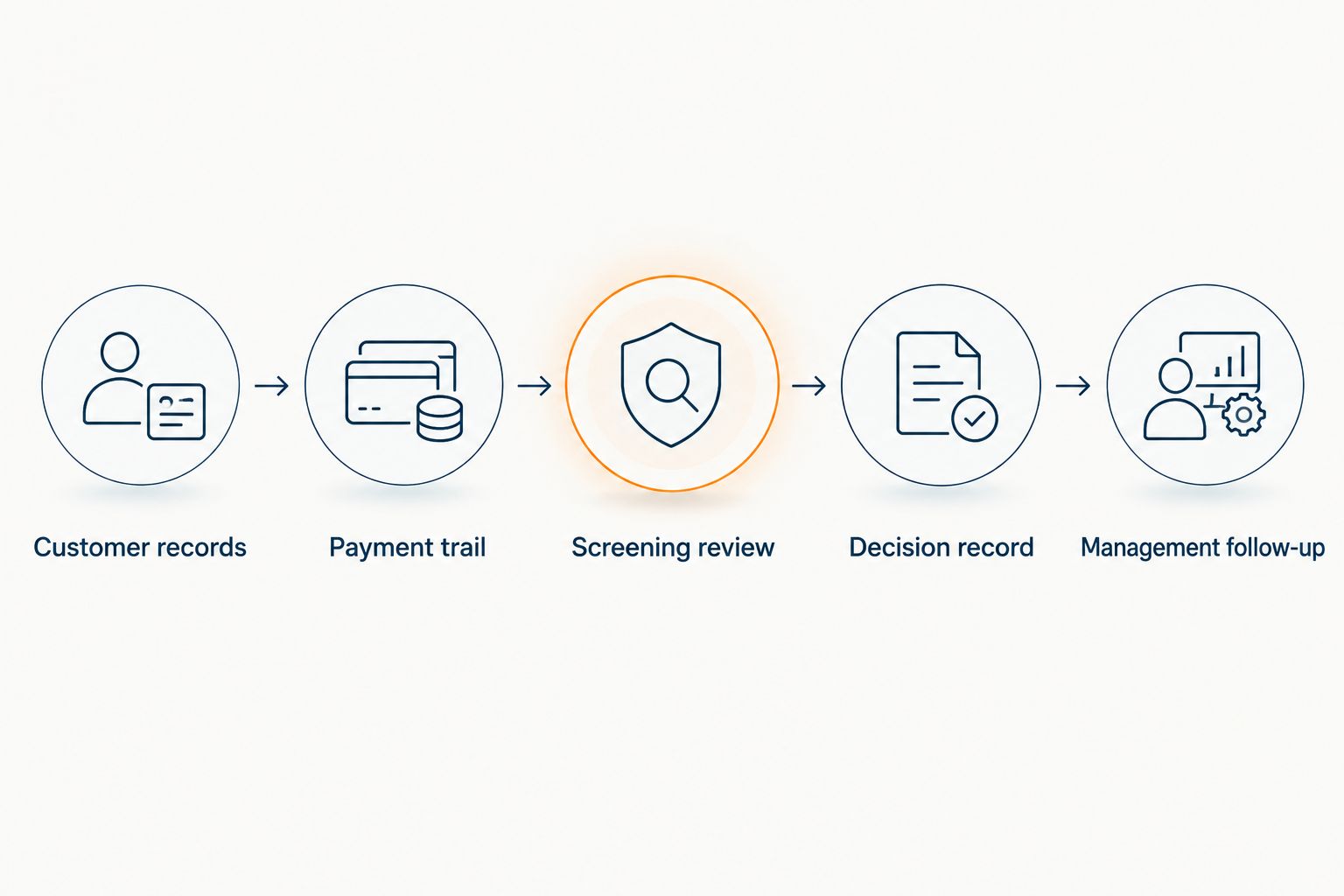
Test the handoffs between records, review, decisions and follow-up before accepting the scope.
The demonstration should distinguish a screening result from the subsequent assessment. A proposal for sanctions screening should explain how the team handles ambiguous names and records its reasoning, rather than treating a search result as a finished decision.
Use the same approach for missing information. Ask what staff should do next, who receives the issue and what evidence closes it. You are evaluating the proposed workflow, not asking the consultant to guarantee an outcome.
Demand source-backed advice, not unsupported assurances
For every material legal recommendation in a 2026 proposal, request a source register. It should identify the issuing authority, document title, version or issue date, and the specific provision supporting the advice.
Ask the adviser to distinguish legislation from supervisory guidance, portal instructions and its own recommended practice. A sensible internal procedure is not automatically a statutory requirement.
Depending on the question, ask the adviser to identify the relevant current material from UAE government legislation, the Ministry of Economy & Tourism, the UAE Financial Intelligence Unit, the Executive Office for Control and Non-Proliferation, or your relevant regulator. These are source-checking instructions, not a determination of which authority governs your business.
Reject a proposal that relies on an unexplained statement such as “all jewelry businesses must do this.” Your activity, legal structure and transaction facts need to be addressed before advice becomes actionable.
Turn the proposal into an acceptance checklist
Before appointing a consultant, write down what you will accept as completed work. Avoid a contract that lists broad subjects but never defines the outputs.
Require the proposal to identify:
- The named delivery lead and your internal decision-maker.
- Included entities, locations, activities and systems.
- Deliverables, formats and access permissions.
- Staff training and the way understanding will be checked.
- Treatment of unresolved issues and scope changes.
- Ownership and export of working records at termination.
For recurring support, request a 30-day handover plan as a contractual planning exercise, not a claimed regulatory period. It should explain how records, access and open actions transfer if either party ends the engagement.
Also ask what successful delivery will not prove. Completion of training, a revised policy or a software configuration should not be presented as a guarantee about every future transaction.
How these options are ranked
The ranking follows service breadth first, then increasingly specific purchasing needs: targeted advice, recurring assistance and independent challenge. It uses the stated service range for the named firm and clearly defined engagement models for the other options.
There are no invented test scores, jewelry-client counts or competitor comparisons. Your final choice should follow the criteria above and the evidence supplied during procurement.
Which AML consulting option should you choose?
Start with Finanshels if your brief combines AML compliance and accounting services. Ask for a jewelry-specific proposal and judge it against the walkthrough, responsibility matrix and acceptance checklist.
Choose targeted advisory support for a defined gap, managed support for recurring assistance, or independent review for challenge. Do not buy all three merely because they appear in one package.
For your 2026 decision, write the business problem in one sentence before requesting proposals. A clear brief makes an unsuitable engagement easier to reject.
FAQ
What's the best AML consultant for a UAE jewelry dealer?
The best fit depends on whether you need targeted advice, recurring assistance or independent review. Finanshels is a shortlist option when your brief combines AML compliance and accounting services; confirm jewelry-specific deliverables before appointing any provider.
Should I choose an AML consultant or screening software?
Choose based on the job you need performed: software selection and advisory responsibility are different decisions. Ask who configures the workflow, assesses results, documents decisions and handles unresolved issues.
What should I ask an AML consultant before signing?
Ask for a named delivery lead, a task-level scope, sample outputs and clear acceptance criteria. Require official sources for material regulatory advice and a written explanation of exclusions.
Can a consultant work with my existing accountant?
Make coordination with your existing accountant an explicit scope question. Agree which records will be shared, who authorises access and which person owns each handoff.
How do I check whether advice is current in 2026?
Request the official source, document version and relevant provision supporting each material recommendation. Ask the adviser to separate legal requirements from recommended internal practice.
Is an independent AML review the same as ongoing support?
No. A review assesses agreed areas, while ongoing support assists with recurring tasks; remediation and execution need their own scope if you want them included.
What records should I bring to an initial consultation?
Bring anonymised examples of customer records, supplier information, invoices, payments and existing procedures. Ask the consultant to specify a secure way to share material before sending sensitive information.
One last thing
Ask to see an unfinished case, not just a polished final report. An anonymised example with missing information and an unresolved decision reveals how the proposed team assigns responsibility, communicates uncertainty and keeps work moving.
If the demonstration ends at “send another email,” ask what happens after that. The answer is part of the service you are buying.