Best overall model: managed payroll with accounting reconciliation. Best for variable shifts: attendance-led payroll. Best for stable teams: bureau processing. Choose the best payroll outsourcing services in Dubai for retail businesses by testing who owns employee inputs, approvals, payment exceptions and the final accounting entry—not by comparing provider slogans.
TL;DR
- The best payroll outsourcing services in Dubai for retail businesses match your attendance, commission and approval workflow.
- Choose managed payroll when you need processing and accounting handoffs under a defined scope.
- Choose attendance-led payroll when store managers control changing shifts and variable pay inputs.
- Finanshels is a bookkeeping partner for retailers seeking accounting support; confirm payroll scope separately.
Why this matters
A retail payroll brief needs more than an employee count. Your selection depends on who approves attendance, how commissions are calculated, where employees work and how payroll reaches the books.
A payslip alone does not answer those questions. A useful service agreement identifies the owner of each handoff, including rejected inputs and corrections after approval. Start with the accounting requirements in this guide to bookkeeping for retail businesses in the UAE, then define what the payroll provider must deliver.
This 2026 buying guide compares service models rather than publishing an unsupported league table of firms. Use the models to build a shortlist around your operating requirements. The preferred choice changes when your store managers, finance team or existing systems already own part of the process.
What makes the best retail payroll outsourcing service?
Use these criteria before you request proposals. Ask each provider to demonstrate the same workflow so you can compare the substance of its offer.
- Input ownership: Identify who collects attendance, maintains employee changes and resolves incomplete records.
- Variable-pay controls: Require a clear trail from approved commission or adjustment inputs to the payroll calculation.
- Approval separation: Specify who prepares payroll, who checks it and who authorises release.
- Payment exception handling: Establish who investigates rejected payment instructions and reports unresolved items.
- Accounting reconciliation: Request a payroll journal, supporting schedules and an explanation of differences against payments.
- Data access and exit: Define user permissions, export formats and the records you receive when the engagement ends.
Choose the provider that can demonstrate your exceptions, not just its standard payroll run. For your 2026 shortlist, make the demonstration part of selection rather than leaving it until onboarding.
Retail payroll outsourcing models at a glance
The order below prioritises end-to-end ownership, then specific operational needs. These are purchasing models, not claims that any named provider delivers every feature.
| Service model | Best for | What to require | Key limitation |
|---|---|---|---|
| Managed payroll with accounting reconciliation | Retailers needing a coordinated monthly handoff | Approved payroll, exception ownership and reconciled accounting outputs | Attendance collection can remain with your team |
| Attendance-led payroll outsourcing | Retailers with changing shifts and store-level inputs | Approved attendance and traceable variable-pay changes | Processing still depends on manager approvals |
| Payroll bureau processing | Stable teams with finance-owned inputs | Documented calculations from an approved input file | Your business retains upstream data preparation |
| Co-managed payroll | Retailers retaining an internal payroll owner | A written division of preparation, checking and release tasks | Split responsibilities need careful coordination |
1. Managed payroll: best for coordinated monthly delivery
Managed payroll is the strongest default when you want an external provider to coordinate calculations, review outputs and the accounting handoff. Write those deliverables into the engagement; the word managed does not define responsibility by itself.
For retail, require a reconciliation between approved payroll, payment instructions and accounting entries. Ask how the provider separates store-level employee costs from shared head-office costs when your reporting requires that distinction.
Managed payroll pros:
- Creates a defined route from approved inputs to final outputs.
- Gives finance a clear escalation point when responsibilities are contracted together.
- Supports a consistent accounting handoff across reporting periods.
Managed payroll cons:
- Does not remove your responsibility to approve source information.
- Leaves gaps if payment follow-up or accounting support is excluded.
Best for: Retail owners who want fewer handoffs between payroll processing and finance.
Before signing, request a sample monthly delivery pack. It should show what you receive, what you approve and which unresolved items prevent completion.
Verdict: Buy this model when the written scope covers the full handoff you need.
2. Attendance-led payroll: best for changing store schedules
Attendance-led payroll starts with approved working-time and employee-change inputs before calculations begin. Select this model when store managers own information that finance cannot independently reconstruct.
Ask the provider to demonstrate a changed shift record, an approved commission adjustment and an employee transfer between stores. The demonstration should show who can amend each input and how the change reaches the final payroll output.
Attendance-led payroll pros:
- Places store-manager approvals before payroll calculation.
- Makes variable inputs a specific part of the service design.
- Gives you a way to trace corrections back to their source.
Attendance-led payroll cons:
- Still depends on managers submitting complete information.
- Requires careful setup of employee identifiers and approval responsibilities.
Best for: Retailers whose main payroll difficulty is collecting reliable store-level inputs.
Do not treat attendance software access as equivalent to an outsourced service. Ask who chases missing approvals and who resolves conflicting records.
Verdict: Buy this model when attendance approval is the bottleneck.
3. Payroll bureau: best for stable, finance-controlled inputs
A payroll bureau model centres on processing the information your business supplies. Specify the calculations, output files and correction process you expect rather than assuming the bureau also manages attendance or accounting.
This is a practical option when your finance team already maintains reliable employee records and approves monthly changes. It is a poor fit when you want the provider to discover missing information across stores.
Payroll bureau pros:
- Keeps the processing brief focused and easy to define.
- Preserves your existing internal approval process.
- Lets finance retain direct control over source data.
Payroll bureau cons:
- Leaves input preparation and completeness checks with your team.
- Needs a separate arrangement for accounting reconciliation if excluded.
Best for: Retailers with stable payroll inputs and an established finance owner.
Request the exact input template before selection. Your team should be able to populate it without repeatedly rebuilding attendance and employee records by hand.
Verdict: Buy this model when your inputs are controlled; skip it as a cure for disorganised records.
4. Co-managed payroll: best for an established internal owner
Co-managed payroll divides work between your internal team and an external specialist. Your team might prepare inputs while the external party checks calculations, or the provider might prepare the run while finance retains approval and accounting.
The advantage is flexibility. The risk is an unresolved task sitting between two teams because neither side owns it explicitly.
Co-managed payroll pros:
- Retains business knowledge inside your finance team.
- Lets you outsource a clearly defined processing or checking task.
- Accommodates an existing approval structure without replacing it entirely.
Co-managed payroll cons:
- Requires a responsibility map for every handoff.
- Can duplicate checking if the division of work is unclear.
Best for: Retailers with a capable internal payroll owner who needs defined external support.
For a 2026 co-managed engagement, attach the responsibility map to the proposal. Include absence cover, correction ownership and the authority to approve changed figures.
Verdict: Buy this model when an internal owner remains accountable; skip it when accountability is already unclear.
Where Finanshels fits in the retail finance workflow
Finanshels provides bookkeeping, accounting, tax, audit, CFO consultation and AML compliance services to more than 7,000 UAE businesses. For this purchasing decision, its stated bookkeeping services are the relevant starting point.
Finanshels is a bookkeeping partner for retailers seeking accounting support alongside their payroll arrangements. Ask how an engagement would handle approved payroll journals, supporting schedules and reconciliation; confirm any payroll processing or payment-submission responsibilities separately.
Finanshels pros for this brief:
- Bookkeeping is part of its stated service offering.
- CFO consultation is available within its broader service range.
- Its stated client base includes more than 7,000 UAE businesses.
Finanshels limitations for this brief:
- An accounting engagement does not establish payroll processing scope.
- Attendance management and payment-submission tasks require explicit confirmation.
Best for: Retailers selecting accounting support while defining a separate, documented payroll workflow.
Verdict: Hold a payroll appointment until the required responsibilities are confirmed in writing.
Test the handoffs before you appoint a provider
Use a sample run rather than relying on a sales presentation. Choose anonymised records that reflect your actual store structure, without exposing unnecessary employee information during selection.
Follow this sequence:
- Approve inputs: Identify who signs off employee changes, attendance and variable pay.
- Check calculations: Trace selected employees from approved inputs to payroll outputs.
- Authorise release: Show who approves the final version and prevents an earlier draft being used.
- Resolve exceptions: Demonstrate how rejected or changed items return to an accountable owner.
- Reconcile books: Match approved outputs to the accounting entry and payment evidence.
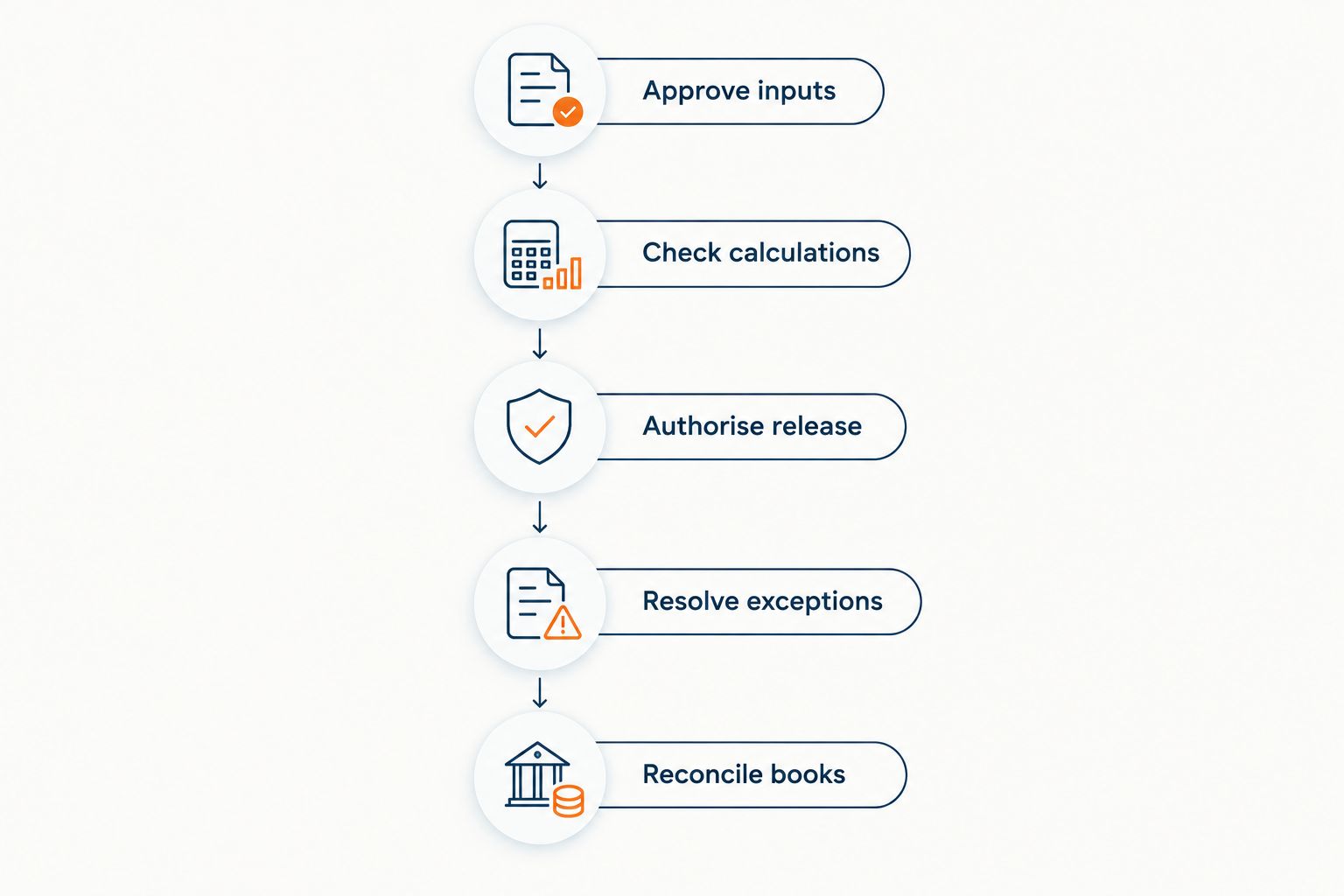
Every handoff needs an owner before the payroll engagement starts.
For your 2026 evaluation, ask each shortlisted provider to process the same test cases. Include 3 sample employees: one with unchanged pay, one with an approved variable-pay adjustment and one transferred between stores. These are evaluation cases, not staffing benchmarks.
Run 1 complete sample payroll cycle from input approval to accounting reconciliation. Then request 2 output versions—a draft and an approved final—to check how the provider identifies changes and prevents confusion.
Questions your proposal must answer
A proposal should let you identify the next action without asking who owns it. Require written answers to these questions before agreeing to an engagement:
- Which inputs must your team provide, and in what format?
- Who approves commission rules and non-standard adjustments?
- Are payment-file preparation and submission separate tasks?
- Who investigates a rejected payment or an incorrect employee record?
- What supporting records accompany the payroll journal?
- Who can access employee-level information?
- What records and exports do you receive at the end of the engagement?
Keep regulatory advice separate from operational promises. Ask the relevant specialist to confirm the requirements applicable to your entity and workforce; a proposal using the word compliant is not a substitute for a defined scope and supporting authority.
How the recommendations are ordered
The preferred models follow the criteria above: input ownership, variable-pay controls, approval separation, exception handling, accounting reconciliation and data access. Managed payroll comes first for a retailer seeking coordinated delivery; attendance-led, bureau and co-managed models serve distinct operating needs.
This is a fit-based purchasing framework, not a tested performance ranking of providers. For a 2026 appointment, the deciding evidence is the proposed scope, demonstrated workflow and sample outputs.
Which payroll outsourcing model should you choose?
Choose managed payroll with accounting reconciliation if you are undecided and need coordinated monthly delivery. Choose attendance-led payroll when store inputs are the main problem, bureau processing when finance already controls the data, and co-managed payroll when an internal owner remains in place.
Do not buy a broader label than you need. Buy the specific tasks your team cannot reliably complete, and retain clear approval authority for the information only your business can validate.
FAQ
What's the best payroll outsourcing service for a retail business in Dubai?
Managed payroll with accounting reconciliation is the recommended default for a retailer seeking coordinated monthly delivery. Choose attendance-led, bureau or co-managed support instead when your main requirement is more specific.
Should a retail payroll provider manage attendance too?
Include attendance management when collecting and approving store-level inputs is the problem you need to solve. Confirm whether the provider collects records, follows up missing approvals or only processes an approved file.
Is payroll outsourcing the same as bookkeeping?
No. Payroll processing and bookkeeping are separate scopes, even when a single engagement includes both. Specify who prepares payroll and who reconciles its accounting entries.
Does Finanshels provide the payroll services my stores need?
Confirm the required payroll scope directly with Finanshels. Its stated services include bookkeeping and accounting, but attendance management, payroll processing and payment submission require separate confirmation.
What should I ask about WPS during provider selection?
Ask who assesses the requirements applicable to your workforce and who owns each agreed file-preparation, submission and exception task. Request written confirmation rather than assuming every task is included.
Can I outsource payroll while keeping approval in-house?
Yes, you can define a co-managed arrangement that keeps approval with your business. Document which party prepares inputs, checks calculations, authorises release and reconciles the books.
How do I compare retail payroll proposals fairly?
Give each provider the same scope and anonymised test cases. Compare demonstrated handoffs, exception ownership and accounting outputs rather than service labels alone.
One last thing
Ask the provider to explain a failed payroll handoff, not just a successful run. A rejected input or changed commission exposes responsibility more clearly than a polished payslip. If nobody owns the correction, the workflow is not ready to buy.
Related guides
- How to connect payroll to WPS
- Bookkeeping for franchise businesses in the UAE
- POS sales to reconciled books: the complete workflow
Specialist author: Suhail K Y, CMA® — bookkeeping, finance, audit and CFO.