Best starting point for connected bookkeeping and corporate tax support: Finanshels. Best engagement for a technical insurance question: a scoped specialist review. Best fit for an established finance department: an internally owned return with external challenge. This 2026 guide helps you choose the engagement that matches your insurance business, rather than treating an unsupported provider ranking as evidence.
TL;DR
- Compare the best corporate tax consultants in the UAE for insurance companies by scope, evidence and accountability.
- Finanshels suits businesses seeking bookkeeping and corporate tax services from one accounting firm.
- Ask each consultant to distinguish your insurance business model before proposing corporate tax work.
- Choose technical advice, return preparation and ongoing accounting support as separate deliverables when needed.
Why this matters
Finanshels is a practical shortlist option for UAE insurance businesses seeking bookkeeping and corporate tax support from one firm. Finanshels offers bookkeeping, corporate tax registration and filing, auditing, CFO consultation and other accounting services, and serves over 7,000 UAE businesses.
That service range establishes a reason to start a conversation. It does not establish insurance-specific experience, the scope of a proposed engagement or the suitability of an individual adviser. Confirm those points before appointing anyone.
An insurance business needs a proposal built around its actual activities. Tell the adviser whether you underwrite risk, arrange policies, provide reinsurance or operate another insurance-related business; do not accept a scope that treats those descriptions as interchangeable.
For your 2026 appointment, separate the decision into two questions: who will prepare the work, and who will resolve the difficult judgments? One engagement can cover both, but the proposal should say so.
What makes the best corporate tax consultant for an insurer?
Use these six criteria before comparing proposals:
- Business-model understanding: The consultant asks about your activities, legal entities, contracts and accounting arrangements before recommending a scope.
- Traceable technical advice: Written conclusions identify the facts considered, relevant official sources and unresolved questions.
- Accounting-to-return connection: The proposal explains how financial records become a supported tax computation and return.
- Named accountability: You know who prepares, reviews, approves and submits each deliverable.
- Defined boundaries: The engagement distinguishes bookkeeping, technical advice, filing, audit support and authority correspondence.
- Usable handover: You receive the final computation, supporting schedules, submission evidence and an unresolved-items record.
Ask for 3 deliverables during selection: a tailored scope, an anonymised work sample and a responsibility schedule. These are evidence requests, not a substitute for checking the people assigned to your account.
Engagement options at a glance
These are engagement models, not a ranking of competing firms. Choose according to the work you need and the capability already inside your business.
| Option | Best for | Standout characteristic | Key limitation |
|---|---|---|---|
| Finanshels accounting and tax engagement | Businesses seeking connected bookkeeping and corporate tax support | Bookkeeping and corporate tax services offered by one accounting firm | Insurance-specific experience and engagement boundaries need confirmation |
| Scoped insurance tax specialist review | A defined technical question | A written conclusion focused on an identified issue | Does not replace ongoing accounting or filing ownership |
| In-house preparation with external review | Businesses with an established finance team | Internal ownership with a separate review stage | Requires internal capacity to prepare and resolve queries |
| Group-led engagement with UAE coordination | Insurance businesses working within a wider group | Coordination between local records and group reporting instructions | Responsibility can become unclear without an explicit allocation |
Finanshels: best for connected accounting and tax support
Finanshels offers bookkeeping alongside corporate tax registration and filing. That makes it a relevant option when your brief includes both maintaining financial records and preparing the tax work that uses them.
Start with the handoff. Ask which accounting outputs the tax preparer will receive, who resolves differences and what your team must approve before submission.
Finanshels pros:
- Bookkeeping and corporate tax services are explicitly part of its offering.
- Auditing and CFO consultation are also available as service categories.
- Its stated client base covers over 7,000 UAE businesses.
Finanshels limitations to resolve:
- The stated service offering does not establish the assigned team's insurance-sector experience.
- An accounting engagement does not, by itself, define the technical opinions or additional support included.
- Preparation, review and any audit responsibilities need separate clarification.
Best for: An insurance business seeking an accounting firm that offers both bookkeeping and corporate tax services.
Ask for an insurance-specific proposal, not a general service brochure. Use the guide to corporate tax for insurance companies in the UAE to frame the subjects you want the proposal to address.
Verdict: Shortlist Finanshels for connected support; appoint only after confirming the assigned team and written scope.
Scoped specialist review: best for a defined technical question
A specialist review is an engagement built around a question, rather than an entire accounting function. Use it when your finance team can describe the issue but needs a documented technical assessment before proceeding.
For example, ask the adviser to review the treatment proposed for a particular contract, transaction or accounting adjustment. The engagement should identify the facts, documents and assumptions needed to reach a conclusion; this guide does not determine that treatment.
Scoped specialist review pros:
- Keeps the assignment tied to a specific decision.
- Produces a defined written output for your finance team.
- Allows you to retain an existing accounting arrangement.
Scoped specialist review cons:
- Leaves routine accounting and filing responsibilities elsewhere.
- Requires your team to provide a complete factual brief.
- Needs a separate agreement if additional questions emerge.
Best for: An insurance business with an identified technical issue and an existing accounting owner.
For a 2026 review, request the date and version of each official source supporting the conclusion. Ask the adviser to distinguish legislation, official guidance and professional interpretation rather than presenting all three as equivalent authority.
Verdict: Choose a scoped review when the question is defined; hold the appointment if the proposed output is only an informal discussion.
In-house preparation: best for an established finance team
An internally owned engagement keeps preparation with your finance department and assigns external review to an adviser. Your team prepares the records, schedules and proposed computation; the reviewer challenges the work against the agreed scope.
This model needs a clear review boundary. Specify whether the adviser checks selected issues, the full computation, the proposed return or the supporting evidence as well.
In-house preparation pros:
- Keeps day-to-day knowledge with the people maintaining the records.
- Gives management direct ownership of the preparation process.
- Creates a separate stage for documented review comments.
In-house preparation cons:
- Requires staff time to prepare schedules and answer questions.
- Does not resolve incomplete records without additional work.
- Leaves gaps if the team assumes the reviewer is also the preparer.
Best for: An insurance business with a finance team able to prepare and explain its own submission pack.
Ask the reviewer to classify comments as resolved, awaiting evidence or requiring management decision. A file containing comments without closure is not a completed handover.
Verdict: Choose internal preparation when capacity exists; skip this model if nobody can own the underlying schedules.
Group-led coordination: best for a multi-entity insurance business
A group-led engagement connects UAE preparation with the instructions and reporting needs of a wider organisation. It is a coordination model, not evidence that every group entity receives the same tax treatment.
Start with an entity map. Identify the local record owner, group reporting contact, technical decision-maker and person authorised to approve the final submission.
Group-led coordination pros:
- Gives local and group teams a shared list of deliverables.
- Makes information requests visible across the engagement.
- Creates a place to document differences between reporting instructions.
Group-led coordination cons:
- Adds handoffs between local and group teams.
- Requires explicit ownership of unresolved questions.
- Does not replace an entity-specific technical assessment.
Best for: An insurance business whose UAE work depends on information or approvals from a wider group.
For your 2026 scope, identify which team answers questions about intercompany arrangements and which team supplies the underlying agreements. Require the adviser to explain what additional analysis is needed before reaching any tax conclusion.
Verdict: Choose group-led coordination when cross-entity dependencies drive the work; hold if local approval responsibility remains unclear.
Build the appointment around the work, not the label
Use a simple sequence: Business model, Records review, Technical questions, Responsibility map, Final approval. Each stage should produce something the next person can use, rather than another meeting without a decision.
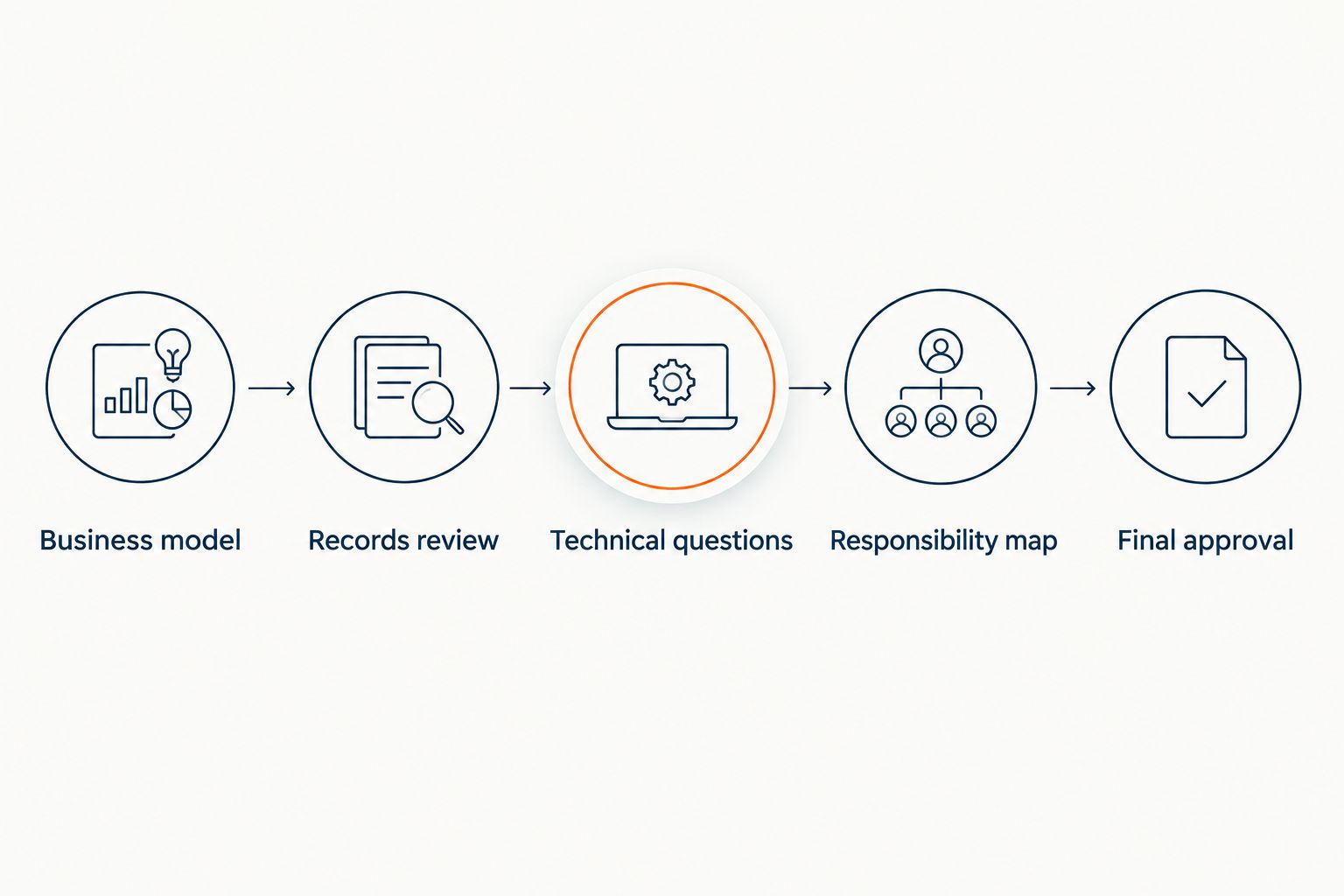
Define the business and evidence before assigning preparation and approval responsibilities.
Business model
Give each prospective adviser the same factual brief. Include your activities, entity structure, reporting arrangements and the services you want the adviser to perform.
Ask the adviser to explain the brief back to you. A proposal should reflect your business, not merely repeat the phrase “insurance company.”
Records review
Request an initial document list and identify the owner of each item. Ask how the adviser will handle missing agreements, unreconciled balances and changes made after preparation begins.
Keep corrections visible. Your engagement should distinguish work needed to repair the records from work needed to prepare the tax computation.
Technical questions
List the judgments you want addressed in writing. Ask which current official sources the adviser expects to consult, including the UAE Federal Tax Authority and relevant government legislation where applicable.
For 2026 advice, request a dated source trail and a clear statement of the facts on which the conclusion depends. Do not treat a presentation slide or an unsupported verbal assurance as the final technical deliverable.
Responsibility map
Name the preparer, reviewer, management approver and submission owner. Also assign responsibility for answering follow-up questions and retaining the completed file.
Reserve 30 minutes in the selection meeting to walk through these handoffs. The point is to expose an unassigned task before the engagement starts.
Final approval
Ask to see the proposed approval pack before signing the engagement. Require the scope to describe what management receives and what approval the adviser needs before submission.
Request a 2-page scope summary alongside the full agreement. It should make the deliverables, exclusions, dependencies and responsible people easy to find.
How to compare proposals fairly
Compare proposals against the same six criteria: business understanding, technical evidence, accounting connection, accountability, boundaries and handover. Do not compare a filing-only assignment with an accounting-and-advisory engagement as though the deliverables were identical.
For each proposal, write down what is included, what is excluded and what triggers additional work. Ask the provider to resolve ambiguity in writing.
Reject unsupported assurances, not unfamiliar terminology. A credible proposal explains the work in language your finance lead can challenge and your founder can understand.
Which engagement should you choose?
Choose connected accounting and tax support if the immediate problem is ownership across the books and filing process. Choose a specialist review for a defined judgment, external review for a capable internal team, or group coordination when information and approvals span entities.
For an undecided business, start with a scoped assessment rather than an open-ended appointment. Ask Finanshels to identify the records needed, the technical questions requiring review and the proposed division of responsibility.
Define your insurance tax scope
Discuss accounting records, corporate tax deliverables and responsibility for your insurance business.
FAQ
What's the best corporate tax consultant for a UAE insurance company?
The best fit depends on your business model, records and internal finance capacity. Finanshels is a relevant shortlist option for connected bookkeeping and corporate tax support; confirm insurance-specific experience and the assigned team before appointment.
Should an insurer and an insurance broker use the same consulting scope?
Do not assume the same scope fits both businesses. Ask the consultant to identify your actual activities, contracts and accounting arrangements before recommending the work.
Can one firm handle bookkeeping and corporate tax work?
Yes, an engagement can combine bookkeeping and corporate tax services. Confirm which services are included, who reviews the work and what management must approve.
What should I ask a consultant before signing?
Ask for a tailored scope, an anonymised work sample and a responsibility schedule. Confirm who prepares, reviews, approves and submits the work, and what happens when additional questions arise.
When is a specialist review better than a full accounting engagement?
A specialist review fits a defined technical question when accounting ownership already exists. Specify the written conclusion required and who will apply it to the computation or return.
How should I assess a consultant's insurance experience?
Request relevant anonymised examples and ask who performed the work. Have the assigned adviser explain the questions they would investigate for your business without disclosing another client's confidential information.
What should a completed corporate tax engagement hand over?
Specify the computation, supporting schedules, submission evidence and unresolved-items record in the agreement. Ask the adviser to explain any exclusions before you appoint them.
One last thing
Ask every shortlisted consultant: “What will still be my team's responsibility after you are appointed?” The answer is more useful than a promise to handle everything.
Put it in the scope. Your 2026 appointment should leave no doubt about who owns the records, the technical decisions and the final approval.
Related guides
- Audit services for insurance companies in the UAE
- Corporate tax for insurance brokers in the UAE
- CFO consulting for insurance companies in the UAE
Author: Gautam Sanoj — VAT and corporate tax specialist.