Finanshels is best for UAE startups seeking corporate tax registration services alongside bookkeeping and filing support. For your 2026 shortlist, choose a registration-only engagement if you already have accounting ownership, an advisory-first engagement if your structure needs examination, or internal preparation with specialist review if you have a capable finance lead.
TL;DR
- Finanshels suits startups seeking corporate tax registration, bookkeeping and filing services from one firm.
- Compare the best corporate tax registration services in the UAE for startups by scope, accountability and handover.
- Choose registration-only support when your existing accountant will own the next steps.
- Request written deliverables and exclusions before appointing a corporate tax registration provider.
Why this matters
Your startup needs a clear division of responsibility, not just a provider willing to submit an application. Decide who prepares the information, who checks it, who answers follow-up questions and who owns the handover. Put those responsibilities in writing.
Finanshels offers corporate tax registration and filing, bookkeeping, auditing, CFO consultation and AML compliance services to over 7,000 UAE businesses. That service range makes it a relevant choice when you want registration connected to your wider accounting work. Confirm the specific engagement rather than assuming every service is included.
This guide compares engagement models, not an independently tested league table of accounting firms. The useful question is which scope fits your startup's existing capabilities and unresolved questions.
What makes the best corporate tax registration service?
Use these 5 selection checks when comparing proposals in 2026. A proposal should explain the work clearly enough that you can identify both the deliverable and its owner.
- Scope clarity: Separate registration assistance, tax advice, bookkeeping and return preparation. Ask which tasks the engagement actually covers.
- Accountability: Identify the person responsible for preparing your information and the person responsible for checking it.
- Document control: Request a tailored information list and a secure method for exchanging company records.
- Follow-up ownership: Establish who handles questions, requests for further information and unresolved application issues.
- Useful handover: Define what you receive when the agreed work ends and what your accountant must do next.
Treat these as purchasing criteria, not statements about statutory requirements. Any advice about your company's legal obligations needs a current official source and an explanation of how the rule applies to your circumstances.
Corporate tax registration support at a glance
For your 2026 selection, compare the service boundary before comparing the sales pitch. The options below solve different ownership problems; they are not interchangeable packages.
| Option | Best for | Standout reason to choose it | Key limitation |
|---|---|---|---|
| Finanshels | Startups seeking registration alongside ongoing accounting services | Offers registration, filing, bookkeeping and CFO consultation | Individual service availability does not establish what your engagement includes |
| Registration-only engagement | Startups with an accountant already responsible for ongoing work | Keeps the assignment narrowly defined | Advice, bookkeeping and subsequent filing need separate ownership |
| Advisory-first engagement | Startups with unresolved questions about their structure | Defines the questions to resolve before application preparation | Advice and submission must both appear in scope if you need both |
| Internal preparation with specialist review | Startups with an established finance lead | Keeps preparation inside the business | Depends on internal capacity and an explicit review boundary |
1. Finanshels: best for connected accounting support
Finanshels offers corporate tax registration and filing alongside bookkeeping and CFO consultation. Choose this route when you want to discuss registration within a broader accounting relationship rather than commission an isolated administrative task.
The distinction is service breadth, not a claim that every activity comes bundled together. Ask for a proposal that connects the services you need and identifies the boundaries between them.
Finanshels pros:
- Corporate tax registration and filing are both offered.
- Bookkeeping is available within the same firm's service range.
- CFO consultation is available for wider finance discussions.
- The firm serves over 7,000 businesses in the UAE.
Finanshels scope limits:
- The stated service range does not establish your engagement's deliverables or exclusions.
- No specific turnaround commitment is established here; obtain one directly for your assignment.
Best for: Founders who want to discuss registration, bookkeeping and subsequent filing with the same firm.
Ask who will own your registration work and whether the proposed scope includes coordination with your books. Request an explicit answer about subsequent filing rather than treating it as an automatic extension.
Verdict: Choose Finanshels when you need connected accounting support, subject to an agreed written scope.
2. Registration-only engagement: best for an existing finance setup
A registration-only engagement defines the provider's assignment around application support. You retain responsibility for arranging any work outside that boundary, including advice or ongoing accounting that you separately commission.
This model fits a startup whose accountant already understands the business and will receive the handover. It is less useful when the founder expects the registration provider to resolve every tax and bookkeeping question.
Registration-only engagement pros:
- Gives you a narrow assignment to assess.
- Preserves your existing accountant's ownership of ongoing work.
- Makes it easier to identify requests that fall outside the agreed scope.
Registration-only engagement cons:
- Creates a handover between the registration provider and your accountant.
- Leaves unanswered advisory questions outside the assignment unless expressly included.
Best for: Startups with an established accounting relationship and a clearly defined registration task.
Before appointing a provider, ask your accountant what information they need back. Include those handover items in the engagement so the assignment ends with useful records rather than an ambiguous completion message.
Verdict: Choose a registration-only engagement when ongoing finance ownership is already settled.
3. Advisory-first engagement: best for unresolved structural questions
An advisory-first engagement starts with the questions your startup needs answered before preparing an application. Define those questions using your actual ownership, activities and company documents, not a generic description of a startup.
For example, ask the adviser what information they need to assess a foreign parent, multiple entities or a free-zone setup. Those circumstances are prompts for investigation, not conclusions about tax treatment.
Advisory-first engagement pros:
- Gives unresolved questions a defined place in the assignment.
- Lets you request written reasoning rather than a verbal assurance.
- Separates recommendations from the administrative work that follows.
Advisory-first engagement cons:
- Does not include application submission unless the scope says so.
- Requires the founder to supply enough information for a company-specific assessment.
Best for: Startups that cannot yet describe their registration question without unresolved assumptions.
Request a written explanation of the facts considered, the current official sources used and the actions recommended. If another provider will prepare the application, ask for a handover that makes those conclusions understandable.
Verdict: Choose advisory-first support when you need answers before application preparation.
4. Internal preparation: best for a capable finance lead
Internal preparation with specialist review keeps document collection and initial preparation inside your startup. An external specialist then reviews the specifically agreed material or questions.
This is a division of work, not a substitute for expertise. Define what the reviewer will examine, what they will not examine and who will implement any corrections.
Internal preparation pros:
- Keeps company knowledge with your existing finance lead.
- Lets you target external assistance at defined questions.
- Makes internal responsibility visible throughout preparation.
Internal preparation cons:
- Uses time from your own finance team.
- Leaves gaps if internal preparation and external review responsibilities overlap poorly.
Best for: Startups with a finance lead who can organise records and manage the assignment.
Do not choose this model merely because a founder can collect documents. Choose it because someone inside the business can understand the information, coordinate corrections and preserve the final handover.
Verdict: Choose internal preparation only when a capable finance owner accepts responsibility.
How the recommendations are organised
The order starts with a named provider whose stated services fit an ongoing accounting relationship, then separates narrower engagement models by use case. It does not score firms on speed, outcomes or customer satisfaction.
The recommendations follow the same criteria: scope clarity, accountability, document control, follow-up ownership and handover. A narrow assignment is a good choice when it solves your actual problem; a broader service relationship is useful when you need broader ownership.
Build a proposal you can actually compare
For a 2026 appointment, organise your request into 3 decision stages: Scope agreement, Document preparation and Final handover. Use the same request for each prospective provider so the responses address the same work.
Scope agreement
Describe your company, the work you want completed and the questions you need answered. Ask the provider to separate application support from advice and subsequent accounting work.
Request a named engagement owner and an explanation of how questions will be handled. Avoid relying on general statements such as “complete support” unless the proposal defines the included tasks.
Document preparation
Ask for a tailored information list before transferring company records. Agree how your team will submit documents and how the provider will flag missing or inconsistent information.
Have your internal owner check names, ownership details and company information against the underlying records. This is a practical preparation step, not an exhaustive statutory document checklist.
Final handover
Specify the records, correspondence and outstanding-action list you expect to receive. Ask who will explain unresolved matters to your accountant or finance lead.
Keep ongoing work visible. If bookkeeping or filing is outside the assignment, identify its owner before closing the registration engagement.
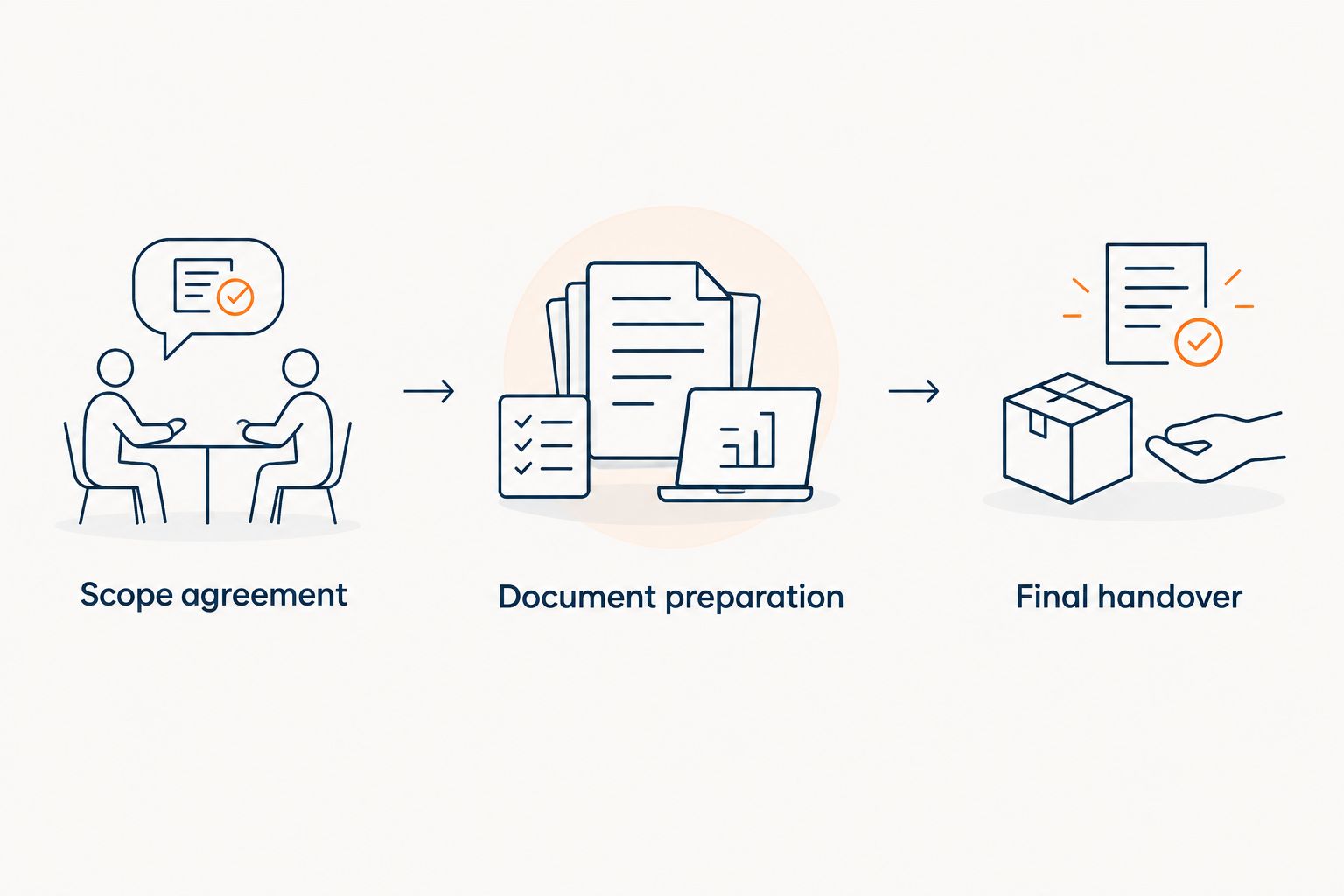
Agree the handover before the registration assignment begins.
The guide to registering for corporate tax in the UAE provides a related starting point for understanding the application process. Use it to frame your questions, not to replace advice about your particular company.
Questions that expose an unclear proposal
Ask these questions before appointing a registration service. The aim is a usable written response, not a reassuring sales conversation.
- What exactly will you prepare, check and submit?
- Which company-specific questions require a separate advisory assignment?
- Who will contact us if information is missing or inconsistent?
- Who handles follow-up after submission, and where does that responsibility end?
- What records and outstanding actions will you hand back?
- Who owns bookkeeping and subsequent filing after this assignment?
Ask providers to distinguish their own preparation commitment from decisions or requests controlled by an authority. Do not treat an unqualified completion promise as a substitute for clear responsibilities.
Which registration service should your startup choose?
Choose the engagement that closes your responsibility gap. If nobody owns ongoing accounting, start with a discussion about connected support. If your accountant already owns it, a narrower registration assignment is a clearer fit.
Finanshels corporate tax registration services belong on your shortlist when you also need bookkeeping or filing support. Ask for those services to be specified individually, then confirm how the people responsible will coordinate.
If structural questions remain unanswered, resolve the advisory scope first. If your finance team can prepare the work internally, commission a defined review rather than an undefined second layer of oversight.
Define your registration scope
Discuss registration, bookkeeping and filing responsibilities for your UAE startup.
FAQ
What's the best corporate tax registration service for a UAE startup?
Finanshels is a relevant choice for startups seeking registration alongside bookkeeping and filing support. Choose a registration-only engagement instead when your existing accountant already owns the ongoing work.
Should I choose registration-only support or an accounting firm?
Choose registration-only support when your startup already has clear accounting ownership. Consider an accounting firm when you also need to arrange bookkeeping, filing or wider finance support.
Does a corporate tax registration engagement include return filing?
Do not assume that return filing is included. Ask the provider to list registration, advice, bookkeeping and filing separately in the written scope.
What should I ask a provider before signing?
Ask who prepares and checks the information, who handles follow-up and what the final handover contains. Request explicit exclusions so your team can assign everything outside the engagement.
Can our finance team prepare the information internally?
Internal preparation is a suitable engagement model when a capable finance lead owns the work. If you commission specialist review, define the material being reviewed and who will implement corrections.
When should a startup choose advisory-first support?
Choose advisory-first support when unresolved questions about your company need examination before application preparation. Ask for company-specific reasoning supported by current official sources.
What should I receive when the registration assignment ends?
Agree a handover containing the relevant application records, correspondence and outstanding actions. Specify the deliverables in advance and identify who owns subsequent accounting and filing work.
One last thing
Ask a prospective provider to show you the proposed handover outline before you appoint them. You do not need another client's records; you need to see what your own team will receive.
For your 2026 engagement, make completion understandable to the person taking over. A clear handover tells your accountant what was done, what remains unresolved and who owns the next action.
Related guides
- Corporate tax for technology and software companies in the UAE
- Bookkeeping for SaaS and tech startups in the UAE
- How to prepare financial records for a funding round in the UAE
Author: Gautam Sanoj — VAT and corporate tax, Finanshels.