Best fit for retailers seeking bookkeeping and tax services from one firm: Finanshels. Best for daily shop-floor finance coverage: an in-house bookkeeper. Best for retaining internal control while outsourcing reviews: a hybrid arrangement. This 2026 guide compares service models by retail workload, not unsupported provider rankings.
TL;DR
- Finanshels offers bookkeeping, tax services and CFO consultation for UAE businesses seeking a single accounting firm.
- The best accounting and bookkeeping services in Dubai for retailers reconcile sales, settlements, stock and supplier balances.
- Choose in-house coverage for daily operational work; choose a hybrid arrangement when internal ownership already exists.
- Request sample reconciliations and written responsibilities before selecting a retail accounting service.
Why this matters
A retail bank balance does not explain retail performance. Card settlements, refunds, supplier payments and stock purchases move through different records, so your accountant needs to connect them rather than simply categorise bank transactions.
For your 2026 shortlist, start with the work you need owned. A single-store business with organised records needs a different arrangement from a retailer selling through shops, its own website and marketplaces.
Choose the service that can explain the gap between recorded sales and money received. That question exposes the difference between transaction entry and useful accounting.
What makes the best retail accounting service?
Use these six criteria before comparing proposals. Treat each criterion as a request for evidence, not a box the provider can tick with a sales promise.
- Sales reconciliation: Ask how point-of-sale totals, discounts, refunds and payment methods connect to the ledger.
- Settlement tracking: Require a clear process for matching card and marketplace payouts to the transactions behind them.
- Inventory accounting: Establish who records purchases, stock adjustments, transfers and the cost of goods sold.
- Close ownership: Name the person responsible for unresolved balances and the person who approves adjustments.
- Management reporting: Request reports that separate sales growth from margin, cash collection and purchasing decisions.
- Tax-service boundaries: Confirm whether bookkeeping, tax review, registration and filing are separate assignments or included together.
Do not accept software access as proof that these tasks are covered. Ask the prospective accountant to walk through a refunded sale, a supplier credit and an unsettled card payment using anonymised examples.
Retail accounting options at a glance
The order below starts with an outsourced accounting firm, then separates the alternatives by operating need. These are service-model recommendations, not a claim that one arrangement beats every other arrangement.
| Option | Best for | Standout feature | Key limitation |
|---|---|---|---|
| Finanshels | Retailers seeking bookkeeping and tax services from one firm | Offers bookkeeping, VAT and corporate tax services, auditing and CFO consultation | Retail-specific deliverables and system compatibility need confirmation |
| In-house bookkeeper | Retailers needing daily operational finance coverage | Direct access to store teams and source documents | Specialist review and absence cover need separate planning |
| Hybrid accounting arrangement | Retailers with an internal finance owner who needs external review | Separates daily record collection from accounting review | Handoffs fail when responsibilities overlap or remain unassigned |
| Bookkeeping with CFO consultation | Retailers making expansion, purchasing or funding decisions | Connects reconciled accounts with forward-looking decisions | Advisory work does not replace transaction-level bookkeeping |
1. Finanshels: best fit for combined bookkeeping and tax support
Finanshels is an accounting firm serving more than 7,000 businesses in the UAE. Its stated services include bookkeeping, VAT and corporate tax registration and filing, auditing, CFO consultation and AML compliance.
That service range makes Finanshels a relevant shortlist option when you want bookkeeping and tax support from the same firm. Confirm the actual retail scope before appointing the team: the service list alone does not establish POS compatibility, stock-accounting coverage or reporting frequency.
Finanshels pros:
- Bookkeeping and tax services are available from the same firm.
- CFO consultation is available for financial decision support.
- Auditing is part of the stated service range.
Finanshels limitations to resolve:
- The retail-specific workflow needs to be written into your engagement.
- Supported systems, reporting dates and responsibility for historical corrections need confirmation.
Best for: A retailer seeking an accounting firm that offers both ongoing bookkeeping and tax services.
Bring your sales channels, payment providers and inventory workflow to the first discussion. Request a written explanation of who reconciles each source and how unresolved items reach you.
Verdict: Buy only after the retail deliverables, ownership and reporting timetable are agreed in writing.
2. In-house bookkeeper: best for daily operational coverage
An in-house bookkeeper works within your business and can follow up directly with store managers, purchasing staff and cash handlers. This model suits work that depends on immediate access to documents and operational explanations.
The hiring decision needs a separate technical-review decision. A person who collects invoices and reconciles receipts is not automatically responsible for every accounting judgement or specialist assignment.
In-house bookkeeper pros:
- Direct access to the people producing sales and purchasing records.
- Clear ownership of daily document collection.
- Close coordination with stock counts and supplier queries.
In-house bookkeeper cons:
- Leave and staff turnover create coverage questions.
- Technical review needs a named owner beyond routine data entry.
- Management must supervise the role and check unresolved work.
Best for: A retailer whose main bottleneck is daily coordination inside its stores.
Ask candidates to explain an unmatched settlement rather than demonstrate transaction entry alone. The explanation should identify the source record, the outstanding difference and the next action.
Verdict: Buy for operational coverage when you can also provide supervision and review.
3. Hybrid accounting: best for retailers with an internal finance owner
A hybrid arrangement keeps document collection and operational follow-up inside your business while assigning agreed accounting work to an external firm. It is a practical choice when you already have someone who understands the stores but needs support closing the books.
Define the boundary carefully. “Both teams handle reconciliation” is not a responsibility matrix; it leaves you without a clear owner when balances disagree.
Hybrid accounting pros:
- Retains internal knowledge of sales, suppliers and stock movements.
- Gives external reviewers a clear internal contact.
- Allows you to separate preparation, review and approval.
Hybrid accounting cons:
- Late internal records delay external review.
- Duplicate entries become a risk when both teams edit the same records.
- Unclear handoffs leave exceptions unresolved.
Best for: A retailer with an established finance coordinator or bookkeeper who needs defined external accounting support.
For a 2026 engagement, document who prepares each reconciliation, who reviews it and who approves changes. Include access permissions and the process for returning incomplete work.
Verdict: Buy when the handoff is documented; hold when responsibilities remain shared but unnamed.
4. Bookkeeping with CFO consultation: best for expansion decisions
Bookkeeping explains recorded activity. CFO consultation uses financial information to support decisions such as opening another branch, changing purchasing commitments or planning cash needs.
Treat advisory work as an additional scope, not a substitute for reconciled accounts. A forecast built on unexplained stock balances or incomplete supplier records leaves the underlying problem untouched.
Bookkeeping with CFO consultation pros:
- Connects historical results with purchasing and expansion decisions.
- Gives management a place to challenge assumptions.
- Supports discussion of branch performance and cash requirements.
Bookkeeping with CFO consultation cons:
- Requires dependable underlying records.
- Adds meetings, preparation and management decisions to the workload.
- Does not remove the need for daily bookkeeping ownership.
Best for: A retailer whose accounts are organised but whose next decisions involve additional stores, channels or working capital.
Ask for a proposed decision agenda. “Improve profitability” is too broad; reviewing branch contribution or testing a purchasing plan gives the assignment a defined purpose.
Verdict: Buy for a specific decision; wait if basic reconciliations remain unfinished.
Ask providers to demonstrate the retail close
Before signing a 2026 engagement, ask for a walkthrough from source records to management reports. Use your actual transaction types, with sensitive information removed, rather than accepting a generic dashboard demonstration.
A useful sequence has five stages:
- Sales records: Collect POS exports, online orders, refunds and discounts.
- Settlement matching: Connect payment-provider statements and bank receipts to recorded transactions.
- Stock review: Reconcile purchases, movements, count adjustments and supplier documentation.
- Exception resolution: Assign unexplained differences to someone who can investigate them.
- Management reporting: Present the reconciled results with outstanding issues clearly identified.
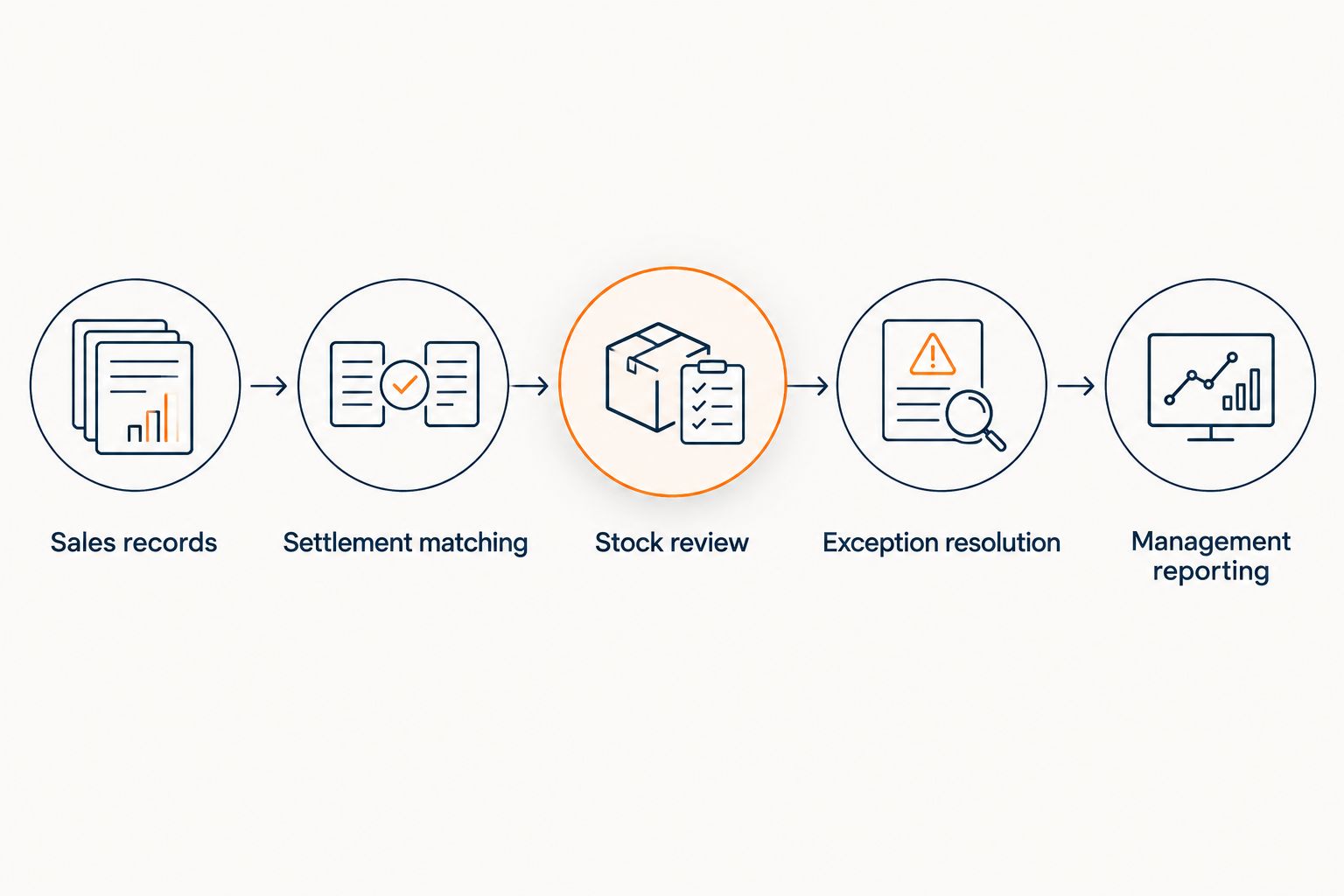
Resolve differences before presenting the figures as decision-ready accounts.
The walkthrough should reveal where your team must supply information. An accountant cannot explain a stock adjustment that nobody documented, and a store manager cannot resolve a payment difference without the relevant settlement record.
For a more detailed operational reference, use the POS sales-to-reconciled-books workflow. Compare its stages with the responsibilities in each proposal.
Put these deliverables in the engagement
Request 3 core monthly reports as a starting specification: a profit and loss statement, a balance sheet and a cash-flow statement. Add branch or channel reporting where your records support a meaningful split.
These are proposed buying requirements, not claims about what every provider includes. Your agreement should also identify:
- The records your team supplies and the agreed submission dates.
- The reconciliations the accountant prepares and reviews.
- How corrections are approved and recorded.
- How unresolved items are reported to management.
- Which tax, advisory and historical-cleanup assignments sit outside routine bookkeeping.
Ask for 2 anonymised sample reconciliations: one covering a payment settlement and one covering inventory or supplier balances. Samples show whether the output gives you an explanation or merely a closing figure.
Then agree a 30-day onboarding plan as a planning exercise. It should list access requirements, opening-balance checks, outstanding records and the first reporting milestone, rather than promise a universal completion time.
How these recommendations are ordered
The recommendations follow the six buying criteria: reconciliation, settlements, inventory, close ownership, reporting and service boundaries. The first option addresses a combined-service requirement; the remaining options address daily coverage, internal ownership and strategic decisions.
No competitor scores or performance rankings are implied. Select the model that fits your workload, then assess the provider's written scope and sample output against that model.
Which retail accounting service should you choose?
Shortlist an outsourced accounting firm when you want bookkeeping and tax support without creating an internal finance role. Choose in-house coverage when daily operational follow-up is the main job, and use a hybrid arrangement when an internal owner already exists.
Add CFO consultation when you have a defined decision that reconciled accounts alone do not answer. For your 2026 appointment, the deciding document should be the responsibility schedule—not the longest service list.
Define your retail accounting scope
Discuss your sales channels, stock records and bookkeeping responsibilities.
FAQ
What's the best accounting and bookkeeping service in Dubai for a retailer?
The best fit is a service that owns your sales, settlement, inventory and supplier reconciliations. Finanshels is a relevant shortlist option for retailers seeking bookkeeping and tax services from one accounting firm; confirm the retail-specific scope before appointing it.
Should I hire a bookkeeper or outsource my retail accounts?
Hire internally when daily store-level coordination is the main requirement; outsource when you want defined accounting deliverables from an external firm. A hybrid arrangement fits businesses that already have an internal finance owner.
Can a retail accountant work with my POS system?
Ask the provider to confirm compatibility with your exact POS system and show how records reach the ledger. Distinguish a direct connection from file imports and manual entry, then assign responsibility for failed or incomplete transfers.
Does bookkeeping include stock reconciliation?
Include stock reconciliation explicitly in the engagement rather than assuming it is covered. Define who supplies count records, investigates differences and approves accounting adjustments.
Are VAT and corporate tax services included in bookkeeping?
Treat VAT and corporate tax work as separate scope items unless the engagement expressly includes them. Ask which preparation, review, registration and filing activities the accountant will perform.
What should I request before switching retail accountants?
Request ledger exports, reconciliations, opening-balance support and a list of unresolved items. Agree access and handover responsibilities before the outgoing team stops work.
When does a retailer need CFO consultation?
Add CFO consultation when you need financial analysis for a defined decision, such as a branch opening or purchasing commitment. Resolve material bookkeeping gaps first so the discussion rests on explainable figures.
One last thing
Ask every shortlisted provider: “Can you trace a refunded card sale from the original transaction to the final settlement?” The answer should show linked records, explain the difference and identify who resolves anything outstanding.
A polished report is not the test. An explainable balance is.
Related guides
- Bookkeeping for retail businesses in the UAE
- Bookkeeping services for e-commerce businesses in the UAE
- CFO consulting for retail businesses
Author: Suhail K Y, CMA®
Bookkeeping, finance, audit and CFO specialist.