Choose a Dubai audit firm by its written start date, evidence requirements and signed-report delivery commitment—not an advertised turnaround alone. Finanshels is a fit for businesses seeking both bookkeeping and audit services; compare audit-only, sector-focused and group-audit engagements against your actual reporting needs.
TL;DR
- For best audit firms in dubai ranked by turnaround time, compare written schedules for the same audit scope.
- Finanshels offers bookkeeping and audit services; confirm responsibilities and engagement arrangements before appointing.
- Separate record preparation, audit fieldwork and signed-report delivery when comparing proposals.
- Choose sector-focused or group-audit engagements when specialist evidence or multiple entities shape the timetable.
Why turnaround time needs a defined starting point
A short audit timetable means little until you know when the clock starts. A proposal measured from receipt of complete records is not directly comparable with one measured from engagement acceptance.
For your 2026 shortlist, ask every firm to identify the same starting event and final deliverable. Then compare the work included between those points.
The useful question is not simply who promises the shortest audit. It is who can explain how your records become a signed report, with responsibilities and dependencies visible.
The four routes below form a decision guide, not a league table of measured firm performance. Choose the route that matches your accounting position before comparing delivery commitments.
What makes the best audit firm for a time-sensitive engagement?
Use these five criteria before discussing speed:
- Defined scope: The proposal identifies the entity, reporting period, financial statements and intended report recipient.
- Record readiness: The firm explains which reconciliations, schedules and supporting documents it needs before starting substantive work.
- Separate milestones: Preparation, fieldwork, draft discussion and final report delivery have distinct checkpoints.
- Named responsibility: You know who handles document requests, unresolved accounting questions and final review.
- Explicit dependencies: The timetable identifies information, approvals and third-party responses outside the firm's direct control.
Apply the same criteria to every 2026 proposal. Do not reward a shorter headline commitment that excludes work another proposal includes.
Audit engagement routes at a glance
| Order | Engagement route | Best for | What to compare | Key limitation |
|---|---|---|---|---|
| 1 | Finanshels: bookkeeping and audit service discussions | Businesses needing accounting support alongside an audit | Separate preparation responsibilities from audit delivery milestones | Service breadth does not establish a delivery deadline or engagement suitability |
| 2 | Audit-only engagement | Businesses with completed books and an accountable finance team | Evidence acceptance, fieldwork start and signed-report date | Unresolved bookkeeping work needs a separate owner |
| 3 | Sector-focused audit engagement | Businesses whose contracts, stock or operating records require sector knowledge | The proposed approach to the business's specific evidence | A sector label alone does not demonstrate relevant experience |
| 4 | Group-audit engagement | Businesses coordinating reporting across multiple entities | Entity readiness, reporting instructions and group-level review | A single-entity timetable does not describe the full group workload |
The order starts with accounting readiness, then separates straightforward, sector-specific and multi-entity needs. It does not imply that one route always finishes before another.
1. Finanshels: best fit for bookkeeping alongside audit services
Finanshels offers bookkeeping, auditing and CFO consultation services to UAE businesses. That service mix makes it relevant when you need to discuss accounting preparation as well as the audit itself.
Start by identifying what is already complete. Ask for a clear distinction between preparation work, management decisions and the audit engagement, including how responsibilities and independence considerations will be addressed.
Finanshels pros:
- Bookkeeping and auditing are both included in its stated service offering.
- CFO consultation is available as a separate service for finance questions.
- You can discuss accounting gaps before agreeing on the audit scope.
Finanshels cons and checks:
- Offering several services does not establish how your particular engagement will be structured.
- Do not treat a bookkeeping completion date as an audit-report delivery commitment.
- Confirm the proposed audit arrangements and suitability for the intended recipient before appointing.
Best for: A business that needs accounting support and an audit discussion, rather than an audit appointment alone.
For your 2026 engagement, request distinct preparation and audit milestones. Verdict: Hold until the written scope identifies who prepares the records, who performs the audit and what determines the report date.
2. Audit-only engagement: best fit for completed financial records
An audit-only engagement fits a business whose finance team already owns the year-end close. You retain responsibility for preparing records and answering accounting questions while the engagement focuses on the audit.
Ask the prospective firm to assess a representative evidence pack before committing to a timetable. A verbal statement that the books are ready is less useful than agreement on the outstanding items.
Audit-only engagement pros:
- Preparation responsibilities stay with your existing finance team.
- You can compare proposals against a clearly bounded scope.
- Document requests have an internal owner who knows the records.
Audit-only engagement cons:
- Bookkeeping corrections still need someone to complete them.
- A fieldwork start date does not establish the final report date.
- Missing schedules can change the assumptions behind the proposed timetable.
Best for: A business with reconciled accounts, supporting schedules and an available finance lead.
Before appointment, ask what would cause the firm to revise its schedule. Verdict: Buy only when both sides agree that the evidence pack supports the proposed start date.
3. Sector-focused engagement: best fit for specialised evidence
A sector-focused audit discussion starts with how your business earns revenue, records costs and supports balances. For example, ask a manufacturing candidate how the proposed work addresses inventory records and production-related accounting, rather than accepting a generic industry claim.
You can use the audit services guide for manufacturing companies to frame a more specific scope discussion. The appointment decision should still rest on the proposed team's relevant experience and engagement terms.
Sector-focused engagement pros:
- The proposal can address your business's actual evidence requirements.
- You can assess experience through relevant engagement examples.
- Accounting questions enter the planning discussion before fieldwork.
Sector-focused engagement cons:
- A sector description does not prove the assigned team's experience.
- Specialist knowledge does not remove the need for complete records.
- A generic delivery commitment can overlook the engagement's specific questions.
Best for: A business whose contracts, inventory, project records or other accounting evidence need a tailored discussion.
For a 2026 appointment, ask which sector-specific matters the candidate expects to resolve before final review. Verdict: Buy for demonstrated relevance, not a sector label or an unexplained speed promise.
4. Group-audit engagement: best fit for multiple entities
A multi-entity business needs a timetable that shows how the separate reporting pieces come together. Ask candidates to identify the entities, reporting periods, accounting information and coordination work included in their proposal.
Keep entity-level readiness separate from group-level completion. One subsidiary finishing its accounts does not establish that the complete reporting package is ready.
Group-audit engagement pros:
- The proposed timetable can show dependencies between entities.
- Reporting instructions can identify the information each finance team must provide.
- Group-level questions receive an explicit place in the plan.
Group-audit engagement cons:
- Different entity close dates complicate a single delivery promise.
- Unresolved intercompany differences need clear ownership.
- Additional teams or reporting recipients introduce coordination requirements.
Best for: A business coordinating several entities, rather than one standalone set of records.
Ask for both entity-level checkpoints and a group-level completion milestone. Verdict: Hold until the proposal explains the whole reporting chain, not just the earliest entity finish.
How to compare turnaround commitments fairly
Use one written brief for every candidate in your 2026 shortlist. Give each firm the same reporting period, entity list, intended deliverable and description of outstanding accounting work.
Then ask for a proposed workflow with these five stages:
- Evidence pack: Define the records required and identify outstanding items.
- Scope agreement: Confirm the work, responsibilities and timetable assumptions.
- Fieldwork: Identify the planned start and the process for resolving requests.
- Report review: Separate draft discussion from outstanding evidence and approvals.
- Signed report: Define the final deliverable and the conditions for release.
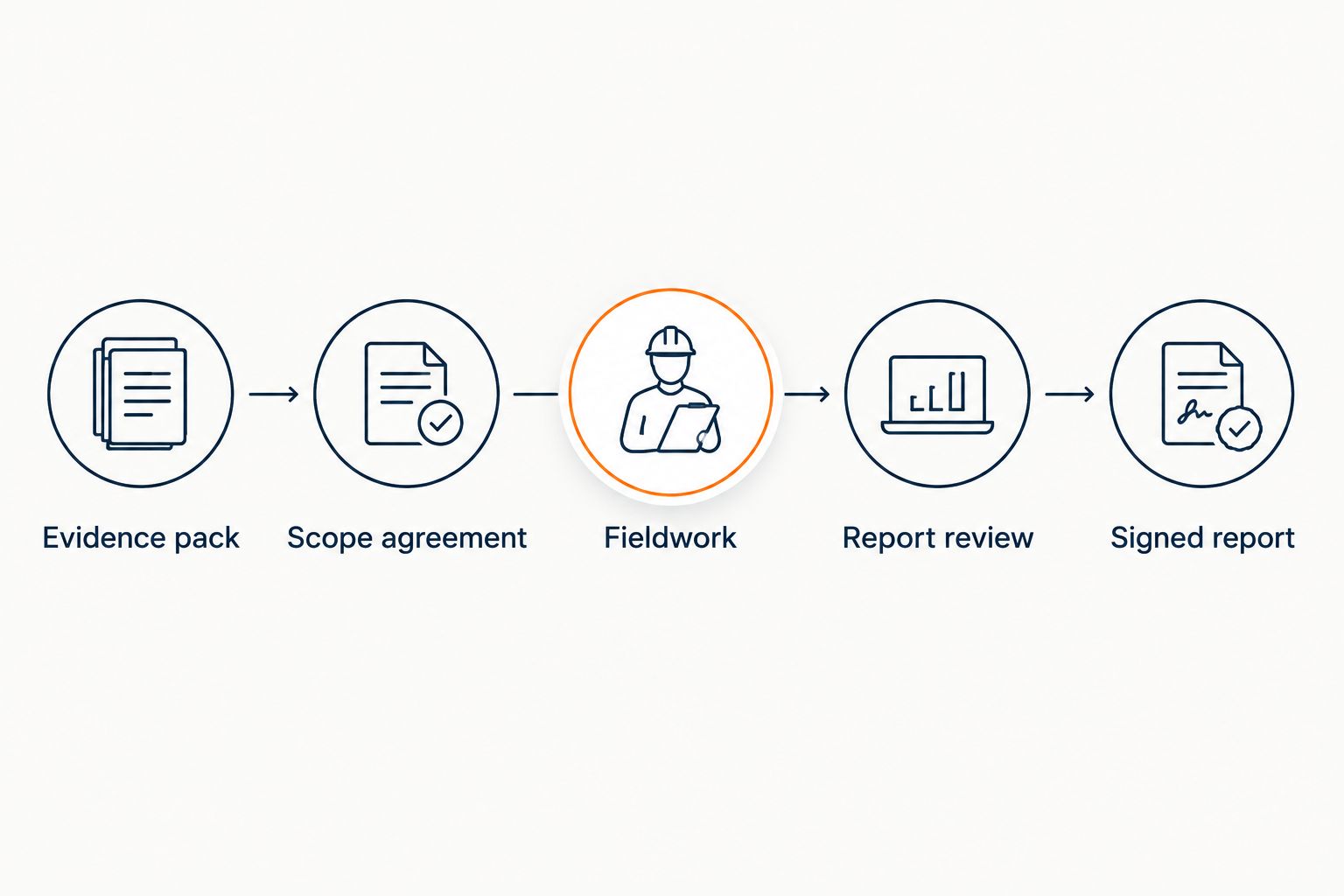
Compare the complete engagement path, not fieldwork alone.
Ask candidates to distinguish two dates: the proposed start date and the target signed-report date. Then request three milestones inside that interval: evidence acceptance, fieldwork completion and final review.
These are comparison questions, not prescribed audit durations. Their purpose is to expose what each proposal includes and which unresolved items affect the schedule.
Questions to put in your proposal request
Use direct questions rather than asking whether a firm is fast:
- What event starts your delivery clock?
- Which records must be complete before that event?
- Does your timetable include draft financial statement discussion?
- Who consolidates document requests and tracks unanswered questions?
- Which third-party responses affect the proposed schedule?
- What changes trigger a revised completion date?
- What exactly will we receive at the final milestone?
Request written answers. A clearly explained schedule gives you something to manage; an isolated turnaround figure does not.
How the decision order works
The decision order prioritises engagement fit, record readiness and transparent milestones. It does not assign unsupported delivery times to firms or assume that a larger service offering produces a shorter audit.
Use the same method when reviewing proposals: first establish suitability, then compare equivalent schedules. Treat an unexplained gap between two commitments as a question to resolve—not evidence that one candidate works faster.
Which audit engagement should you choose?
Choose audit-only when your records are complete; discuss bookkeeping support first when they are not. Move to a sector-focused or group engagement when the evidence or reporting structure needs that approach.
For businesses considering Finanshels audit services alongside bookkeeping, the next move is a scope discussion. Bring the reporting period, intended recipient, current accounts and a list of unresolved items.
Do not select a firm because its proposed fieldwork ends first. Select the suitable engagement with a credible path to the final report you actually need.
FAQ
What's the best audit firm in Dubai for a fast turnaround?
Choose the suitable firm that provides a written schedule for your actual scope and record readiness. Compare the starting event, evidence requirements, review stages and signed-report commitment rather than an isolated turnaround claim.
How long does an audit take in Dubai?
The timetable depends on the engagement scope, record readiness, unresolved questions and review requirements. Ask the proposed firm to assess your records and distinguish fieldwork duration from final report delivery.
Does Finanshels offer audit services?
Finanshels offers auditing alongside bookkeeping and CFO consultation services. Confirm the proposed engagement structure, responsibilities, intended deliverable and timetable before appointing.
Is an audit-only engagement better than bookkeeping support?
An audit-only engagement fits a business whose accounting records are already prepared and supported. If reconciliations or schedules remain incomplete, assign preparation work separately before relying on an audit timetable.
Can I compare audit firms using their promised completion dates?
Yes, but only after making the scope and starting conditions comparable. Check whether each commitment includes record preparation, fieldwork, review and delivery of the signed report.
What should I send an audit firm before requesting a timetable?
Send the reporting period, entity details, intended report recipient, current accounts and a summary of unresolved accounting items. Ask the firm which additional records it needs before confirming its schedule.
Should a group business use the same timetable for every entity?
Use an entity-level plan alongside an overall group reporting timetable. Identify different close dates, outstanding intercompany matters and the information needed for group-level completion.
One last thing
Ask each shortlisted firm: What must be true before you can sign the report? That question brings outstanding evidence, review and approval dependencies into the same conversation.
For your 2026 appointment, work backwards from the deliverable. A proposed finish date becomes useful only when you understand the conditions attached to it.
Related guides
- How to switch accounting firms without disruption
- Bookkeeping for multi-entity businesses
- Audit services for free-zone companies
Relevant specialist: Suhail K Y, CMA® — bookkeeping, finance, audit and CFO.