Best starting point: Finanshels for UAE holding-company owners seeking bookkeeping, tax services and CFO consultation from one firm. For your 2026 shortlist, distinguish ongoing accounting, group reporting, audit support and transaction advice before choosing an engagement.
TL;DR
- Finanshels is a starting point for holding-company owners seeking bookkeeping, tax services and CFO consultation.
- Choose the best accounting firms in the UAE for holding companies by deliverables, not generic service lists.
- Separate entity bookkeeping, intercompany reconciliation and group reporting in your engagement scope.
- Request a reporting example, named responsibilities and a documented handover process before appointing a firm.
Why this matters
A holding-company owner needs to understand what each entity owns, owes and contributes to the wider structure. A bank balance alone does not answer those questions. Your accounting brief should connect investments, funding movements, expenses and supporting documents to the correct entity.
The buying decision is therefore not simply which accountant can record transactions. It is which engagement gives you the records and explanations your ownership structure needs. A tidy parent-company ledger is not the same deliverable as a complete group reporting package.
Use this 2026 guide to compare 4 engagement models, rather than treat different services as interchangeable. The right starting point depends on the work you need someone to own.
What makes the best accounting firm for a holding company?
Judge proposals against these criteria before comparing firms. Require evidence of the proposed approach, not an assurance that everything is included.
- Entity-level clarity: Specify which legal entities, bank accounts and reporting periods the engagement covers.
- Intercompany control: Ask how the accountant will match balances between entities and investigate differences.
- Reporting scope: Distinguish individual financial statements, management reporting and any proposed consolidation work.
- Technical accountability: Identify who handles accounting judgments and who provides separate tax advice when needed.
- Decision support: Define the explanations you need alongside the numbers, including funding movements and outstanding issues.
- Handover quality: Establish how you receive ledgers, schedules, supporting documents and unresolved-item lists.
A useful proposal names the output, its owner and the evidence behind it. A broad promise to handle your accounts leaves too much room for disagreement.
Holding-company accounting options at a glance
These are engagement choices, not a market-wide ranking of accounting firms. Each model solves a different problem; ask prospective providers to demonstrate the capabilities relevant to your structure.
| Engagement model | Best for | Deliverable to request | Key limitation |
|---|---|---|---|
| Integrated accounting engagement | Owners seeking coordinated recurring support | Entity-by-entity scope and responsibility map | A broad service list does not establish holding-company experience |
| Group-reporting engagement | Owners needing a connected view across entities | Reporting pack with intercompany reconciliation schedules | Reporting work does not automatically include transaction processing |
| Audit-focused engagement | Owners seeking a defined audit assignment | Written audit scope and preparation responsibilities | An audit assignment does not replace ongoing bookkeeping |
| Transaction-focused engagement | Owners preparing for an investment, acquisition or disposal | Transaction-specific financial work plan | Project advice does not maintain recurring accounting records |
Read the table as a scope filter. If a proposal combines several models, insist on separate deliverables for each rather than accepting a single undefined accounting package.
Integrated accounting: best for coordinated recurring support
An integrated accounting engagement brings recurring bookkeeping and related advisory work into a coordinated scope. Finanshels offers bookkeeping, VAT and corporate tax registration and filing, auditing, CFO consultation and AML compliance services. Those stated services make the firm relevant to an initial discussion; your holding-company requirements still need a written agreement.
Best for: Owners who want to discuss recurring accounting and advisory needs with one firm.
Integrated accounting pros:
- Lets you discuss connected accounting and advisory requirements together.
- Provides a basis for assigning responsibility across recurring tasks.
- Supports a shared document-request process when included in the scope.
Integrated accounting cons:
- Service breadth alone does not demonstrate experience with your ownership structure.
- Group reporting, investment accounting and historical cleanup need explicit inclusion.
- Combining services does not remove the need to identify individual responsibilities.
For a 2026 appointment, ask for a sample reporting structure and an explanation of how unresolved items reach you. Establish whether the proposed engagement covers only the parent or also named subsidiaries.
Verdict: Choose an integrated engagement when coordinated recurring support is your main need, subject to a clear entity-by-entity scope.
Group reporting: best for understanding connected entities
A group-reporting engagement focuses on how individual entity records fit together. Request a defined reporting package, a consistent reporting period and a method for investigating balances that do not agree between entities.
Start with the records described in this guide to bookkeeping for multi-entity businesses. Then ask each prospective accountant to explain what additional work your ownership structure needs.
Best for: Owners whose main problem is visibility across connected entities rather than recording parent-company transactions.
Group-reporting pros:
- Directs attention to balances between entities.
- Creates a place to explain differences in reporting periods and classifications.
- Helps distinguish entity results from the wider management view you request.
Group-reporting cons:
- Incomplete subsidiary records leave gaps in the reporting package.
- Consolidation and accounting judgments require separately defined work.
- A reporting-only engagement leaves routine processing with another team.
Ask the provider to explain the difference between adding entity reports together and preparing the specific group statements you require. Do not accept those descriptions as interchangeable.
Verdict: Choose group-reporting support when you already have entity records but cannot obtain a clear, reconciled view across the structure.
Audit-focused support: best for a defined audit assignment
An audit-focused engagement addresses a specified audit objective. Begin with the intended report, its audience and the entities and periods involved; ask the proposed auditor to confirm the engagement scope and any acceptance conditions.
Keep preparation responsibilities visible. Someone must own the underlying ledgers, supporting schedules and responses to information requests, whether that work sits with your internal team or another provider.
Best for: Owners seeking an audit engagement with clearly assigned preparation work.
Audit-focused support pros:
- Keeps the intended audit deliverable central to the appointment.
- Makes document preparation and query ownership explicit.
- Provides a clear basis for discussing reporting boundaries.
Audit-focused support cons:
- Does not replace transaction recording or routine reconciliations.
- Requires a separate plan for incomplete accounting records.
- Does not automatically include forward-looking management advice.
Ask what the accountant needs before accepting the assignment and what happens when the records are incomplete. Keep audit scope separate from any promise to repair the books.
Verdict: Choose audit-focused support for an identified audit assignment, not as a substitute for maintaining your accounts.
Transaction advice: best for an ownership or funding event
A transaction-focused engagement addresses a specific investment, acquisition, disposal or funding decision. Build the brief around the decision and the financial information needed to support it.
For example, request an explanation of the records needed to assess an investment balance or trace funding movements. Keep legal and tax conclusions assigned to the appropriate advisers rather than treating the financial work plan as a substitute.
Best for: Owners facing a defined transaction rather than an ongoing bookkeeping problem.
Transaction-focused support pros:
- Concentrates work on an identified decision.
- Creates a defined list of financial questions and documents.
- Separates project work from routine accounting responsibilities.
Transaction-focused support cons:
- Does not maintain your books after the project ends.
- Depends on the quality of the underlying records.
- Requires clear boundaries between accounting, valuation, tax and legal advice.
Request a deliverable list tied to the transaction. An open-ended advisory description makes it difficult to determine whether the engagement answered your original question.
Verdict: Choose transaction advice for a defined event; retain a separate owner for recurring accounting.
Test the proposal against your actual structure
Before appointing an accountant in 2026, prepare 3 supporting schedules: an entity map, a balance map and a reporting map. These are selection tools, not prescribed statutory forms.
Entity map
List the companies in scope, ownership relationships, reporting periods and the people who hold the records. Mark entities excluded from the proposed engagement so the boundary is visible.
Balance map
Identify investment balances, amounts between entities, shareholder funding and bank accounts. Ask the provider which supporting documents they need to investigate and reconcile each category.
Reporting map
List the reports you want, who uses them and what decisions they support. Separate historical reporting from forecasts and distinguish parent-only outputs from wider group information.
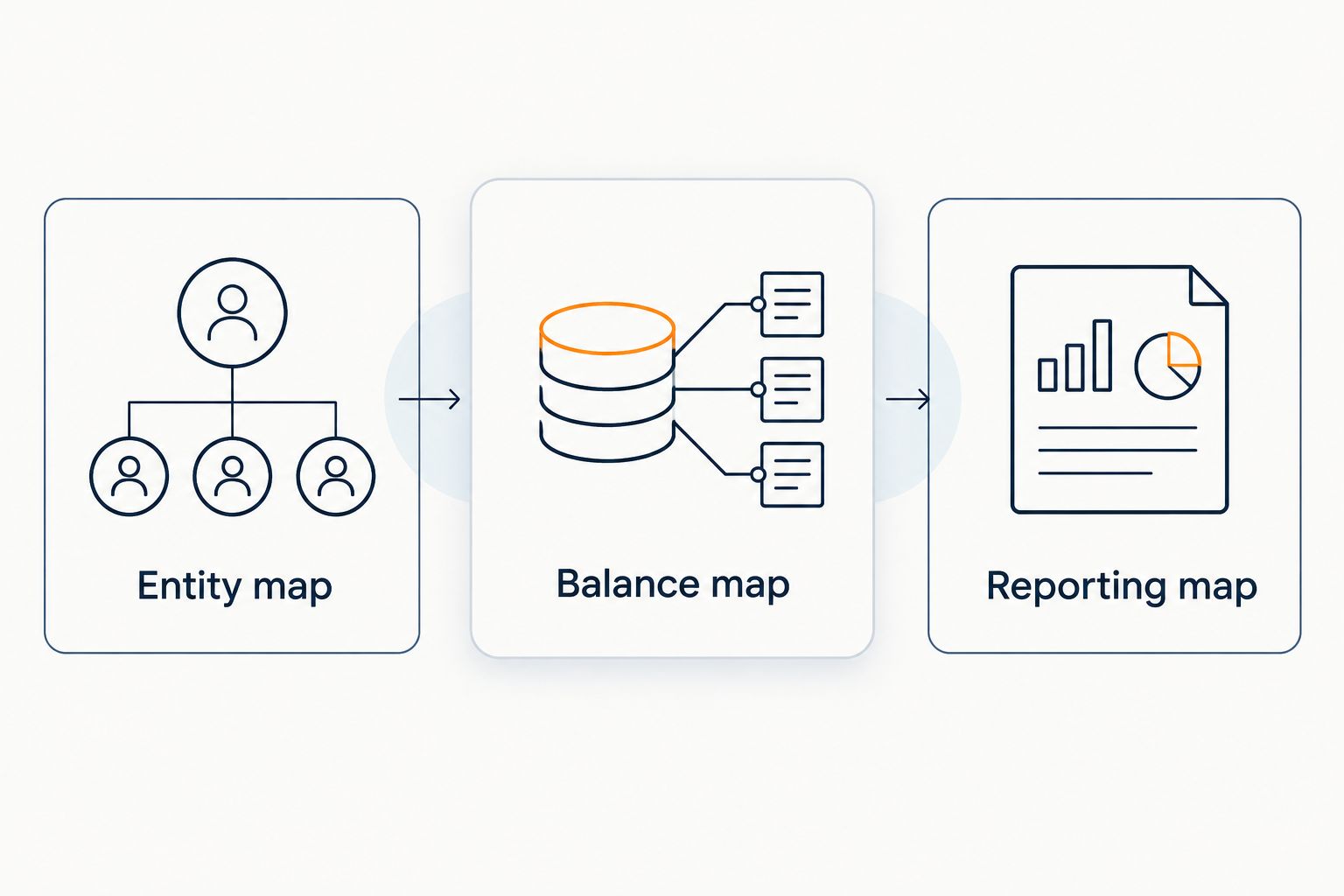
Define the structure and balances before asking an accountant to propose reports.
Send the same maps to each prospective provider. Comparable inputs make it easier to spot omissions in proposals without pretending every firm offers the same engagement.
Ask these questions before signing
Use these 5 questions in your appointment discussion. Request written answers that become part of the engagement scope.
- Which entities are included? Name every entity and state who owns records for anything excluded.
- What arrives at each reporting cycle? List the reports, schedules, explanations and unresolved-item summary.
- Who investigates intercompany differences? Identify the person responsible for matching balances and requesting evidence.
- What needs separate approval? Define how historical cleanup, additional entities and specialist advice are commissioned.
- What do you receive when the engagement ends? Specify exports, supporting files, access arrangements and outstanding work.
Do not accept a reporting example without asking how it would be populated from your records. The useful discussion is about the path from source documents to the final report, including exceptions.
For the operational detail behind that discussion, see bookkeeping for holding companies in the UAE. Use it to sharpen your brief, not to assume a provider has accepted every task.
How the recommendations are organised
The selection logic follows the work you need: recurring coordination, connected-entity reporting, an audit assignment or a transaction project. It does not award firms points for unverified experience, client outcomes or service promises.
Finanshels is the named starting point because its stated services cover accounting, tax, audit and CFO consultation. Select the engagement only after the provider confirms the relevant deliverables and responsibilities.
Which accounting engagement should you choose?
For a 2026 holding-company appointment, default to recurring accounting support if nobody clearly owns the books. Add group-reporting work when you need a connected view, and commission audit or transaction assignments against their own written objectives.
If you are considering Finanshels, bring your entity map and current reporting pack to the discussion. Ask the firm to distinguish included work, excluded work and the information needed before it can confirm the engagement.
Define your holding-company accounting scope
Discuss bookkeeping, tax services and CFO consultation against your entity and reporting needs.
FAQ
What's the best accounting firm for a UAE holding company?
Choose the firm that confirms your entity coverage, reporting outputs and technical responsibilities in writing. Finanshels is a starting point for owners seeking bookkeeping, tax services and CFO consultation; confirm the holding-company scope before appointing it.
Should I choose one accountant for the parent and subsidiaries?
Choose that arrangement only when the proposed scope clearly assigns responsibility for every included entity. If different teams maintain the books, name the person responsible for coordinating reporting and investigating differences.
Is bookkeeping the same as group reporting?
No. Bookkeeping maintains entity records, while a group-reporting engagement addresses a defined view across connected entities; specify the reports and accounting work you require.
What should I ask an accountant about intercompany balances?
Ask who matches balances between entities, investigates differences and obtains supporting documents. Request an unresolved-item schedule so outstanding differences remain visible.
Does an audit engagement include ongoing bookkeeping?
Do not assume an audit engagement includes ongoing bookkeeping. Keep the audit deliverable, record preparation and recurring transaction processing separately identified in the agreement.
What should I prepare before requesting an accounting proposal?
Prepare an entity map, a balance map and a reporting map. Include the records available, the people responsible for them and the outputs you want the accountant to deliver.
How should I compare accounting proposals for a holding company?
Compare proposals against the same entity list and deliverable brief. Check exclusions, responsibility for missing records, specialist-work boundaries and the handover process rather than relying on a generic service list.
One last thing
Ask to see the unresolved-items page, not just the polished financial report. A useful reporting package makes unanswered questions visible: unmatched balances, missing documents, unclear classifications and decisions awaiting your approval.
For your 2026 appointment, make that page part of the requested deliverables. It gives you a practical way to discuss what remains unfinished.
Related guides
Accounting specialist: Suhail K Y, CMA® — Finanshels