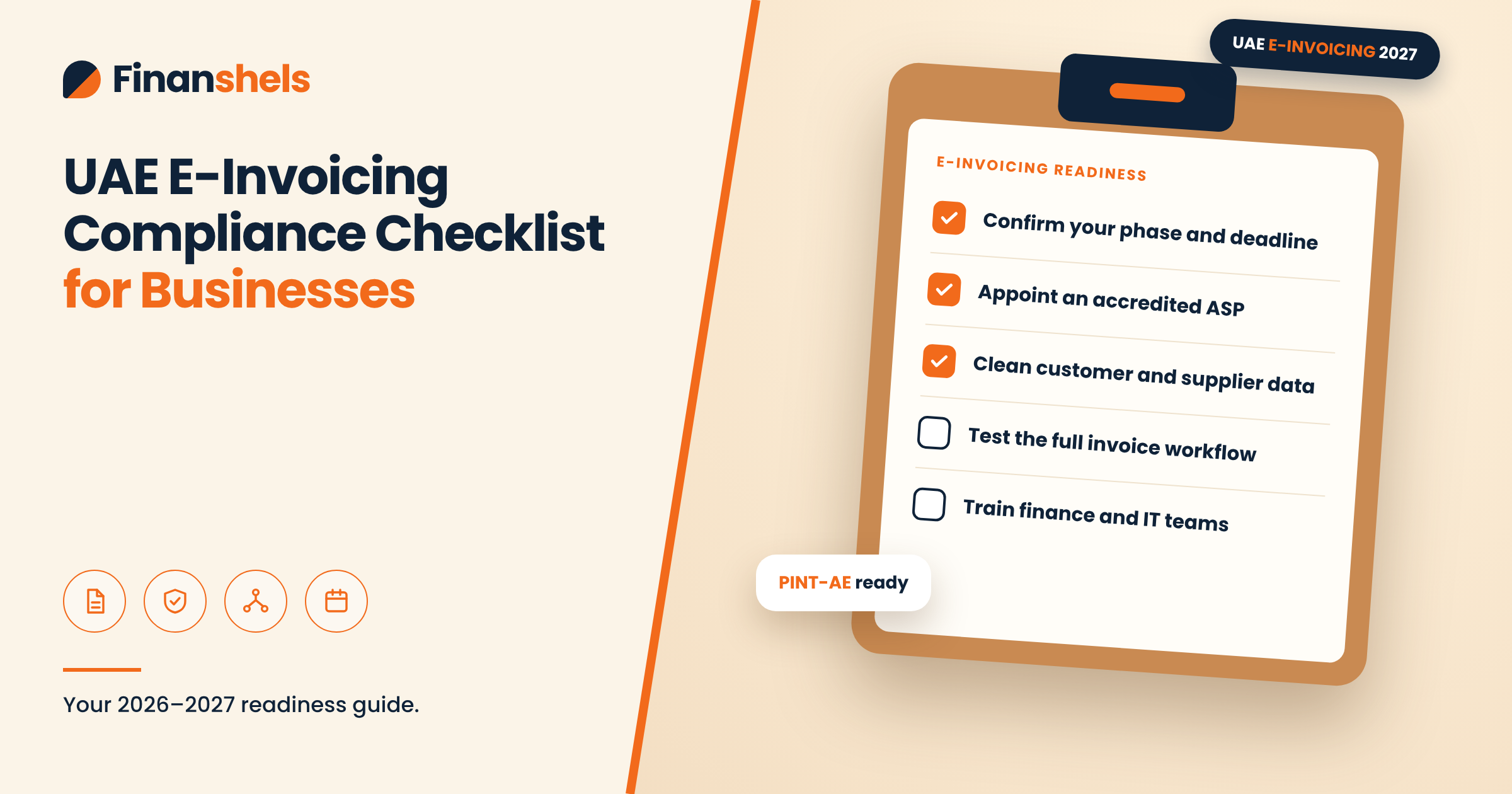
The UAE is moving towards a more connected, digital invoicing system that will change how businesses issue, exchange and report invoices. For businesses covered by the new requirements, preparing for e-invoicing involves more than switching from paper invoices to electronic files. It requires the right accounting systems, accurate customer and supplier data, updated finance processes and coordination with an Accredited Service Provider (ASP).
The UAE's e-invoicing framework uses structured invoice data that can be processed electronically and exchanged through a network of accredited providers. A PDF invoice sent by email, a scanned document, or a Word file does not qualify as an e-invoice under this framework.
The mandatory rollout will take place in phases during 2027, with deadlines depending on the business's annual revenue and whether it is a government entity. Businesses should confirm which requirements apply to them and begin preparing well before their implementation date.
This guide provides a practical UAE e-invoicing checklist for business owners, finance teams, IT teams, and operations managers preparing for the transition. For a broader overview of the rollout, read our guide to UAE e-invoicing requirements, timelines, ASPs and implementation.
Key takeaways
- Understand the format. UAE e-invoicing uses structured electronic invoice data, not simply PDFs or scanned invoices.
- Prepare your data. Review customer details, supplier records, invoice fields and VAT configurations before implementation.
- Choose an accredited provider. Check the latest Ministry of Finance list and assess software compatibility, integration costs and support.
- Confirm your deadline. ASP appointment and implementation dates differ by business category.
- Test before going live. Validate invoice data, test integrations and train the teams responsible for invoicing and reconciliation.
Understanding the PINT-AE Standard
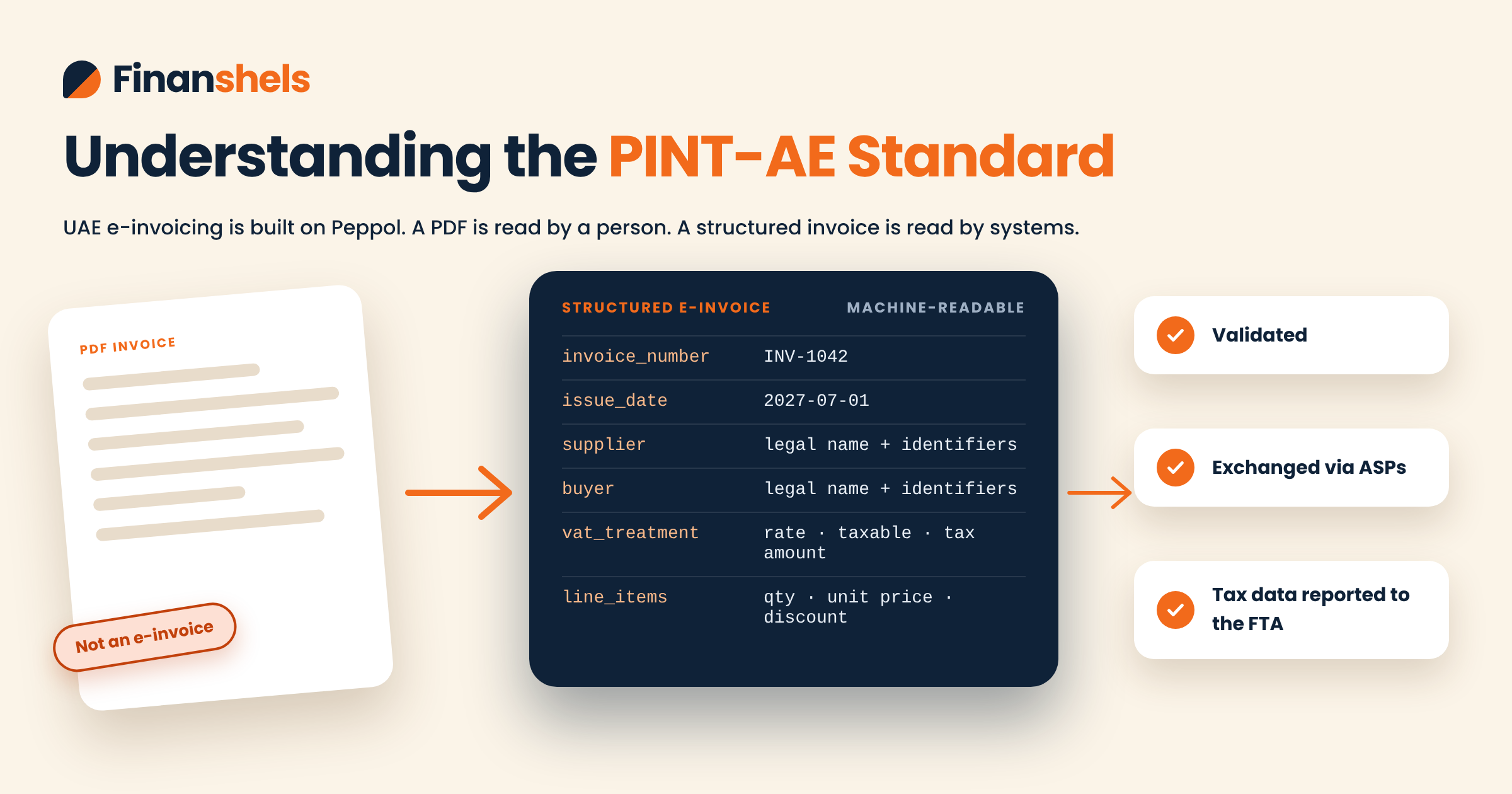
PINT-AE is the UAE's electronic invoicing specification based on the Peppol International Invoice Model. It defines how invoice information should be structured so that different systems can exchange and process it consistently.
Unlike a conventional PDF invoice, a structured e-invoice contains machine-readable data that can be validated and transmitted electronically. This supports more consistent invoice processing, better data quality and the reporting of relevant tax information to the Federal Tax Authority (FTA).
For businesses, adopting e-invoicing means ensuring that invoice information can be captured and exchanged in the required format.
What businesses need to prepare
Before implementing e-invoicing, check whether your current invoicing process can capture the required information, including:
- Supplier details: Legal business name, relevant registration details and other required identifiers.
- Buyer details: Accurate customer information and identifiers required for the transaction.
- Invoice information: Invoice number, issue date, transaction details and applicable invoice references.
- Tax information: VAT treatment, applicable rates, taxable amounts and tax amounts, where relevant.
- Line-item details: Descriptions, quantities, unit prices, discounts and other required values.
- Supporting references: Purchase orders, credit notes and related documents where applicable.
The exact data requirements depend on the applicable invoice type and transaction. Businesses should use the UAE Ministry of Finance's electronic invoicing guidelines and mandatory field requirements rather than relying on a generic invoice template.
Your PINT-AE readiness checklist
- Review your current sales invoices, purchase invoices and credit notes.
- Identify missing or inconsistent customer and supplier information.
- Check whether your invoicing system can produce the required structured data.
- Review how VAT rates, exemptions and other tax treatments are recorded.
- Confirm how invoice corrections, cancellations and credit notes will be handled.
- Ask your software provider or ASP how the system will validate invoices against the UAE requirements.
Practical tip: Identify gaps in invoice data before configuring integrations. Fixing incomplete records early can reduce validation errors and implementation delays.
Role of Accredited Service Providers (ASPs)
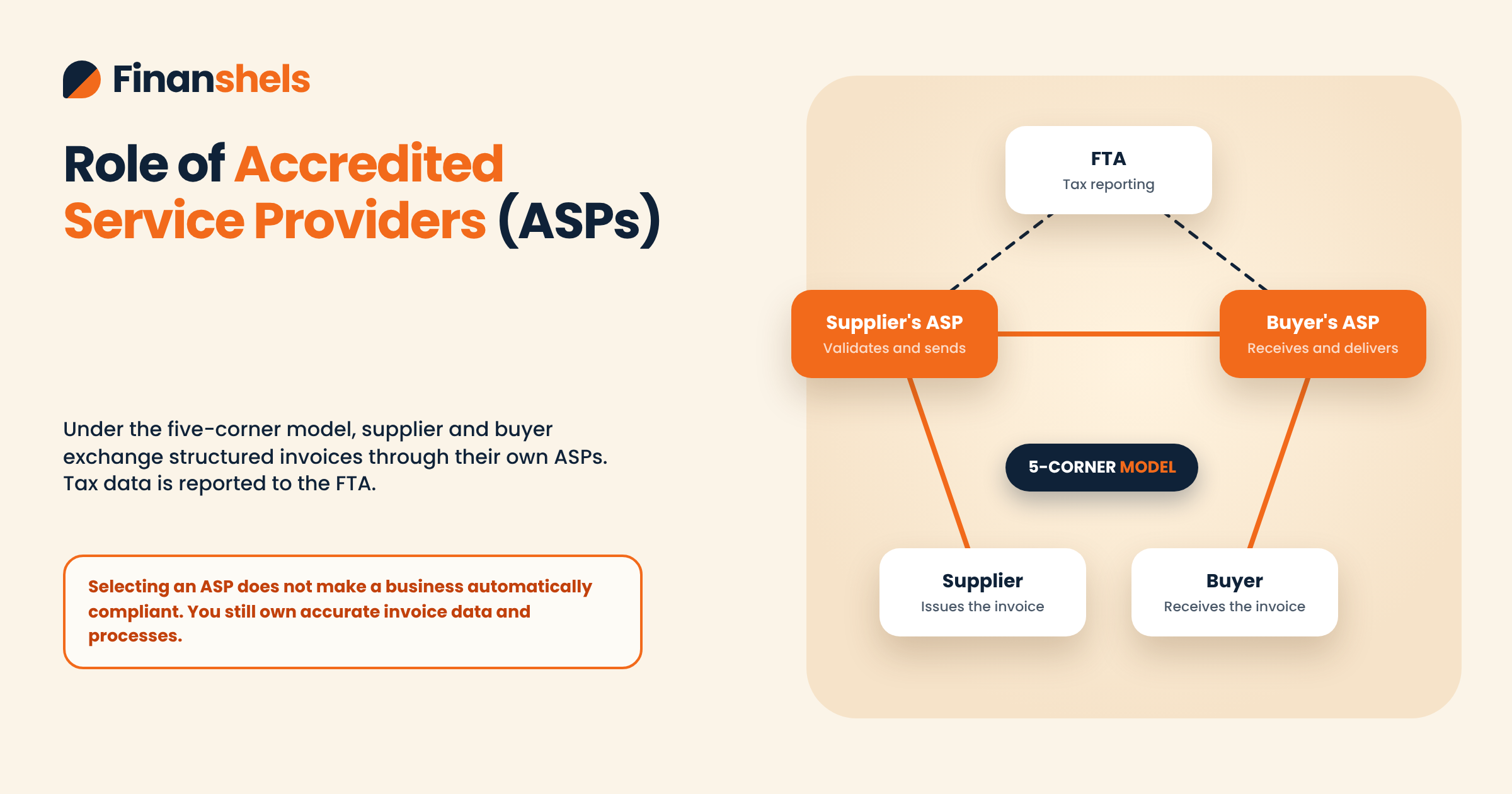
An Accredited Service Provider is an organisation authorised under the UAE e-invoicing framework to provide electronic invoicing services. Businesses subject to the system will need to work with an ASP to support compliant invoice exchange and reporting.
Under the UAE's five-corner model, the supplier and buyer use their respective service providers to exchange structured invoice data. The relevant tax data is also reported to the FTA through the prescribed process.
An ASP can help businesses connect their existing invoicing or accounting systems to this process, validate invoice data and manage the technical exchange of invoices. The specific services and integration requirements depend on the provider and the business's systems.
How to choose an ASP
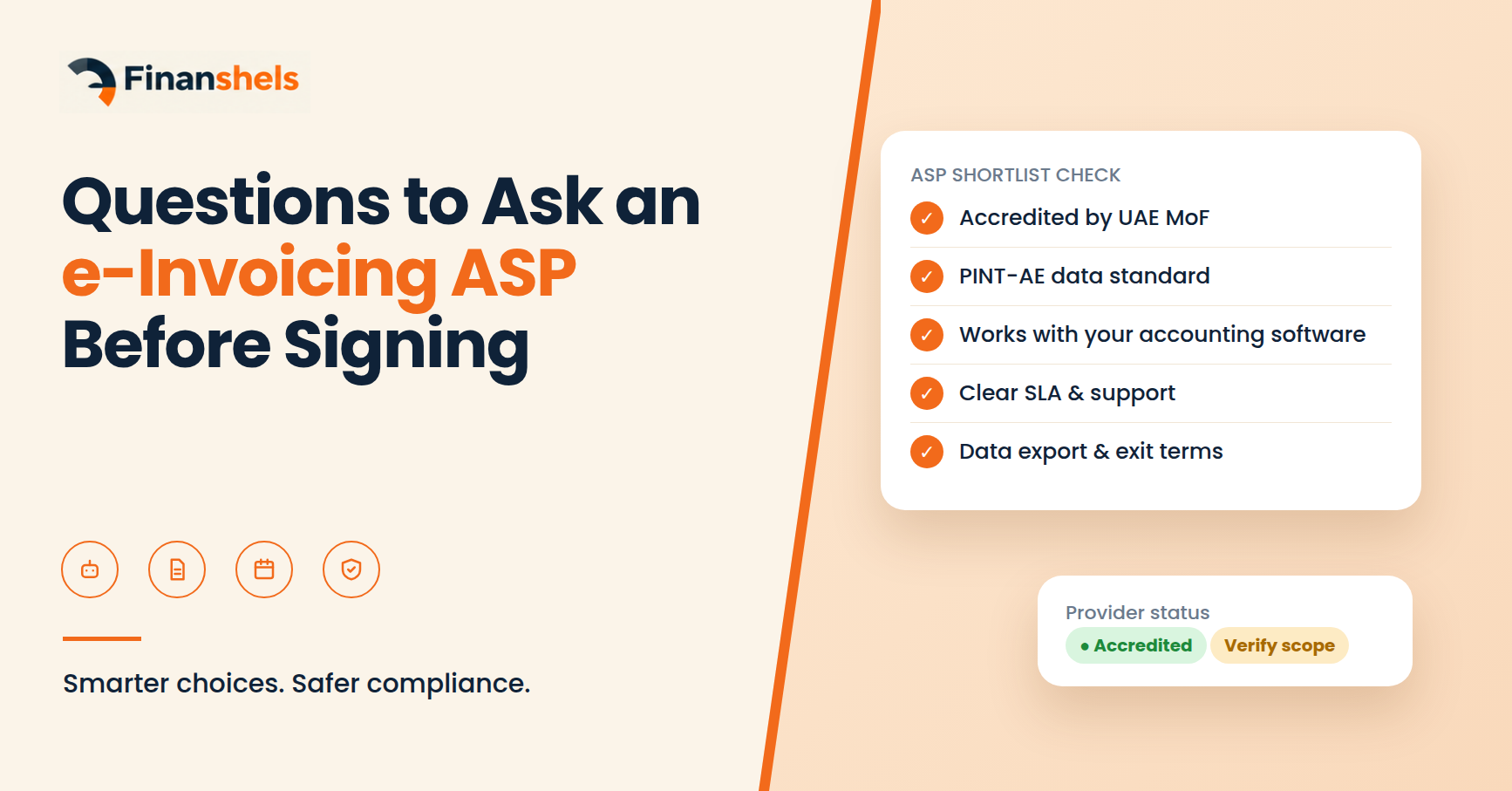
Price is important, but it should not be the only consideration. Businesses should evaluate whether a provider can support their transaction volumes, software environment and operational needs.
- Confirm that the provider has received full accreditation from the UAE Ministry of Finance.
- Check compatibility with your current accounting or ERP software.
- Understand the setup, integration, subscription and transaction costs.
- Confirm support for the required invoice types and transaction scenarios.
- Ask how invoice validation errors and rejected invoices will be communicated.
- Review data security, access controls, backup and retention arrangements.
- Confirm the availability of technical support during implementation and after go-live.
- Understand how the provider will handle system updates and changes to applicable requirements.
The Ministry of Finance publishes a list of accredited providers that businesses can use during their selection process. Check the latest list before making a decision, as accreditation status and provider options may change.
Important: Selecting an ASP does not automatically make a business fully compliant. The business remains responsible for providing accurate invoice data, maintaining appropriate processes and meeting its applicable obligations.
Data Preparation and Accounting Software Alignment
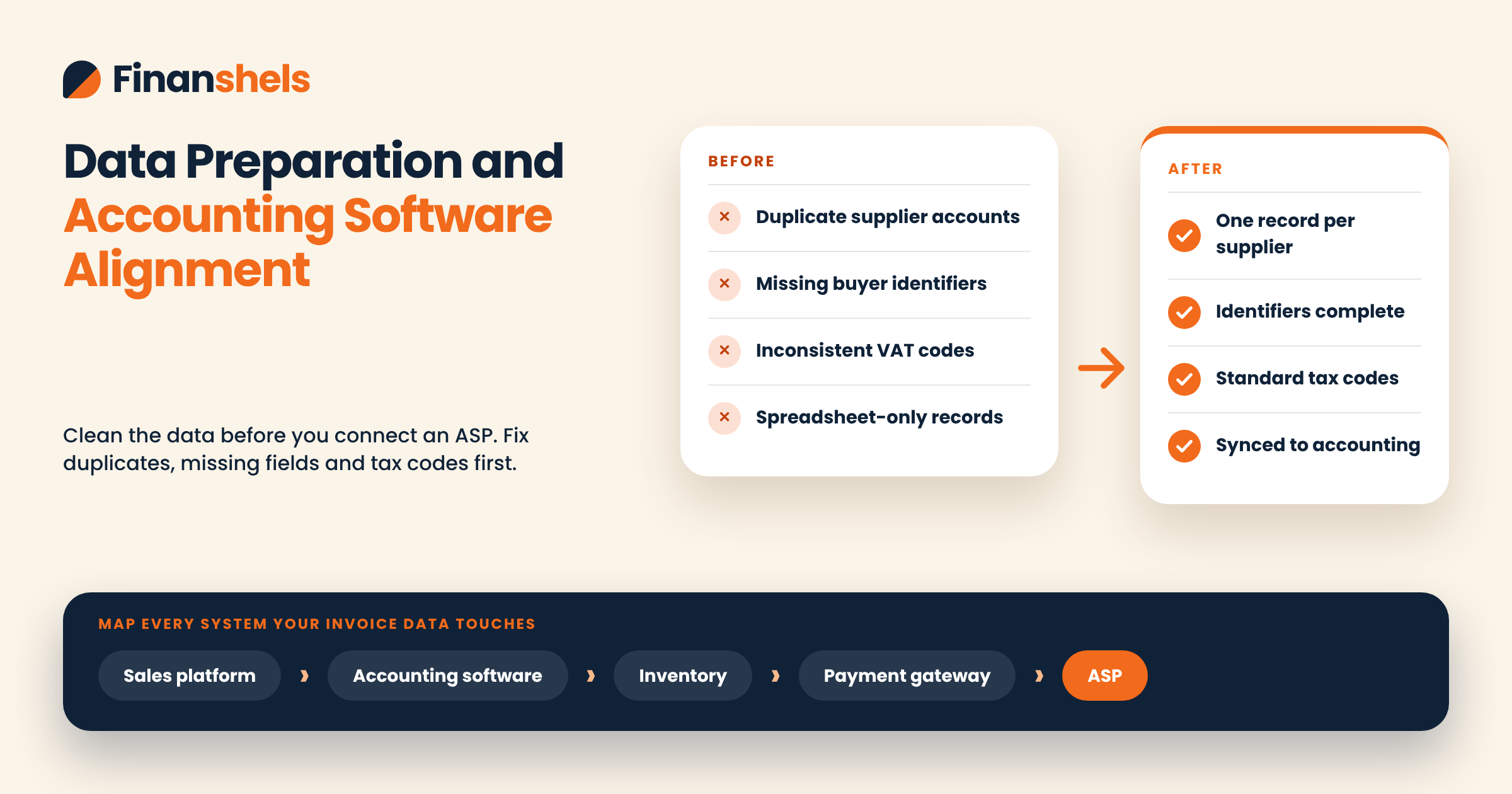
One of the most important parts of e-invoicing implementation is preparing the data already stored in your accounting and business systems.
Incomplete customer records, duplicate supplier accounts, inconsistent tax codes and manually maintained spreadsheets can create problems when invoice data needs to be validated and exchanged electronically.
Businesses should review their data before connecting their systems to an ASP. This is also a useful opportunity to improve the accuracy of accounting records and reduce recurring reconciliation issues. Businesses that need help organising their records can explore Finanshels' bookkeeping services in the UAE.
Review your accounting software
Start by documenting how invoices are currently created, approved, recorded and shared. Include all systems involved in the process, rather than looking only at the accounting software.
For example, a business may create invoices through its sales platform, record them in its accounting software, manage inventory in a separate system and track collections through a payment gateway. Each connection may affect the information required for e-invoicing.
- Identify the software used for invoicing, accounting, inventory and order management.
- Confirm whether the software provider supports UAE e-invoicing requirements or offers a compatible integration.
- Map how invoice data moves between systems.
- Standardise customer and supplier records.
- Review VAT codes, tax calculations and transaction classifications.
- Remove duplicate records and correct incomplete fields.
- Confirm how credit notes and invoice adjustments are recorded.
- Check whether existing invoice records can be retrieved when needed.
- Assign responsibility for maintaining master data and correcting errors.
What if your business uses Tally UAE?
Businesses using Tally in the UAE should speak with their software provider or implementation partner to understand the available e-invoicing integration options and any configuration or upgrade requirements.
Do not assume that an accounting system is automatically compliant simply because it generates tax invoices or exports data. Confirm whether the complete setup can support the applicable UAE requirements, including structured invoice data, ASP connectivity and error handling.
If your business uses multiple accounting tools, spreadsheets or separate sales systems, document the full workflow before selecting an integration approach.
Test the complete invoicing process
Before going live, test the process using representative business transactions. Include ordinary sales, purchases, credit notes and any other transaction types relevant to your business.
- Invoice data is transferred accurately between systems.
- Required fields are populated correctly.
- VAT calculations and invoice totals reconcile.
- The ASP can validate and exchange the invoice data.
- Validation errors can be identified and corrected.
- Invoice statuses can be tracked by the relevant team.
- Finance staff know how to resolve failed transactions.
- The process works across the systems used by your business.
Testing helps uncover problems before they affect routine invoicing, customer payments or month-end reconciliation.
Phased Implementation Deadlines
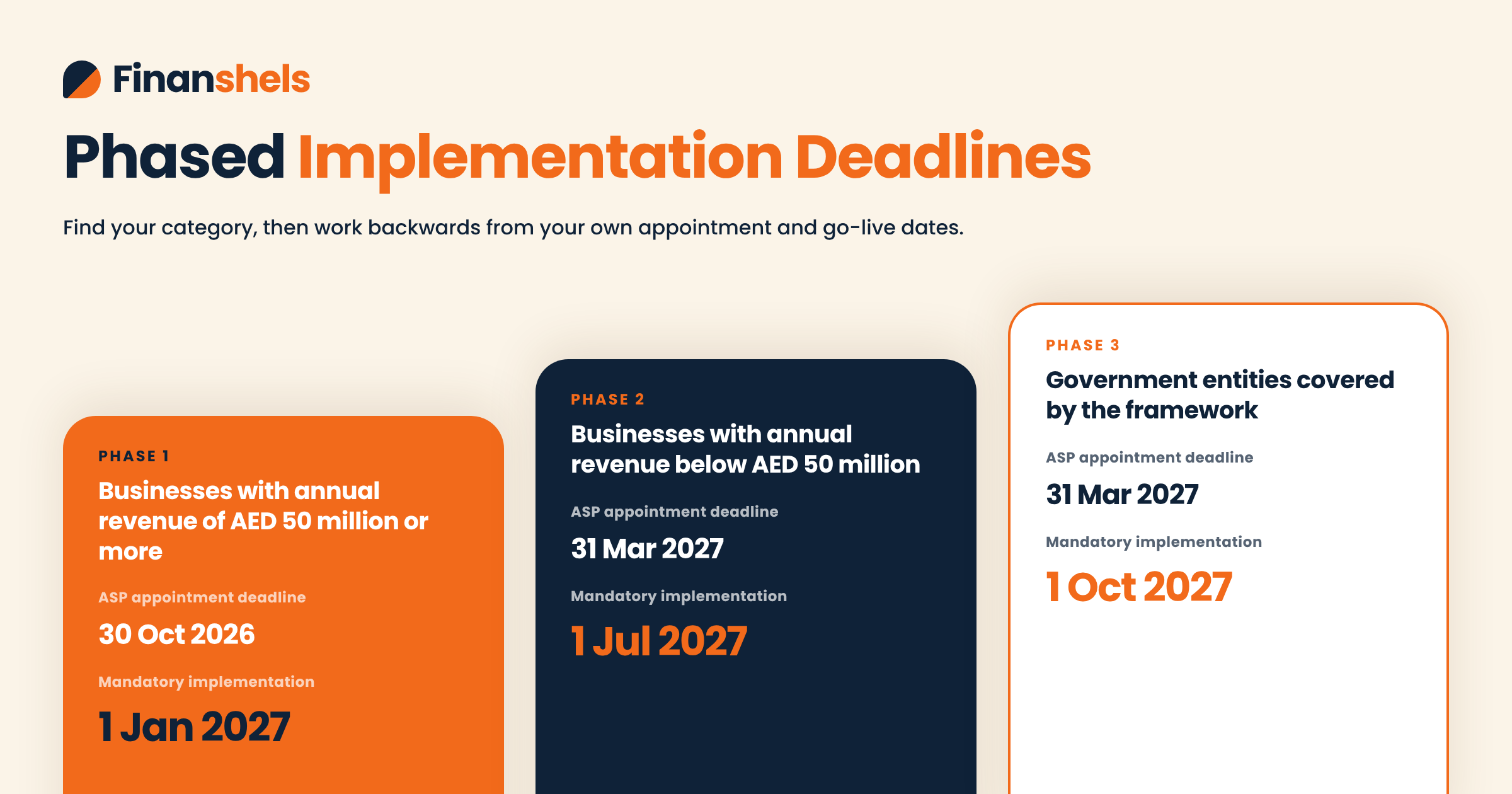
The UAE's e-invoicing system is being introduced in phases. Businesses should identify their applicable category, verify the latest official requirements and work backwards from their relevant appointment and implementation deadlines.
As of October 2026, the published mandatory rollout includes the following milestones:
| Business category | ASP appointment deadline and implementation |
|---|---|
| Businesses with annual revenue of AED 50 million or more |
ASP appointment: 30 October 2026
Implementation: 1 January 2027 |
| Businesses with annual revenue below AED 50 million |
ASP appointment: 31 March 2027
Implementation: 1 July 2027 |
| Government entities covered by the framework |
ASP appointment: 31 March 2027
Implementation: 1 October 2027 |
These dates reflect the Ministry of Finance's published implementation timeline and amendments. Confirm your classification and applicable requirements against the latest official guidance before making implementation decisions.
Official source: UAE Ministry of Finance: E-Invoicing.
How to plan around your deadline
Step 1: Confirm your implementation category
Review the revenue figure used under the applicable rules and determine whether your business falls within the relevant phase. Newly established businesses should also check the applicable rules for determining their revenue category.
Step 2: Appoint an ASP within the required timeframe
Compare suitable providers, confirm accreditation and agree on the integration approach. Businesses in the first phase should prioritise this step because their appointment deadline falls in October 2026.
Step 3: Prepare your systems and data
Clean up master data, review tax configurations, identify integration gaps and assign responsibilities across finance and IT.
Step 4: Test before the mandatory date
Allow sufficient time for configuration, data validation, user training and resolving technical issues. Avoid scheduling all testing for the final weeks before go-live.
Step 5: Establish an ongoing compliance process
Once the system is operational, monitor invoice statuses, review errors, maintain records and assign responsibility for keeping the system aligned with applicable requirements.
The earlier your business begins, the more time you will have to resolve data and software issues without disrupting everyday operations.
Get Your Business Ready for UAE E-Invoicing
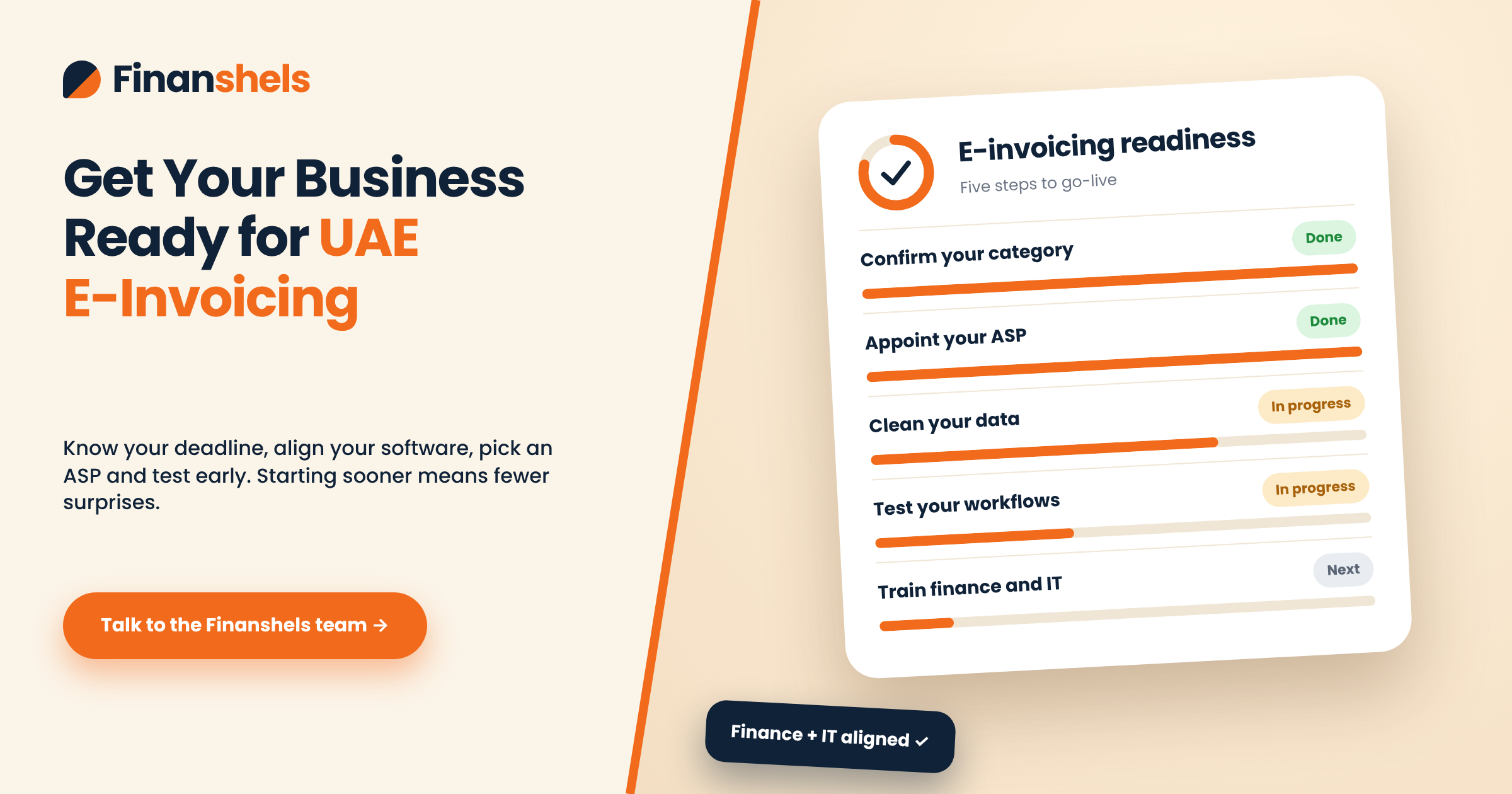
UAE e-invoicing preparation starts with understanding your implementation deadline, reviewing your accounting software and ensuring your invoice data is accurate. Businesses should also select an accredited service provider, test their invoicing workflows and prepare finance and IT teams before going live.
Starting early gives your business more time to address data gaps, resolve integration issues and maintain VAT compliance without disrupting day-to-day operations.
If you need help assessing your readiness, Finanshels can help you review your accounting processes and understand the next steps for your business. Visit Finanshels to explore our accounting and tax services.
Frequently asked questions
1. What is the UAE e-invoicing implementation deadline for 2027?
The deadline depends on the business category. Under the published phased rollout, businesses with annual revenue of AED 50 million or more must appoint an Accredited Service Provider by 30 October 2026 and implement e-invoicing by 1 January 2027. Businesses below AED 50 million have an ASP appointment deadline of 31 March 2027 and an implementation deadline of 1 July 2027. Government entities covered by the framework have a 1 October 2027 implementation deadline. Confirm the applicable requirements with the UAE Ministry of Finance.
2. What is included in a UAE e-invoicing checklist?
A UAE e-invoicing checklist should cover implementation deadlines, ASP selection, accounting software compatibility, customer and supplier data, VAT configurations, invoice validation, system integration, employee training and error-handling procedures.
3. Is a PDF invoice compliant with UAE e-invoicing requirements?
No. A PDF invoice sent by email does not, by itself, meet the UAE e-invoicing requirements. The framework requires structured electronic invoice data that can be processed and exchanged through the prescribed system.
4. Do UAE businesses need an Accredited Service Provider for e-invoicing?
Businesses subject to the mandatory framework must follow the applicable ASP appointment and implementation requirements. An ASP facilitates electronic invoice exchange and related processes under the UAE framework. Businesses should verify provider accreditation through the Ministry of Finance's latest published list.
5. Does UAE e-invoicing replace VAT returns?
No. E-invoicing does not remove a business's existing VAT obligations. Businesses must continue to apply the correct VAT treatment, maintain supporting records and file VAT returns when required. For additional support with VAT obligations, explore Finanshels' accounting and tax services.
6. Can Tally accounting software support UAE e-invoicing?
Businesses using Tally should check with their software provider or implementation partner to confirm the available UAE e-invoicing integration, configuration and upgrade options. Compatibility should be assessed against the applicable technical requirements rather than assumed.
7. What are the penalties for non-compliance with UAE e-invoicing?
Penalties depend on the specific violation. Under the published framework, failure to implement the system or appoint an ASP within the prescribed timeframe can attract a penalty of AED 5,000 for each month or part of a month of delay. Other violations, including failures relating to invoice transmission and system-failure notifications, have separate penalties. Check the latest official decisions for the applicable penalty and circumstances.
8. How can a business prepare for UAE e-invoicing?
Start by confirming your implementation phase, reviewing your invoicing and accounting systems, cleaning up customer and supplier data, evaluating accredited providers and testing invoice workflows. Involve finance and IT teams early to identify potential issues before the mandatory deadline.
9. How many mandatory fields does a UAE e-invoice have?
The number of mandatory fields depends on the type of electronic invoice and the applicable Ministry of Finance specifications. Businesses should consult the official mandatory-field guidance and ensure their invoicing systems capture the information required for their transaction types.
Preparing for UAE E-Invoicing?
Review your accounting processes, organise your financial records, and understand what your business needs to prepare for the transition.
Talk to the Finanshels team about your accounting and tax compliance requirements.