UAE eInvoicing is being introduced through a phased implementation that changes how businesses create, exchange, and report electronic invoices. Under the UAE framework, an eInvoice is structured invoice data that is issued and exchanged electronically between a supplier and buyer and reported electronically to the Federal Tax Authority (FTA).
A PDF, Word document, image, scanned invoice or invoice sent only by email is not considered an eInvoice under the UAE system.
The UAE model uses the international OpenPeppol framework and a five-corner architecture involving suppliers, buyers, Accredited Service Providers (ASPs) and the FTA.
For businesses, preparing for eInvoicing involves more than replacing an invoice template. Companies need to understand their implementation phase, assess their accounting and bookkeeping systems or ERP systems, prepare customer and supplier data, appoint an ASP, complete technical integration and test their invoicing workflows before mandatory implementation.
UAE eInvoicing at a Glance
| Question | Answer |
|---|---|
| What is UAE eInvoicing? | The structured electronic creation, exchange and reporting of invoice data through the UAE eInvoicing system. |
| Is eInvoicing mandatory in the UAE? | Yes, for businesses and government entities within the scope of the system, subject to applicable exclusions and phased implementation dates. |
| What standard does the UAE use? | The UAE system uses OpenPeppol and the PINT-AE specification for structured electronic invoices. |
| What is an ASP? | An Accredited Service Provider that connects businesses to the UAE eInvoicing system and supports electronic invoice exchange and reporting. |
| Is a PDF invoice an eInvoice? | No. PDFs and other unstructured formats are not eInvoices under the UAE framework. |
| When does mandatory implementation begin? | Mandatory implementation begins in phases from 1 January 2027, depending on the business’s annual revenue and applicable category. |
| What should businesses do now? | Confirm their applicable phase, appoint an ASP by the relevant deadline, assess their systems and data, and begin integration and testing. |
The Ministry of Finance states that its official eInvoicing portal is the primary source for programme information and updates. Businesses should check the latest guidance when confirming their specific obligations.
UAE eInvoicing Timeline and Implementation Phases
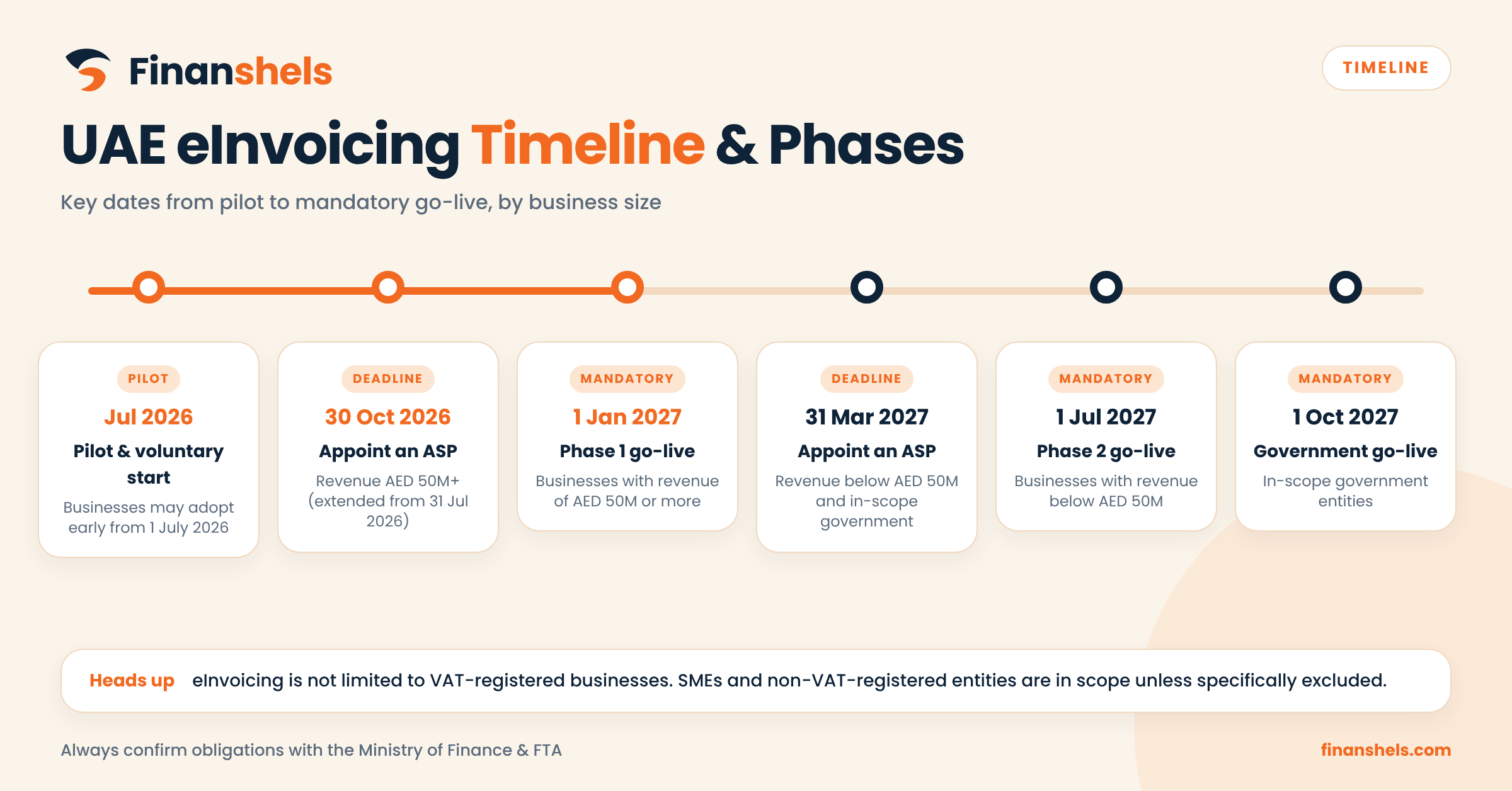
The UAE eInvoicing rollout is phased according to the type of entity and, for businesses, annual revenue.
The programme began with a pilot phase in July 2026. Voluntary implementation is also available before a business reaches its mandatory implementation date.
The current implementation timeline is:
| Entity / category | Revenue, ASP deadline and go-live date |
|---|---|
| Businesses subject to the system |
Annual revenue
AED 50 million or more
ASP appointment deadline 30 October 2026 Mandatory eInvoicing 1 January 2027 |
| Businesses subject to the system |
Annual revenue
Below AED 50 million
ASP appointment deadline 31 March 2027 Mandatory eInvoicing 1 July 2027 |
| Government entities within scope |
Annual revenue
Not applicable
ASP appointment deadline 31 March 2027 Mandatory eInvoicing 1 October 2027 |
The Ministry of Finance extended the ASP appointment deadline for businesses with annual revenue of AED 50 million or more from 31 July 2026 to 30 October 2026 , while keeping the mandatory implementation date of 1 January 2027 unchanged.
Businesses can also choose to implement eInvoicing voluntarily from 1 July 2026, before their mandatory implementation date.
Because the programme is still being rolled out, businesses should check the latest official Ministry of Finance and FTA guidance before relying on a deadline.
Who Needs to Comply With UAE eInvoicing?
The UAE eInvoicing system generally applies to persons conducting business in the UAE in relation to in-scope business transactions, including B2B and B2G transactions, subject to specific exclusions.
Importantly, eInvoicing is not limited to VAT-registered businesses. The Ministry’s guidance states that the system applies to persons conducting business in the UAE regardless of VAT registration status, unless specifically excluded.
Businesses should therefore assess:
- Whether they conduct transactions within the scope of the system
- Whether any exclusions apply
- Their annual revenue
- The applicable implementation phase
- Their B2B and B2G transaction flows
- Their accounting and invoicing systems
- Their customer and supplier data
Businesses should not assume that being an SME or not being VAT-registered automatically removes them from the eInvoicing framework.
What Is UAE eInvoicing?
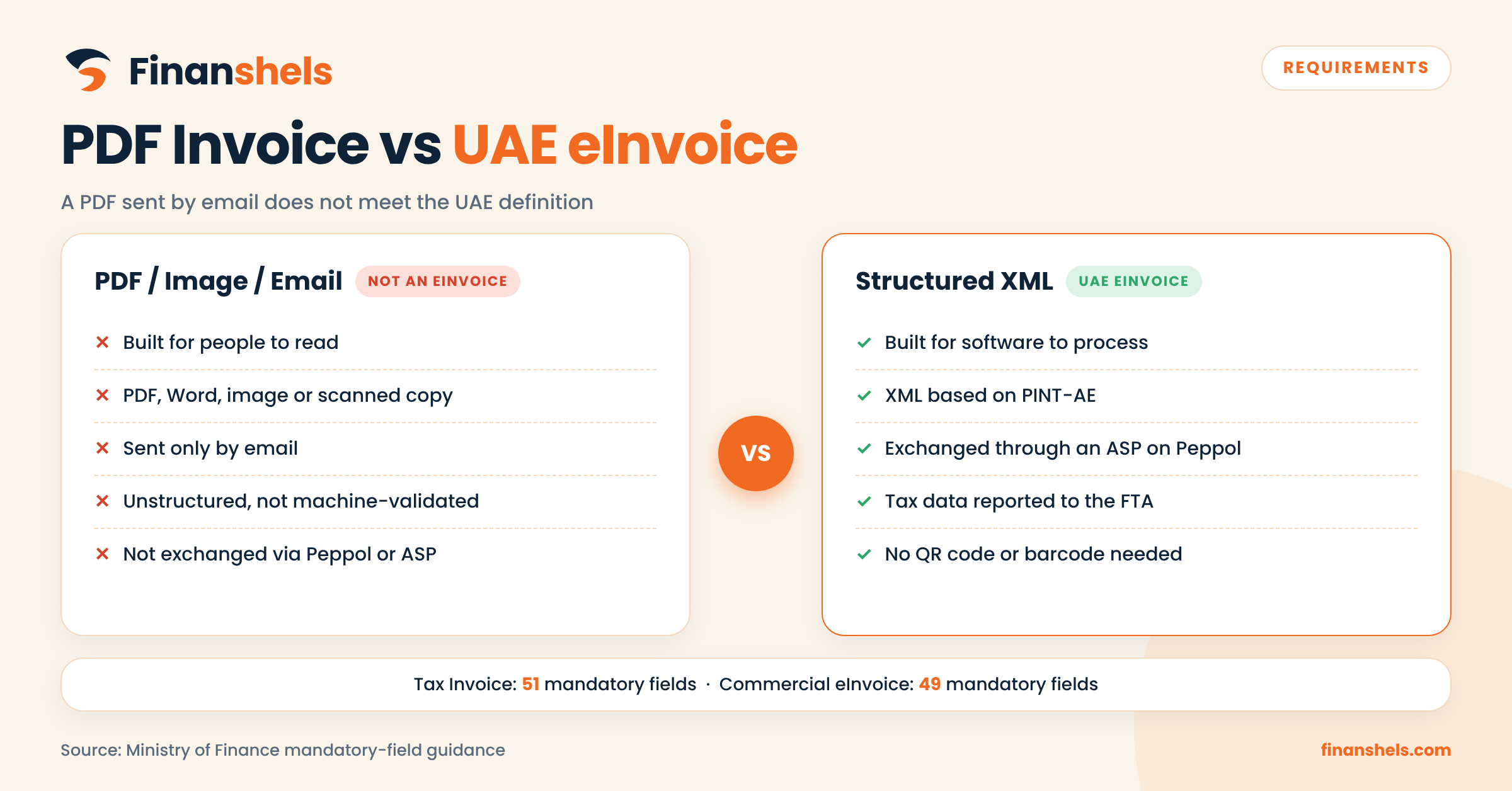
UAE eInvoicing involves issuing, transmitting and receiving structured electronic invoice data through the approved eInvoicing framework.
This is different from sending a PDF invoice by email.
A PDF is primarily designed for a person to read. A structured eInvoice is designed for software systems to process and exchange consistently.
Under the UAE system, electronic invoices are issued, transmitted and received in structured XML format based on the applicable PINT-AE specifications.
This means eInvoicing can affect more than the invoice itself. Businesses may need to update:
- Accounting and ERP systems
- Customer and supplier master data
- Tax classifications
- Invoice approval workflows
- Credit note processes
- Data validation
- Record-keeping
- Reconciliation processes
- Reporting workflows
Key UAE eInvoicing Terms
Accredited Service Provider (ASP)
An Accredited Service Provider, or ASP, is a provider accredited under the UAE eInvoicing framework to facilitate electronic invoice exchange and related reporting processes.
An ASP connects a business’s accounting or bookkeeping system or ERP with the wider eInvoicing network.
Depending on the provider and integration, its role can include:
- Validating invoice data
- Converting data into the required UAE format
- Connecting to the eInvoicing network
- Transmitting invoices
- Receiving acknowledgements and rejection messages
- Reporting required tax data
- Supporting technical integration
- Providing monitoring and related services
Businesses should use the current official list of accredited or pre-approved providers when selecting an ASP.
PINT-AE
PINT-AE is the UAE’s implementation of the Peppol International Invoice specification.
It defines the structured format and business rules used for UAE electronic invoices and credit notes.
The applicable requirements vary according to the document type and transaction scenario. Businesses therefore need to map their invoice data to the relevant PINT-AE requirements rather than assuming that one generic invoice template will cover every transaction.
Peppol
Peppol is an international framework that supports the interoperable exchange of electronic business documents.
The UAE has adopted the OpenPeppol framework for its eInvoicing system. This allows businesses to exchange structured invoice information through connected service providers using common technical standards.
Tax Identification Number (TIN)
A Tax Identification Number, or TIN, is a unique 10-digit identifier used within the UAE eInvoicing framework.
For entities registered for Corporate Tax, the TIN is associated with their Corporate Tax registration information . Businesses should ensure that the required identifiers are correctly recorded in their systems and mapped according to the applicable eInvoicing specifications.
The TIN used for eInvoicing should not simply be treated as interchangeable with every other tax identifier used in the UAE. Businesses should follow the specific field requirements for the relevant invoice type.
Five-Corner Model
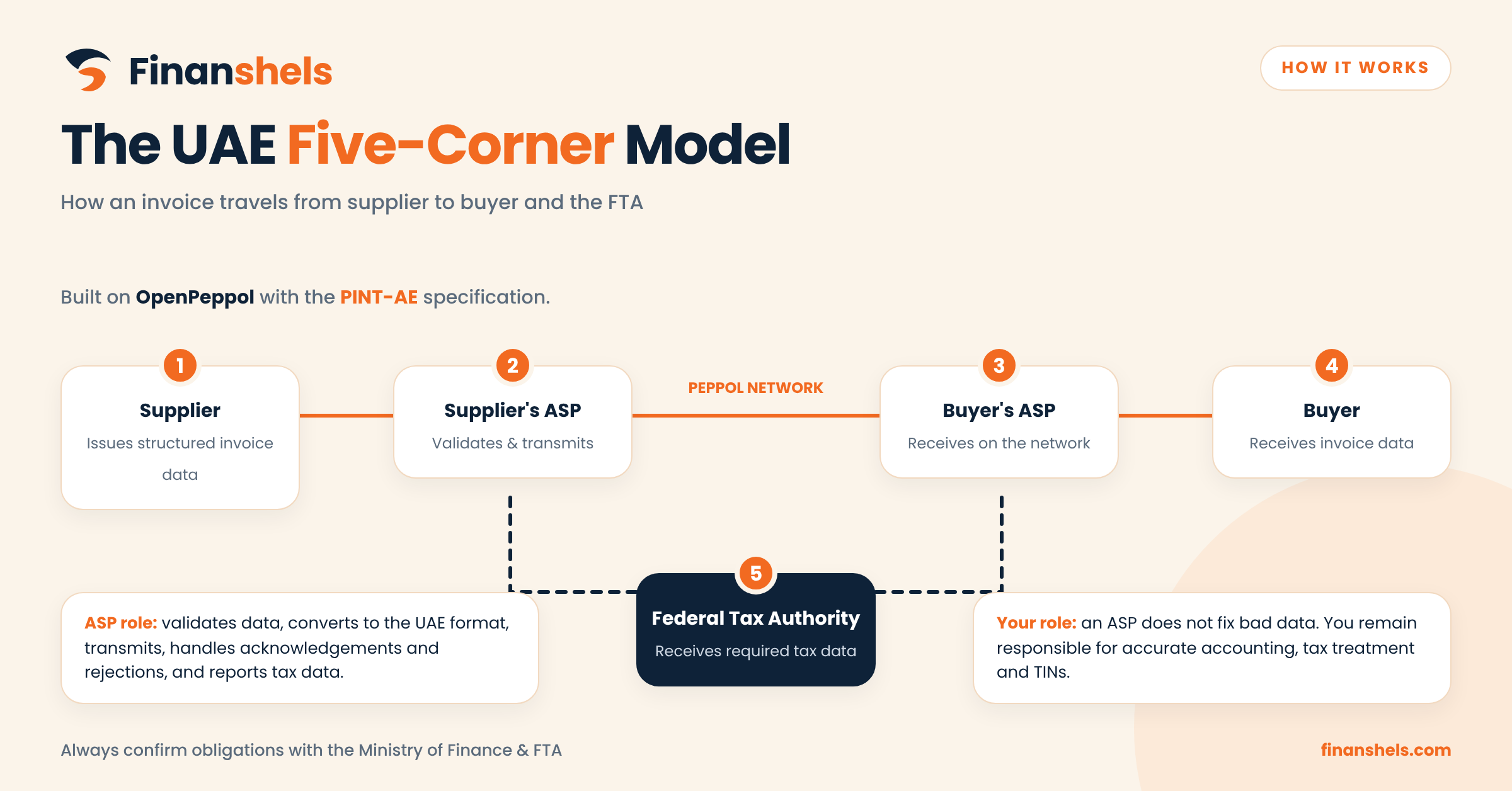
The UAE eInvoicing system uses a five-corner model.
The five corners are:
- Supplier
- Supplier’s Accredited Service Provider
- Buyer’s Accredited Service Provider
- Buyer
- Federal Tax Authority
The supplier sends structured invoice data through its ASP. The invoice is transmitted through the connected service providers, while relevant tax data is reported to the FTA.
The model is designed to support electronic invoice exchange between businesses while enabling the tax authority to receive the required tax data.
UAE eInvoicing Requirements
UAE eInvoicing requirements cover the structure and information contained in electronic invoices as well as the way invoices are exchanged through the system.
The exact mandatory fields depend on the type of electronic invoice and transaction scenario.
Mandatory Invoice Information
The Ministry of Finance’s mandatory-field guidance identifies required data across areas including:
- Invoice details
- Seller details
- Buyer details
- Document totals
- Tax breakdown
- Invoice-line information
For common invoice categories, the published mandatory-field lists contain different numbers of fields.
An electronic Tax Invoice has 51 mandatory fields , while a Commercial Electronic Invoice has 49 mandatory fields under the Ministry’s published mandatory-field guidance.
These can include information such as:
- Invoice number
- Invoice date
- Invoice type code
- Currency
- Seller information
- Buyer information
- Tax identifiers
- Electronic addresses
- Tax information
- Invoice totals
- Line-level information
Businesses should use the official mandatory-field requirements together with the applicable PINT-AE specification rather than relying on a simplified invoice template.
VAT Treatment and Tax Categories
Correct VAT treatment is an important part of eInvoicing preparation.
Businesses need to ensure their systems correctly identify the applicable tax treatment for each transaction.
Depending on the transaction, this may involve:
- Standard-rated supplies
- Zero-rated supplies
- Exempt supplies
- Out-of-scope transactions
- Reverse-charge transactionsl
- Other specific scenarios under UAE VAT rules
Tax categories and rates need to be correctly mapped because technical validation does not replace tax review.
A structured invoice can pass technical checks while still containing an incorrect tax treatment if the underlying business data or tax configuration is wrong.
Currency and Tax Information
Businesses issuing invoices in foreign currencies need to configure their systems to handle the currency and tax information required under UAE VAT and eInvoicing rules.
Businesses should verify that:
- Invoice currency is correctly identified
- Tax calculations are accurate
- Required AED tax information is correctly reported
- Exchange rates are applied according to the applicable rules
- Invoice totals reconcile with accounting records
Businesses operating through multiple legal entities or tax groups should also verify that the correct entity and tax information is used for each transaction.
Digital Signatures, QR Codes and XML Format
One important distinction is that UAE eInvoices are not defined by a visual PDF-style invoice containing a QR code .
The Ministry of Finance’s guidance states that electronic invoices are issued, transmitted and received in XML format and will not feature a QR code or barcode.
The applicable PINT-AE specification defines the structured invoice data and validation requirements.
Businesses should therefore focus their implementation efforts on:
- Correct structured data
- XML generation
- PINT-AE compliance
- Validation
- Accurate tax information
- Correct transmission
- Data integrity
- Appropriate record retention
A QR code should not be treated as a required component of the UAE eInvoice itself.
What Is an Accredited Service Provider in UAE eInvoicing?
An ASP provides the technical connection that allows a business to participate in the UAE eInvoicing system.
The ASP may support activities such as:
- Invoice validation
- Data transformation
- PINT-AE compliance
- Network connectivity
- Invoice transmission
- Reporting to the FTA
- Acknowledgement handling
- Rejection handling
- Technical monitoring
- Integration with accounting or ERP systems
The ASP is therefore an important part of the implementation architecture.
However, businesses remain responsible for ensuring that their underlying accounting information, tax treatment and business data are accurate.
UAE eInvoicing ASP Providers: How to Choose an ASP
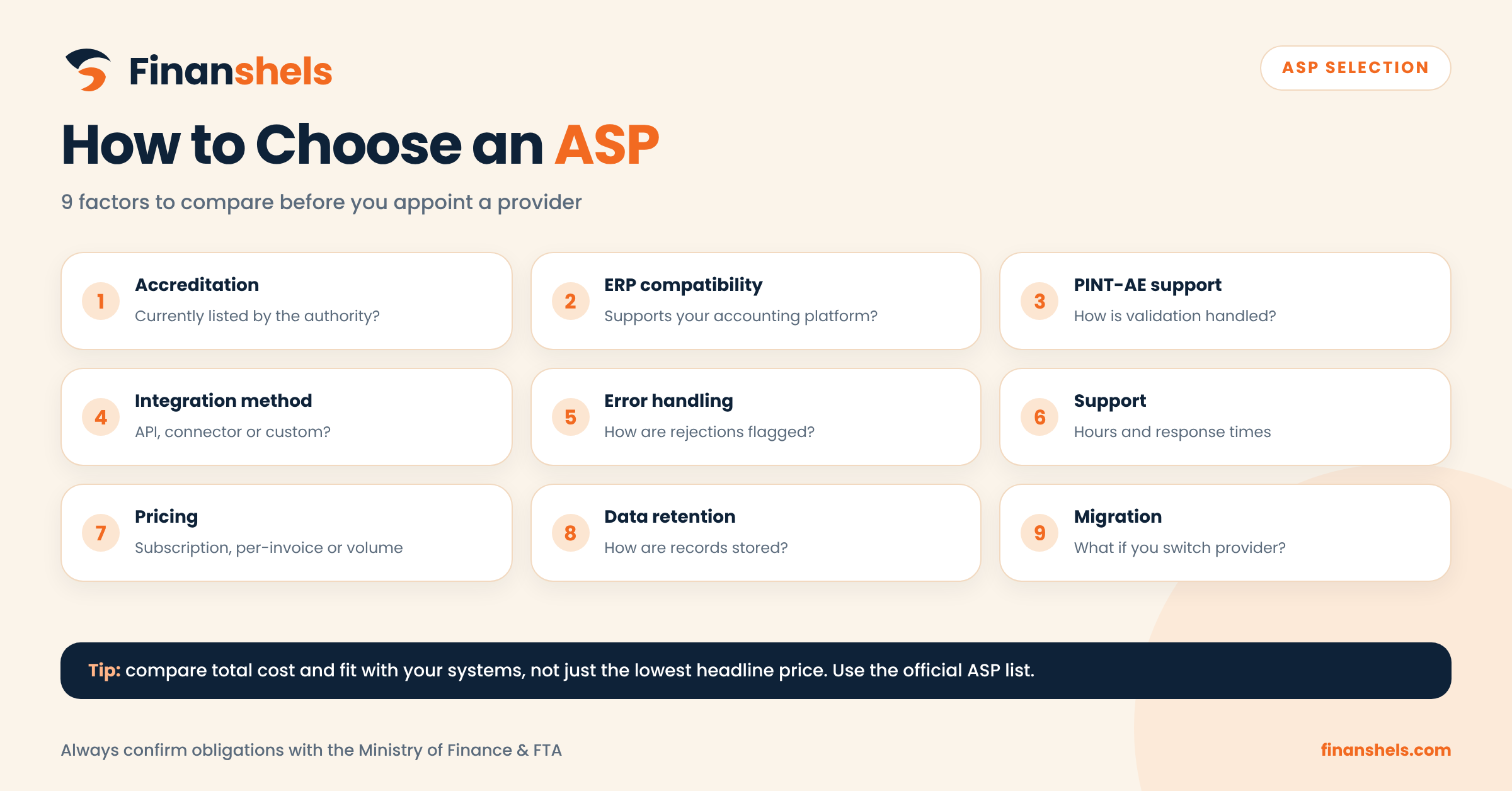
The official Ministry of Finance and FTA resources provide access to the current provider information.
Once businesses identify eligible providers, they should compare them based on their actual systems and transaction requirements rather than simply selecting the provider with the lowest headline price.
| Selection factor | Evaluation guide |
|---|---|
| Accreditation |
Why it matters
Confirms the provider is approved within the UAE framework
Question to ask Is the provider currently listed by the relevant authority? |
| ERP compatibility |
Why it matters
Determines integration complexity
Question to ask Does it support our ERP or accounting platform? |
| PINT-AE support |
Why it matters
Ensures invoice data follows the required structure
Question to ask How is PINT-AE validation handled? |
| Network connectivity |
Why it matters
Enables electronic exchange
Question to ask How does the solution connect to the UAE eInvoicing network? |
| Integration method |
Why it matters
Affects implementation time and cost
Question to ask Is the solution API-, connector- or integration-based? |
| Error handling |
Why it matters
Rejected invoices need prompt attention
Question to ask How are validation errors communicated? |
| Support |
Why it matters
Technical issues can affect billing
Question to ask What support hours and response times are offered? |
| Pricing |
Why it matters
Costs can increase with transaction volume
Question to ask Is pricing subscription-, transaction- or volume-based? |
| Data retention |
Why it matters
Businesses need access to records
Question to ask How are invoices and related records stored? |
| Migration |
Why it matters
Provider changes should not disrupt records
Question to ask What happens to data if we change providers? |
Before signing, ask:
- What is the implementation timeline for our ERP or accounting system?
- Who is responsible for field mapping?
- What testing support is included?
- How are rejected invoices handled?
- What support is available during UAE business hours?
- How are historical records handled if we change providers?
UAE eInvoicing Software and ERP Requirements
Your accounting or ERP system is a critical part of eInvoicing readiness.
Businesses should determine whether their current systems can:
- Generate the required structured invoice data
- Capture the necessary customer and supplier information
- Apply appropriate tax classifications
- Generate the required invoice and credit-note types
- Integrate with an ASP
- Receive transmission and rejection responses
- Maintain appropriate records
- Support reconciliation
A system described as “eInvoicing-ready” does not automatically mean that the complete setup is compliant with UAE requirements.
The relevant question is whether the full workflow — accounting or ERP system + ASP + data + processes — can meet the requirements applicable to the business.
How to Implement UAE eInvoicing: Step-by-Step
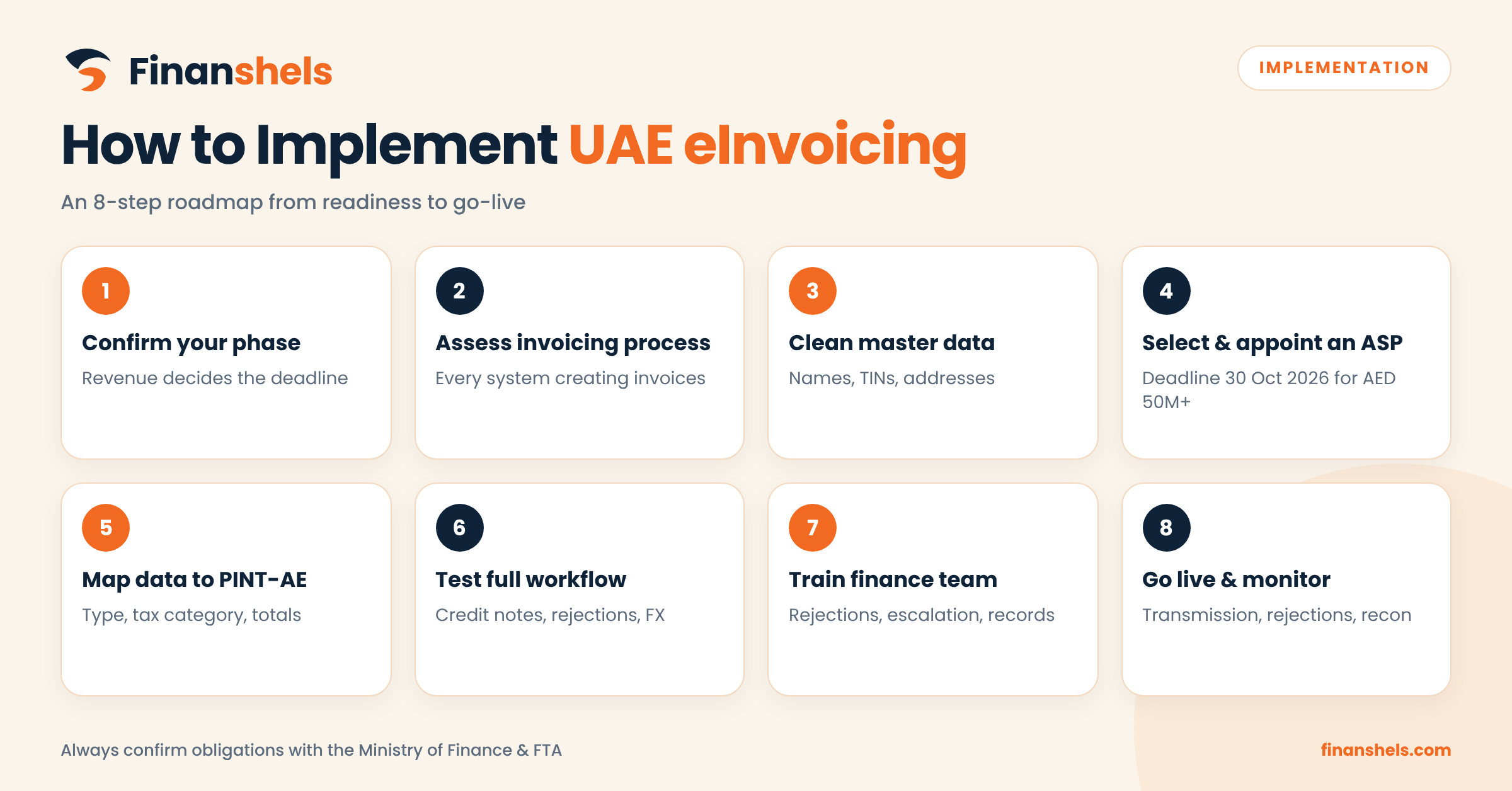
1. Confirm Your Implementation Phase
Start by identifying the deadline that applies to your business.
For businesses, annual revenue is an important factor in determining the mandatory implementation phase.
2. Assess Your Current Invoicing Process
Identify every system used to create or modify invoices, including:
- Accounting software
- ERP systems
- Spreadsheets
- Sales platforms
- E-commerce systems
- Point-of-sale systems
- Manual invoice templates
Also document how the business handles:
- Credit notes
- Refunds
- Discounts
- Advances
- Returns
- Reverse-charge transactions
- Other special scenarios
3. Clean Your Master Data
Review customer and supplier records before integration.
Check:
- Legal names
- Tax information
- TINs and other required identifiers
- Addresses
- Country information
- Tax classifications
- Electronic addresses
- Duplicate records
Poor master data can create validation and reconciliation problems after implementation.
4. Select and Appoint an ASP
Compare providers based on:
- Accreditation
- ERP compatibility
- Integration requirements
- Technical capabilities
- Support
- Pricing
- Data retention
- Implementation timeline
Businesses subject to the first mandatory phase should be particularly mindful of the 30 October 2026 ASP appointment deadline .
5. Map Data to PINT-AE
Map information in the existing accounting or ERP system to the applicable eInvoice structure.
Pay particular attention to:
- Invoice type
- Tax category
- Tax rate
- Units of measure
- Document references
- Discounts
- Tax amounts
- Customer identifiers
- Electronic addresses
- Currency
- Invoice totals
6. Test the Complete Workflow
Do not test only a successful standard invoice.
Test:
- Standard tax invoices
- Commercial invoices where applicable
- Credit notes
- Different VAT treatments
- Foreign-currency transactions
- Incorrect data
- Rejected invoices
- Amendments
- System failures
- Customer and supplier identifiers
7. Train the Finance Team
Finance staff should understand how to:
- Create invoices
- Identify rejected documents
- Correct errors
- Monitor acknowledgements
- Escalate technical problems
- Reconcile transmitted invoices
- Maintain required records
8. Go Live and Monitor
After implementation, monitor:
- Invoice transmission
- Rejections
- System errors
- Reporting
- Reconciliation
- Data quality
Implementation is not complete simply because the technical connection is live. Businesses need ongoing controls to ensure that the information being transmitted is complete and accurate.
UAE eInvoicing Costs
The total cost of eInvoicing depends on the size and complexity of the business.
Potential costs include:
- ASP subscription fees
- Per-invoice or transaction charges
- ERP integration
- API or connector development
- System upgrades
- Data cleansing
- Implementation support
- Staff training
- Ongoing technical support
Businesses should compare the total cost of implementation and ongoing operation rather than selecting a provider based only on its monthly subscription price.
A lower headline price may not necessarily mean a lower total cost if the solution requires significant custom integration or charges separately for support and additional transactions.
UAE eInvoicing Penalties and Compliance Risks
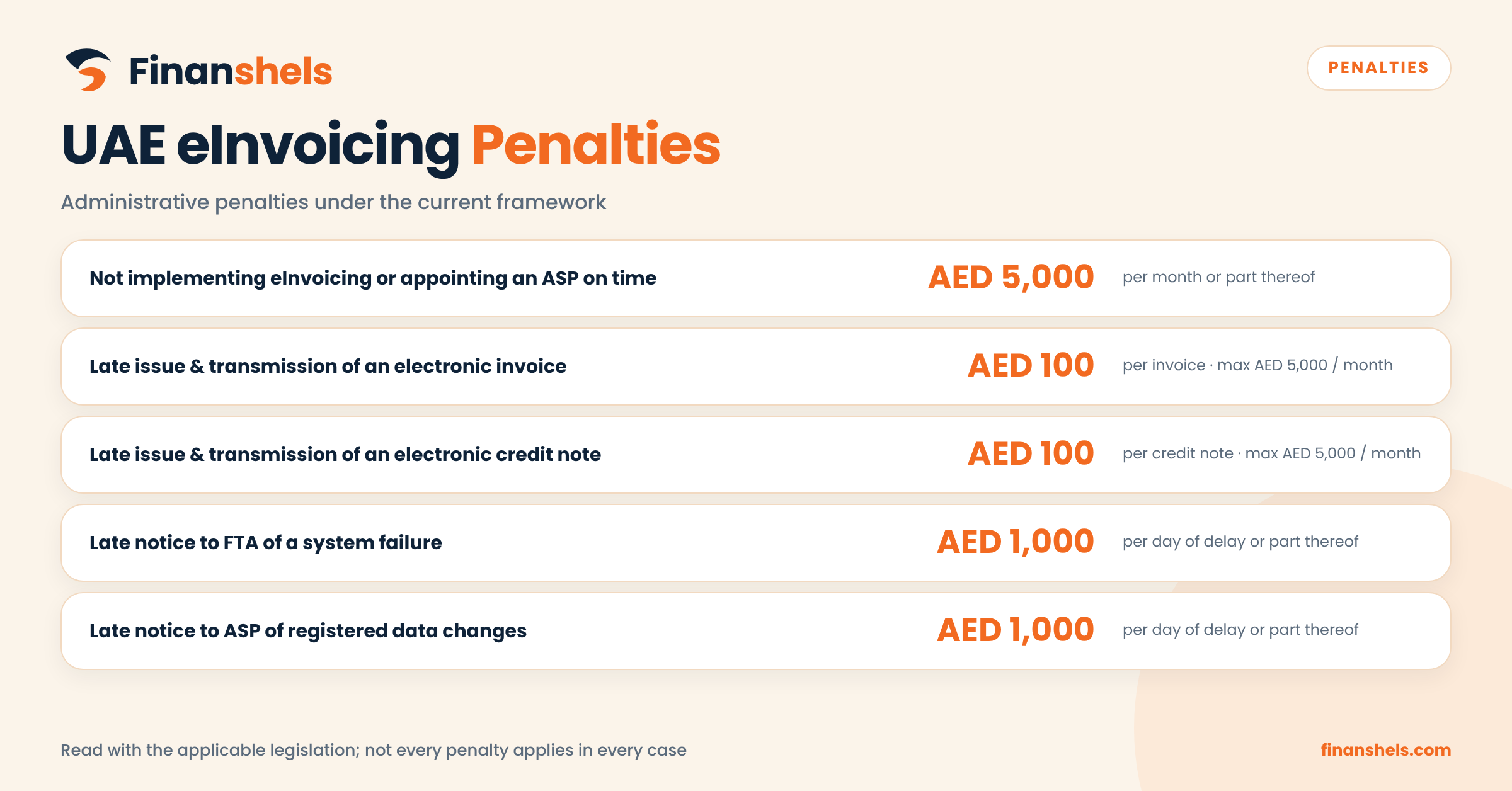
The UAE has established administrative penalties for failures relating to the eInvoicing system.
Under the current penalty framework, these include:
| Violation | Administrative Penalty |
|---|---|
| Failure to implement eInvoicing or appoint an ASP within the prescribed timeframe | AED 5,000 per month or part thereof |
| Failure to issue and transmit an electronic invoice within the prescribed timeframe | AED 100 per invoice, subject to a maximum of AED 5,000 per calendar month |
| Failure to issue and transmit an electronic credit note within the prescribed timeframe | AED 100 per credit note, subject to a maximum of AED 5,000 per calendar month |
| Failure to notify the FTA of a system failure within the prescribed timeframe | AED 1,000 per day of delay or part thereof |
| Failure to notify the ASP of specified changes to registered data within the prescribed timeframe | AED 1,000 per day of delay or part thereof |
The penalty framework should be read together with the applicable legislation and implementation decisions. Businesses should not assume that every penalty applies in every circumstance.
The practical risks also include:
- Rejected invoices
- Delayed collections
- Reconciliation problems
- Additional administrative work
- Billing disruption
- Incorrect tax reporting
- Audit issues
Preparing early gives businesses more time to identify technical and data problems before mandatory implementation.
What Happens During an eInvoicing System Failure?
System outages can happen even after implementation.
Businesses should establish a documented process covering:
1. Identify the Failure
Determine whether the problem originates from the internal accounting system, the ASP, the network or another part of the process.
2. Assign Responsibility
Nominate a primary owner and backup responsible for handling the incident.
3. Follow Notification Requirements
Understand when a system failure must be reported to the FTA and the ASP and ensure the responsible team knows the applicable notification procedure.
4. Maintain Transaction Records
Ensure transactions are recorded and preserved while the system is unavailable.
5. Document the Incident
Keep:
- Timestamps
- Error messages
- System notifications
- Communications
- Notification references
- Corrective actions
6. Reconcile After Recovery
Once the system is restored, confirm that affected invoices have been processed and that accounting and tax records are complete.
UAE eInvoicing for SMEs and Startups
For SMEs, eInvoicing can initially look like a technology project. In practice, much of the preparation involves data and process management.
Smaller businesses should focus on three areas.
Clean Data
Review customer, supplier and tax information before connecting systems.
Simple Processes
Reduce the number of places where invoices are created. If sales, finance and operations use different systems, determine which system should be the source of invoice data.
Scalable Systems
Choose an implementation that can support increased transaction volume as the business grows.
A business issuing a small number of invoices may be able to manage manual processes today, but duplicate data entry, reconciliation and invoice tracking can become increasingly difficult as transaction volumes increase.
A structured eInvoicing workflow can reduce manual processing and improve the flow of invoice information between businesses and their accounting systems.
UAE eInvoicing Dos and Don’ts
| Do | Don’t |
|---|---|
| Confirm your implementation phase early | Wait until your deadline is approaching |
| Review customer and supplier data | Assume existing master data is accurate |
| Use the current official ASP information | Rely solely on vendor marketing claims |
| Confirm ERP and accounting-system compatibility | Assume “eInvoicing-ready” means fully compliant |
| Map tax treatments carefully | Treat VAT configuration as an afterthought |
| Test rejected and unusual invoices | Test only standard successful invoices |
| Train finance staff | Leave the workflow with one person |
| Document system-failure procedures | Wait for an outage to create a process |
| Reconcile eInvoices with accounting and tax records | Assume successful transmission means the data is correct |
| Monitor official guidance | Rely indefinitely on an old checklist |
UAE eInvoicing Checklist
Before going live, businesses should be able to answer “yes” to the following:
- We have confirmed the implementation phase that applies to us.
- We understand the applicable eInvoicing requirements.
- We have reviewed our current invoicing systems.
- We have identified and appointed an appropriate ASP.
- Our accounting or ERP system can integrate with the required framework.
- Customer and supplier master data has been reviewed.
- Required TINs and other identifiers have been checked.
- VAT tax treatments have been mapped correctly, with reference to the business’s VAT filing requirements .
- PINT-AE requirements have been mapped.
- Required invoice and credit-note scenarios have been tested.
- Rejection and error-handling processes have been tested.
- Finance staff have been trained.
- System-failure procedures have been documented.
- Record retention and reconciliation processes are in place.
- We are monitoring the latest official UAE guidance.
Frequently Asked Questions About UAE eInvoicing
Is eInvoicing mandatory in the UAE?
Yes. The UAE is introducing eInvoicing through a phased mandatory framework covering in-scope businesses and government entities, subject to applicable exclusions.
When does UAE eInvoicing become mandatory?
Mandatory implementation begins in phases.
Businesses with annual revenue of AED 50 million or more must implement eInvoicing from 1 January 2027 . Businesses with annual revenue below AED 50 million must implement it from 1 July 2027 , while in-scope government entities have a 1 October 2027 implementation date.
When must businesses appoint an ASP?
For businesses with annual revenue of AED 50 million or more, the current deadline to appoint an ASP is 30 October 2026 .
Businesses with annual revenue below AED 50 million have until 31 March 2027 to appoint an ASP.
Is a PDF invoice considered an eInvoice in the UAE?
No. The Ministry of Finance states that PDFs, Word documents, images, scanned copies and emails are unstructured formats and are not eInvoices under the UAE system.
What is PINT-AE?
PINT-AE is the UAE implementation of the Peppol International Invoice specification. It defines the structured invoice format and associated business rules used in the UAE eInvoicing system.
What is an Accredited Service Provider?
An Accredited Service Provider is an approved provider that facilitates participation in the UAE eInvoicing system, including electronic invoice exchange and related technical and reporting functions.
Do SMEs need to prepare for eInvoicing?
Yes, if they fall within the scope of the system. Businesses with annual revenue below AED 50 million are currently scheduled for mandatory implementation from 1 July 2027 , subject to the applicable rules and exclusions.
Does my accounting software need to change?
Not necessarily. A business may be able to connect its existing accounting and bookkeeping system or ERP to an ASP. However, some businesses may require software upgrades, configuration changes or additional integration work.
How many mandatory fields does a UAE eInvoice have?
The published Ministry of Finance mandatory-field guidance specifies 51 mandatory fields for an electronic Tax Invoice and 49 for a Commercial Electronic Invoice . The applicable fields depend on the document type and transaction scenario.
Does a UAE eInvoice need a QR code?
No. The Ministry’s published guidance states that UAE electronic invoices are issued, transmitted and received in XML format and do not feature a QR code or barcode.
What happens if an eInvoice is rejected?
The business needs to identify and correct the issue according to the applicable validation requirements before the invoice can be successfully processed. Businesses should establish a rejection-management workflow before going live.
What are the penalties for UAE eInvoicing non-compliance?
Penalties can apply to failures such as late implementation or ASP appointment, failure to issue and transmit required eInvoices or credit notes, and failure to report certain system failures or data changes within the prescribed timeframe.
How Finanshels Can Help With UAE eInvoicing
For businesses that need support preparing for eInvoicing, Finanshels can help assess current invoicing and accounting workflows, review financial data, support implementation planning, and align eInvoicing preparation with ongoing bookkeeping , VAT filing and Corporate Tax filing processes.
The objective is not simply to connect an invoicing system. It is to ensure that the data flowing through the system is accurate, properly classified, and reconciled with the wider finance function, including bookkeeping , VAT return preparation and Corporate Tax return preparation .
Schedule a compliance audit with Finanshels to review your invoicing workflow, system readiness, and preparation requirements.