


The UAE is moving towards a structured electronic invoicing system that will change how businesses issue, exchange and process invoices. For businesses still relying on spreadsheets, PDFs or disconnected accounting tools, preparing for this transition involves more than simply switching to digital invoicing software.
Choosing the right e-invoicing solution in the UAE means finding a system that meets applicable regulatory requirements, integrates with your existing finance processes and can support your business as it grows.
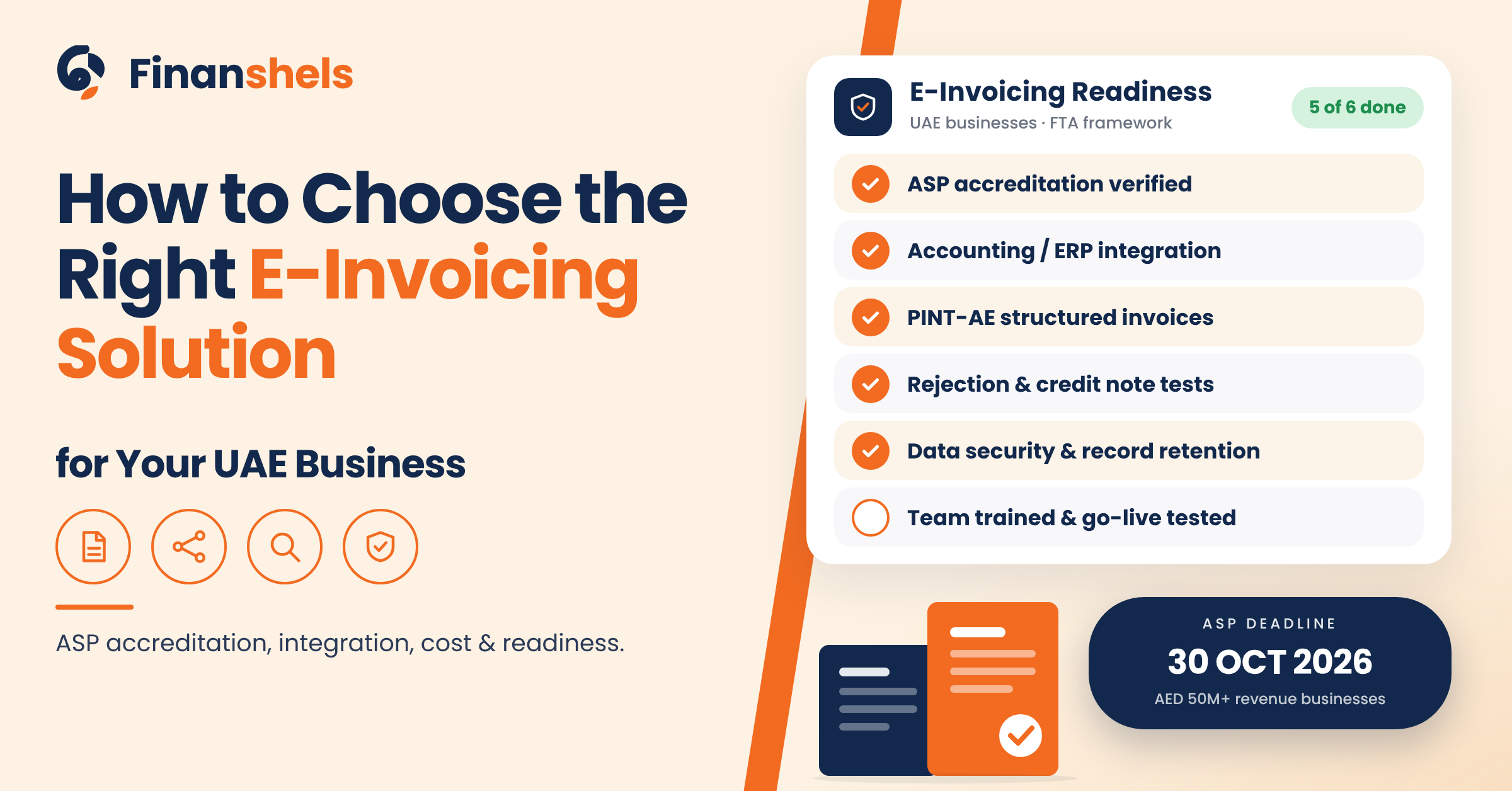
The decision is also becoming more urgent. Under the current implementation schedule, businesses with annual revenue of AED 50 million or more must appoint an Accredited Service Provider (ASP) by 30 October 2026 and implement e-invoicing by 1 January 2027. Other businesses generally have until 31 March 2027 to appoint an ASP and 1 July 2027 to implement the system, subject to the applicable rules and scope.
This guide explains what to look for when comparing e-invoicing solutions, the questions to ask providers and how to prepare your business for implementation. For a more detailed overview of the rollout, read our guide to UAE e-invoicing requirements, timelines and ASP implementation.
Key takeaways
- Your chosen provider must meet the UAE's applicable ASP accreditation requirements.
- The solution should work with your accounting software, ERP or existing finance systems.
- A PDF invoice sent by email is not the same as a structured electronic invoice under the UAE framework.
- Consider setup, integration, transaction volumes, support and ongoing subscription fees.
- Clean data, review workflows and test the system before implementation becomes mandatory.
| What to evaluate | Why it matters |
|---|---|
| UAE compliance | Supports alignment with applicable e-invoicing requirements |
| ASP accreditation | Helps ensure invoices can be exchanged through an appropriately accredited provider |
| Software integration | Reduces duplicate data entry and manual work |
| Automation | Improves invoice processing and status tracking |
| Security and records | Supports data protection and record-retention obligations |
| Pricing and scalability | Helps manage costs as transaction volumes increase |
What is e-invoicing in the UAE?
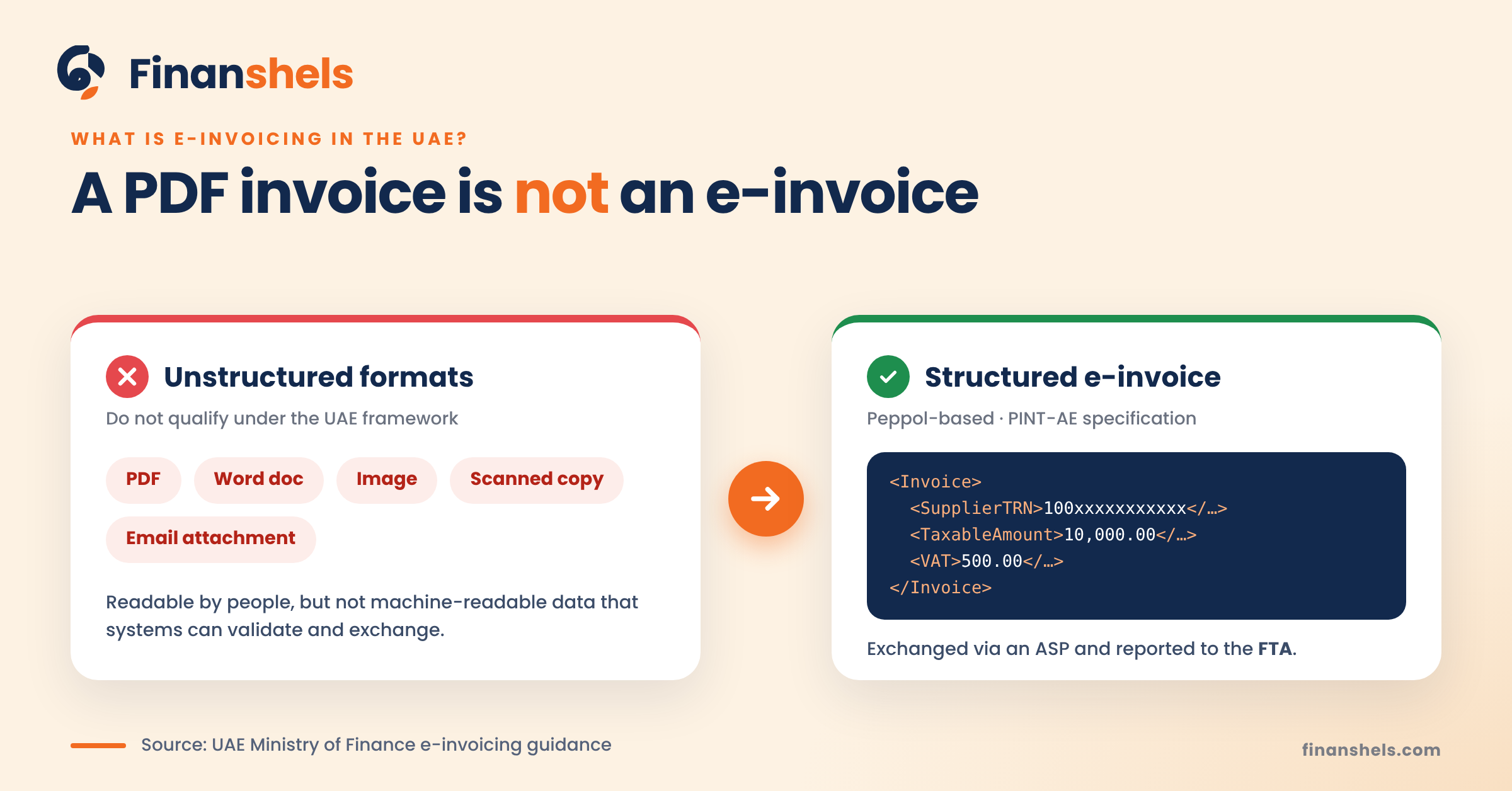
Electronic invoicing, or e-invoicing, is the process of issuing, transmitting, receiving and processing invoice data in a structured digital format. Under the UAE's national framework, the data is exchanged electronically and reported to the Federal Tax Authority (FTA) through the prescribed system.
The distinction between an ordinary digital invoice and a compliant e-invoice is important. According to the UAE Ministry of Finance, PDFs, Word documents, images, scanned copies and invoices sent as email attachments are unstructured formats and do not qualify as e-invoices under this framework.
How does the UAE e-invoicing system work?
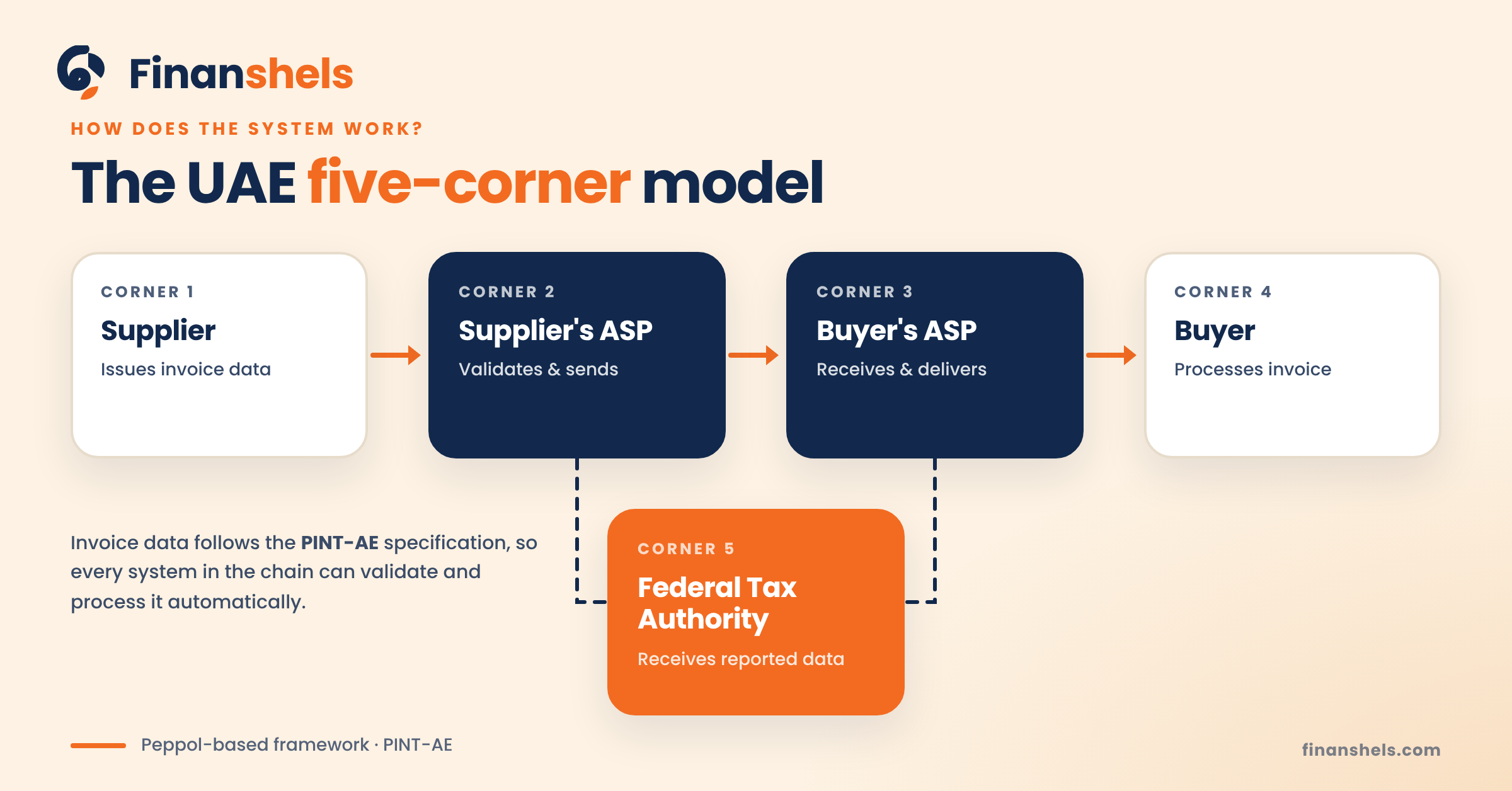
The UAE is adopting a Peppol-based framework using the PINT-AE specification, which defines the data requirements for electronic invoices. The system uses a five-corner model to support invoice exchange and reporting.
In a typical transaction, the supplier sends structured invoice data through its ASP. The provider facilitates the exchange with the buyer's provider, and the prescribed reporting process transmits relevant data to the FTA.
This approach is intended to make invoice information more consistent and machine-readable, reducing reliance on manual handling and enabling systems to process invoice data electronically. The precise technical responsibilities depend on the framework requirements and the services offered by the provider.
Who needs to prepare for e-invoicing?
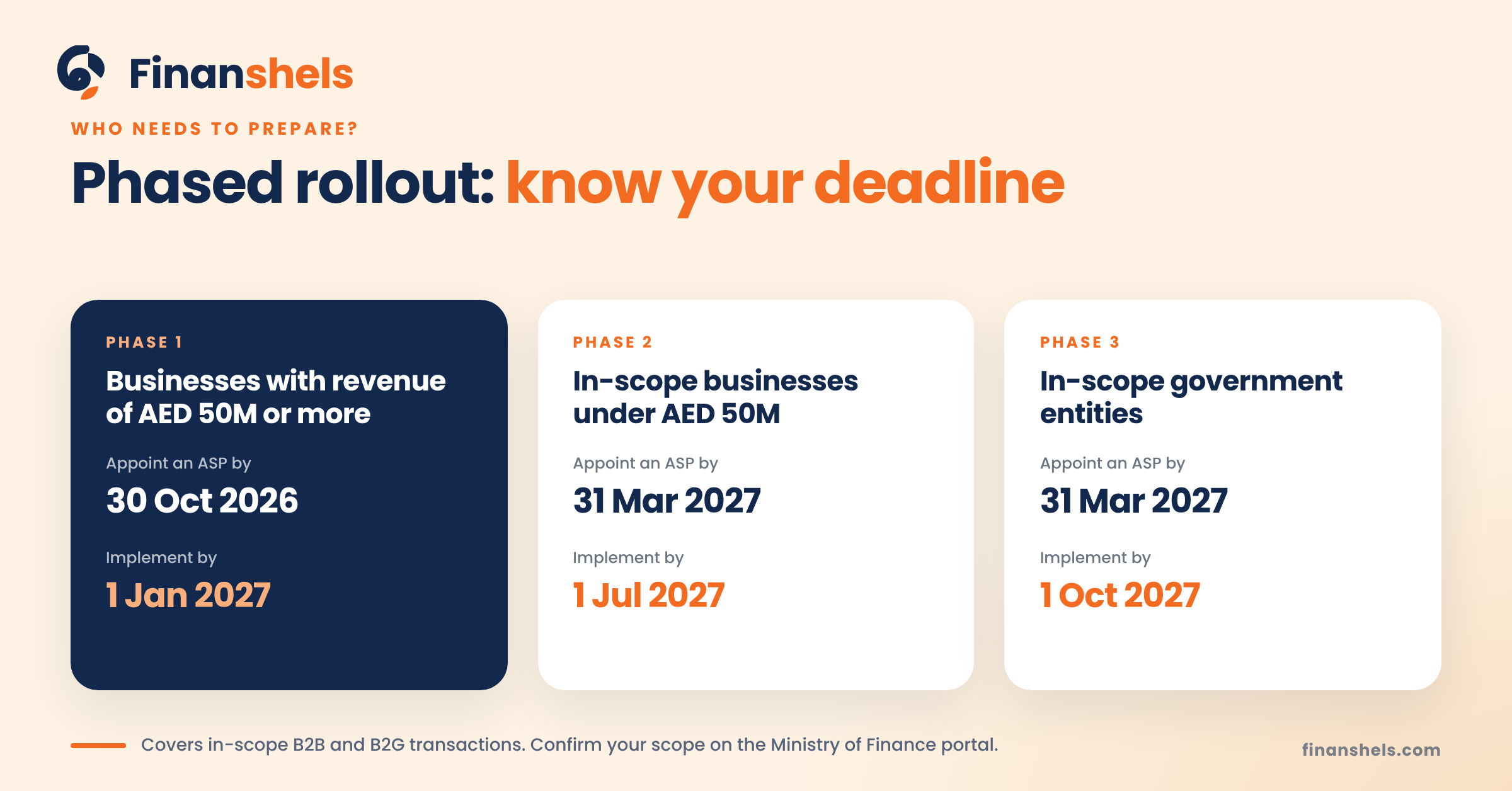
The UAE framework covers in-scope business-to-business (B2B) and business-to-government (B2G) transactions, subject to specified exclusions and implementation rules. The rollout is phased, so businesses should confirm their applicable scope and dates rather than assuming every business has the same deadline.
| Business category | ASP appointment deadline | Implementation date |
|---|---|---|
| Businesses with annual revenue of AED 50 million or more | 30 October 2026 | 1 January 2027 |
| Other in-scope businesses below AED 50 million | 31 March 2027 | 1 July 2027 |
| In-scope government entities | 31 March 2027 | 1 October 2027 |
The practical implication is that businesses should begin evaluating their options before their implementation date. Waiting until the final weeks can leave little time to resolve software compatibility issues, clean up invoice data or train employees.
8 factors to consider when choosing an e-invoicing solution in the UAE
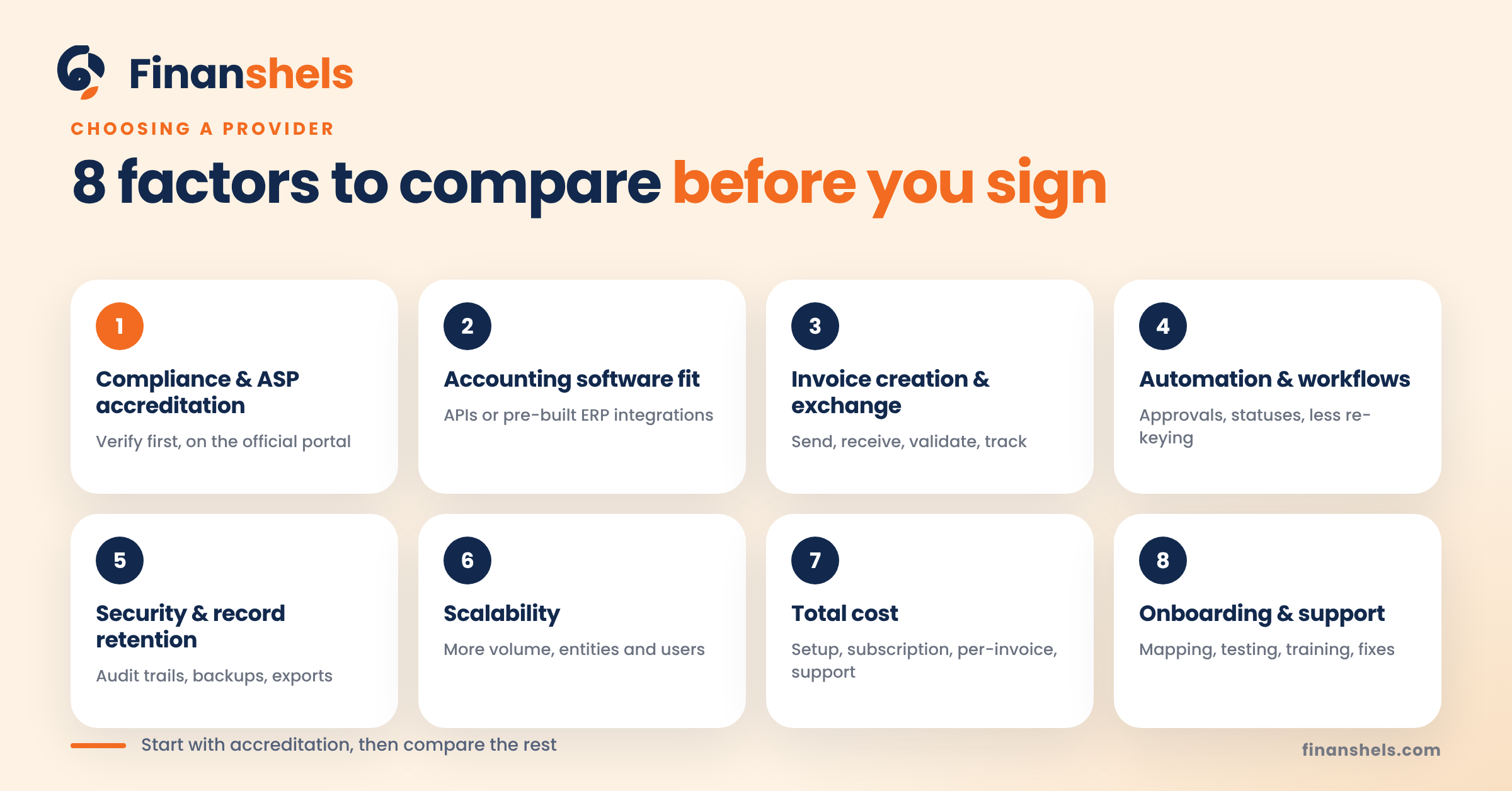
Not every invoicing tool is designed to meet the UAE's new requirements. Some focus on creating invoices and tracking payments, while others support structured invoice exchange, accounting integration and regulatory reporting.
Use the following criteria to compare providers before making a decision.
1. Verify UAE e-invoicing compliance and ASP accreditation
Start by confirming that the provider meets the UAE's applicable accreditation requirements. This should be your first screening criterion, before comparing pricing or additional features.
Ask the provider:
- Is the service provider accredited under the current UAE framework?
- Does the solution support the PINT-AE specification and required invoice data fields?
- How does it validate invoices before transmission?
- How are rejected invoices, credit notes and corrections handled?
- How are regulatory and technical updates implemented?
The accreditation framework changed in October 2026. The Ministry of Finance's updated accreditation decision explains the move to a direct accreditation process. Businesses should verify the provider's current status against the official UAE e-invoicing portal rather than relying only on a provider's marketing claims.
2. Check compatibility with your accounting software
An e-invoicing solution should fit into your existing finance workflow instead of creating another disconnected system.
If your business uses accounting software or an enterprise resource planning (ERP) system, check whether the provider can connect to it directly. Integration can reduce duplicate data entry and help maintain consistent records across invoicing, accounting and reporting.
Before selecting a provider, confirm:
- Compatibility with your current accounting software or ERP.
- Availability of APIs or pre-built integrations.
- Automatic synchronisation of customer, supplier and invoice data.
- Support for your existing approval and payment workflows.
- Responsibility for integration, testing and ongoing maintenance.
For example, a business that processes hundreds of invoices through an ERP may need a different integration approach from a small consultancy that raises a few dozen invoices each month.
If your accounting records also need attention before implementation, explore Finanshels' bookkeeping services for UAE businesses.
3. Evaluate invoice creation, exchange and processing features
An automated invoicing system should support more than generating an invoice document. Under the UAE framework, the ability to exchange structured invoice data is central to compliance.
Look for capabilities that support your actual business transactions.
| Feature | What to check |
|---|---|
| Invoice creation | Required fields and structured data generation |
| Invoice transmission | Exchange through the applicable provider network |
| Incoming invoices | Receipt and processing of supplier invoices |
| Validation | Checks for missing or invalid data |
| Invoice status | Visibility into acceptance, rejection and processing |
| Credit notes | Support for relevant credit note requirements |
| Reporting | Access to transaction and reporting records |
Ask for a demonstration using a realistic transaction, including what happens when an invoice is rejected or needs correction.
4. Look for useful automation and workflow controls
One of the main electronic invoicing benefits is reducing repetitive manual work. However, the level of automation varies by solution.
Consider whether the system can validate invoice data, route documents for approval, update statuses and reduce the need to enter the same information in multiple places.
For businesses with regular supplier purchases, automated accounts payable workflows may also help organise incoming invoices and flag discrepancies. For service businesses, invoice status tracking and reminders may be more useful.
The objective is to reduce unnecessary manual handling while keeping appropriate human review for exceptions, unusual transactions and accounting decisions.
5. Review data security and record retention
Invoices contain commercially sensitive information, including customer details, transaction values and supplier records. Your provider should explain how this information is protected and made available when required.
Check for:
- Role-based access controls and user permissions.
- Encryption and secure data transmission.
- Audit trails showing relevant changes and actions.
- Backup, recovery and business continuity procedures.
- Clear data ownership, export and termination arrangements.
- Record retention and retrieval capabilities that support applicable UAE requirements.
The Ministry of Finance's UAE Electronic Invoicing Guidelines provide the official reference for the framework's technical and record-keeping requirements. The provider should explain how its services support your business's obligations rather than simply promising that the software is secure.
6. Choose a solution that can scale with your business
Your invoicing needs may change as your business adds customers, suppliers, employees, branches or legal entities.
A solution that works for a small operation today may become difficult to manage if transaction volumes grow significantly. Assess whether the provider can support higher invoice volumes without requiring a complete system replacement.
Consider whether you need:
- Multi-entity or multi-branch functionality.
- Different user roles and approval levels.
- Multiple currencies for relevant transactions.
- Integration with additional accounting or ERP systems.
- Consolidated reporting across entities.
- Flexible pricing as invoice volumes increase.
You do not need to pay for every advanced feature from day one. Choose a system that meets current requirements and offers a realistic upgrade path.
7. Compare total cost, not just the subscription fee
The cheapest advertised plan may not be the least expensive option once implementation and ongoing usage are included.
Request a complete breakdown of charges before signing a contract.
| Cost component | Questions to ask |
|---|---|
| Setup | Is there a one-time onboarding fee? |
| Subscription | Is pricing fixed monthly or annual? |
| Transactions | Are there limits or per-invoice charges? |
| Integration | Are APIs, ERP connections or custom development charged separately? |
| Support | Is technical assistance included? |
| Training | Are onboarding sessions included or billed separately? |
| Upgrades | Are additional features or entities charged extra? |
Estimate costs using your expected invoice volume, not just your current monthly average. Ask what happens if transaction volumes increase or you need to add another entity.
Also check the contract term, cancellation conditions and whether your business can export its invoice data if it changes providers.
8. Assess onboarding and ongoing support
A technically capable solution can still be difficult to implement if the provider offers limited onboarding support.
Ask how long implementation typically takes for businesses of your size and what your team will need to prepare. The answer should cover more than software installation.
Look for a clear process for data mapping, system integration, testing, staff training and issue resolution. You should also know whom to contact when invoices fail validation or transmission.
A provider that explains these steps clearly can help your team prepare more effectively than one that focuses exclusively on product features.
How to compare e-invoicing solutions for UAE businesses
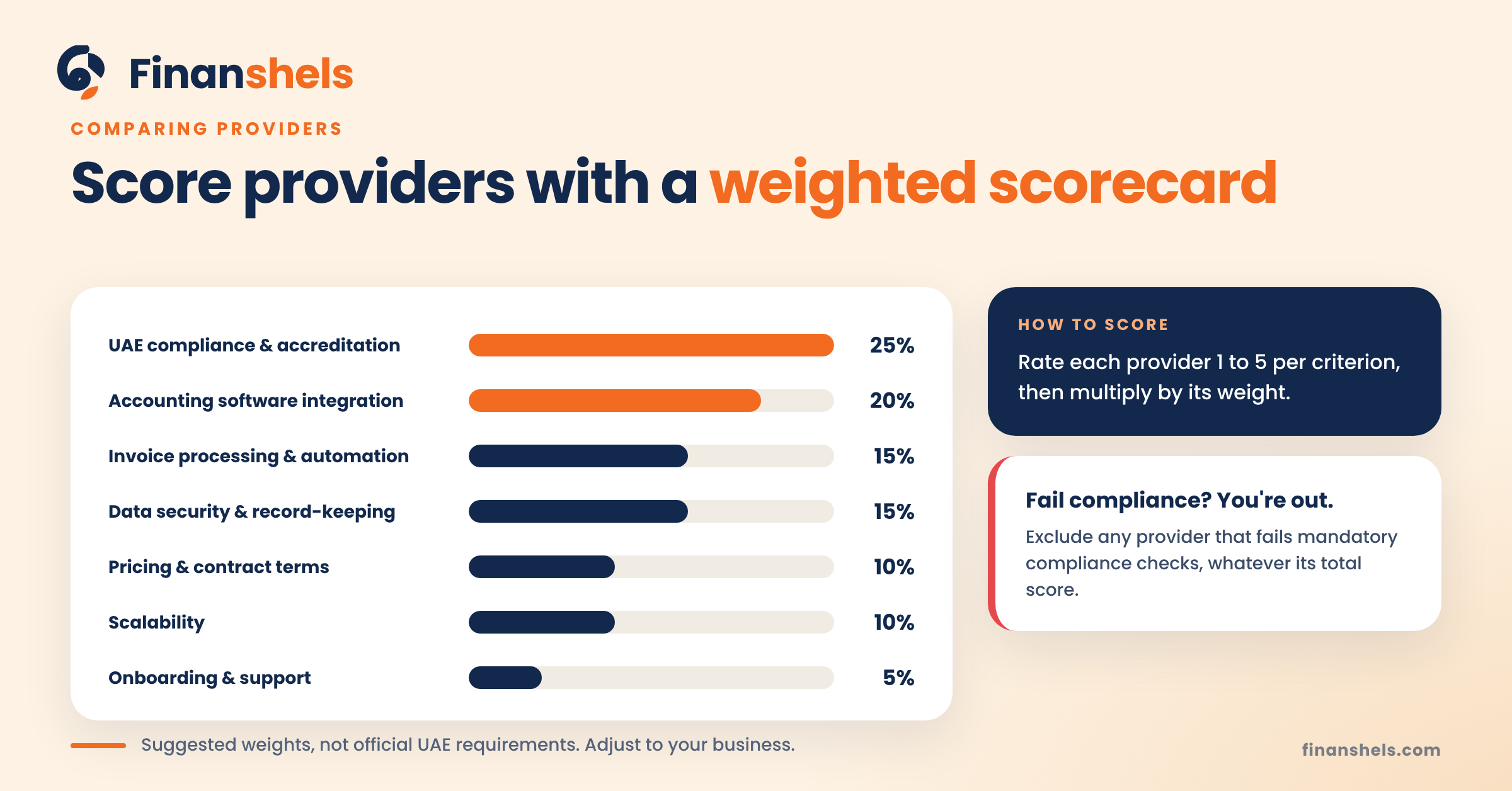
Once you have shortlisted providers, use a consistent evaluation method rather than relying on sales demonstrations alone.
Score each provider against your requirements, with greater weight given to compliance, integration and operational reliability.
| Evaluation criterion | Suggested weight |
|---|---|
| UAE compliance and accreditation | 25% |
| Accounting software integration | 20% |
| Invoice processing and automation | 15% |
| Data security and record-keeping | 15% |
| Pricing and contract terms | 10% |
| Scalability | 10% |
| Onboarding and support | 5% |
| Total | 100% |
These are suggested evaluation weights, not official UAE requirements. Adjust them to reflect your business's size, systems and priorities.
Rate each provider from 1 to 5 for every criterion, then multiply its score by the corresponding weight. Any provider that fails your mandatory compliance checks should be excluded, regardless of its overall score.
Before making a final decision, request a practical demonstration and ask the provider to explain how it handles a rejected invoice, an incorrect data field and a credit note. These scenarios can reveal gaps that a standard product demonstration might not show.
How to prepare your business for e-invoicing in the UAE
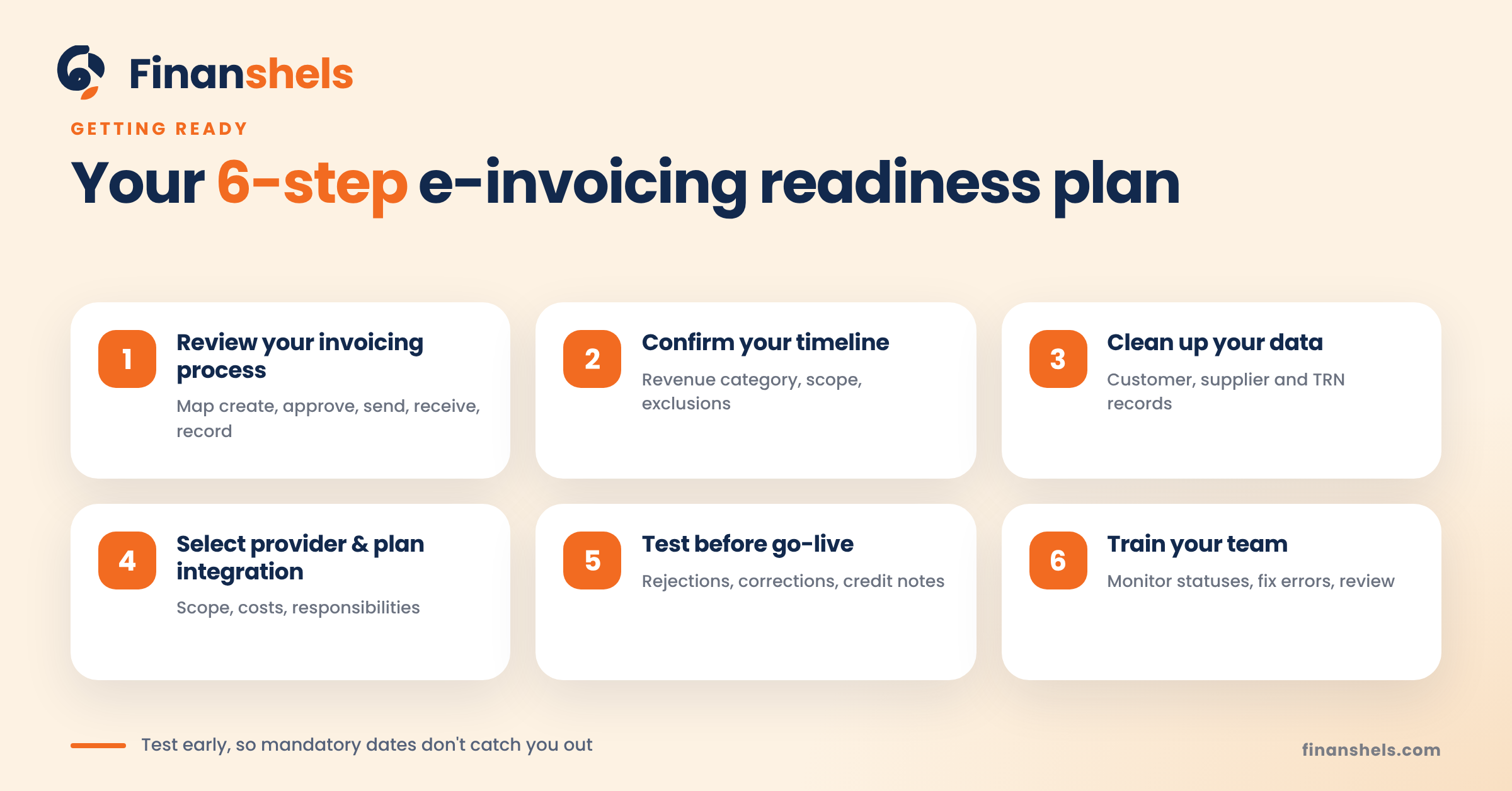
Selecting software is only one part of the transition. Your business also needs accurate data, clear responsibilities and a tested implementation process.
Step 1: Review your current invoicing process
Map how your business creates, approves, sends, receives and records invoices today. Identify manual steps, duplicate entries, recurring errors and disconnected systems.
This will help you determine which features are essential and where automation can make the biggest difference.
Step 2: Confirm your implementation timeline
Check your annual revenue category, transaction types, applicable exclusions and the relevant appointment and go-live deadlines.
Use the official Ministry of Finance e-invoicing portal to confirm current guidance. Do not assume that your VAT registration status alone determines every aspect of your e-invoicing obligations.
Step 3: Clean up your invoice and customer data
Review customer and supplier records, tax registration details, invoice numbering, transaction classifications and other required data fields.
Incorrect or incomplete information can create problems during validation and integration. Resolve obvious inconsistencies before moving to testing.
Step 4: Select your provider and plan integration
After verifying accreditation and comparing providers, agree on the implementation scope, responsibilities, costs and timeline.
Work with the provider and your accounting team to map data between systems and identify any changes required to your existing processes.
Step 5: Test transactions before going live
Test invoice creation, transmission, receipt, validation, status updates and credit note handling. Include rejected invoices and other exceptions in your test scenarios.
Confirm that records are consistent across the invoicing solution and your accounting system before moving into production.
Step 6: Train your team and establish ongoing checks
Make sure finance staff understand how to monitor invoice statuses, resolve errors and retrieve records. Assign responsibility for provider communication, system access and compliance updates.
After implementation, periodically review failed transactions, data quality, system performance and changes to regulatory requirements.
Final thoughts
Choosing the right e-invoicing solution is not simply a software purchase. It is a decision about how your business will manage invoice data, connect finance systems and meet its obligations as the UAE's electronic invoicing framework is introduced.
Start with accreditation and compliance, then compare integration, automation, security, scalability and total cost. A solution that fits your existing processes and gives your team enough time to prepare will be more useful than one selected solely for its price or feature list.
Frequently asked questions about e-invoicing in the UAE
How do you set up an e-invoice in the UAE?
To set up e-invoicing, review the applicable UAE requirements, choose an appropriately accredited service provider, prepare the required invoice data and integrate your invoicing or accounting software. Test invoice generation, exchange, validation and reporting before implementation.
Under the UAE framework, an e-invoice must use the prescribed structured format. Creating a PDF and emailing it to a customer does not, by itself, meet this requirement.
What is a tax invoice in the UAE?
A tax invoice is a document issued for a taxable supply under UAE VAT rules. It contains prescribed details such as the supplier's name and tax registration number, invoice date, description of goods or services, taxable amount and VAT information, as applicable.
A tax invoice is not automatically a compliant e-invoice under the new framework. The former refers to the document's tax requirements, while the latter involves structured data exchange under the UAE e-invoicing system. See the UAE Government's digital invoicing guidance for further information.
What are the three types of invoices?
There is no universal classification limited to three invoice types. In the context of UAE VAT, businesses commonly encounter:
- Standard tax invoices: Generally used for taxable supplies where a full tax invoice is required.
- Simplified tax invoices: Permitted in circumstances specified under UAE VAT rules.
- Credit notes: Used to document qualifying reductions, cancellations, refunds or corrections to a previous transaction.
Credit notes are a separate document category rather than simply another type of invoice. The applicable requirements depend on the transaction and the relevant VAT and e-invoicing rules.
Is a PDF invoice considered an e-invoice in the UAE?
No. Under the UAE's national e-invoicing framework, a PDF, scanned invoice, image or Word document is not a structured e-invoice. The system requires invoice data to be exchanged in the prescribed machine-readable format, using the applicable technical specifications.
Do UAE businesses need an Accredited Service Provider for e-invoicing?
Businesses within the mandatory scope must follow the applicable provider appointment and implementation requirements. An ASP facilitates the compliant exchange of electronic invoice data under the UAE framework.
Businesses should verify the provider's current accreditation and confirm their own implementation deadline using the official Ministry of Finance guidance.
How much does an e-invoicing solution cost in the UAE?
Costs depend on invoice volumes, subscription structure, integrations, implementation requirements, additional entities, and ongoing support. Some providers may charge per transaction, while others use fixed subscriptions or customised pricing.
Compare the full cost over your expected usage period, including onboarding and integration, rather than choosing solely on the advertised monthly price.
Can e-invoicing software integrate with existing accounting systems?
Yes, depending on the software and provider. Integration may use APIs, built-in connectors, or custom development. Before selecting a solution, confirm that it can exchange the required data with your current accounting or ERP system and test the integration with realistic transactions.
Preparing your business for UAE e-invoicing?
Finanshels helps UAE businesses navigate tax and finance requirements, review their accounting processes, and plan their next steps. Speak to the Finanshels team to discuss how to prepare your business for the transition. You can also explore our accounting and bookkeeping packages to understand how ongoing finance support may fit into your preparation.



