Blog Includes
- What is VAT in the UAE?
- Who Needs to File VAT Returns?
- Step-by-Step Guide to Filing VAT Returns
- Deadlines for Filing VAT Returns
- Common Mistakes to Avoid
- FAQs about VAT Returns in the UAE
- Conclusion
What Is VAT in the UAE?
Value Added Tax (VAT) is a form of indirect tax that is levied on the consumption of goods and services in the UAE. VAT came into force on January 2018 at a standard rate of 5% and applies to most goods and services, with a few exceptions. Businesses registered for VAT must collect this tax from customers and remit it to the Federal Tax Authority (FTA).
VAT is an essential aspect of many UAE start-ups, but don’t panic, it can be handled if you do the right things. You need to keep your VAT records up-to-date, file VAT returns on time and make payments as required so that you don’t incur penalties.
Who Needs to File VAT Returns?
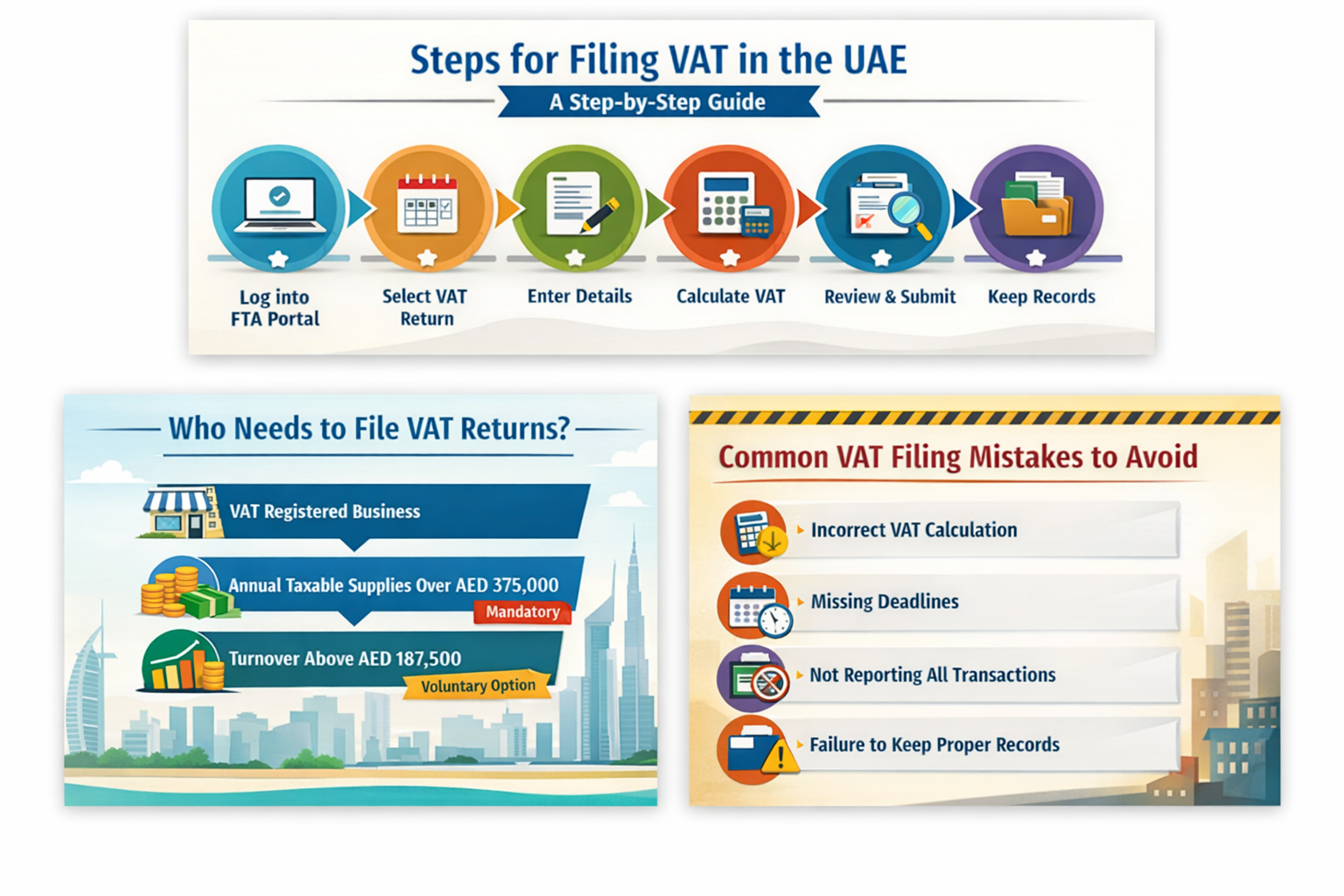
If your organization fulfills the following criteria, you are obligated to file VAT returns in the UAE. Here’s a quick summary which will help you to understand if you are obligated to file VAT returns:
- Your organization is VAT registered with the FTA
- You are making taxable transactions (selling goods/services) in the UAE
- Your organization’s annual taxable supplies exceed the requisite registration threshold of AED 375,000
If your organization’s turnover is below AED 375,000 but more than AED 187,500, you may voluntarily register for VAT
If your organization is part of one of these categories, you are obliged to file VAT returns on a regular basis.
Step-by-Step Guide to Filing VAT Returns
Filing VAT returns doesn’t have to be complicated. By following the steps below, you can easily stay compliant with UAE’s VAT regulations.
Step 1: Log into the FTA e-Services Portal
The first step to filing your VAT return is to log into the official FTA e-Services portal. This is the platform where you will manage your VAT registration and file your returns.
- Make sure you have your username and password, which were provided when you registered for VAT with the FTA.
- The portal is user-friendly and allows businesses to manage VAT-related tasks conveniently.
Step 2: Select VAT Return
Once you are logged into the FTA portal go to the VAT section, you will find the option to file your VAT Return. Choose the right tax period according to your filing is quarterly or annual.
FTA provides the option to file returns for multiple periods, so do not forget to choose the right one!
Step 3: Enter the Required Information
Once you’ve selected the relevant tax period, the next step is to enter detailed information about your business’s taxable transactions. You’ll need to provide the following:
- Sales Revenue: The total value of the goods and services you’ve sold, excluding VAT.
- VAT on Sales: The amount of VAT collected from your customers.
- Purchases: The total value of goods and services your business has purchased, excluding VAT.
- VAT on Purchases: The VAT you’ve paid on your business expenses.
Ensure that all of these figures are accurate to avoid errors. Discrepancies may result in penalties or audits.
Step 4: Calculate VAT Payable or Refundable
Once you’ve entered the data, the system will calculate the VAT payable or refundable based on your sales and purchase VAT amounts. Here’s how it works:
- If your VAT on sales exceeds your VAT on purchases, you will owe VAT to the FTA.
- If your VAT on purchases exceeds your VAT on sales, you may be eligible for a VAT refund.
For example, if you’ve collected more VAT from customers than you’ve paid on purchases, you will owe the FTA the difference.
Step 5: Review and Submit the VAT Return
Before submitting, double-check the details you’ve entered to ensure everything is accurate. Once satisfied, submit your VAT return electronically via the FTA portal.
The FTA will process your submission, and you’ll receive a confirmation of your VAT filing.
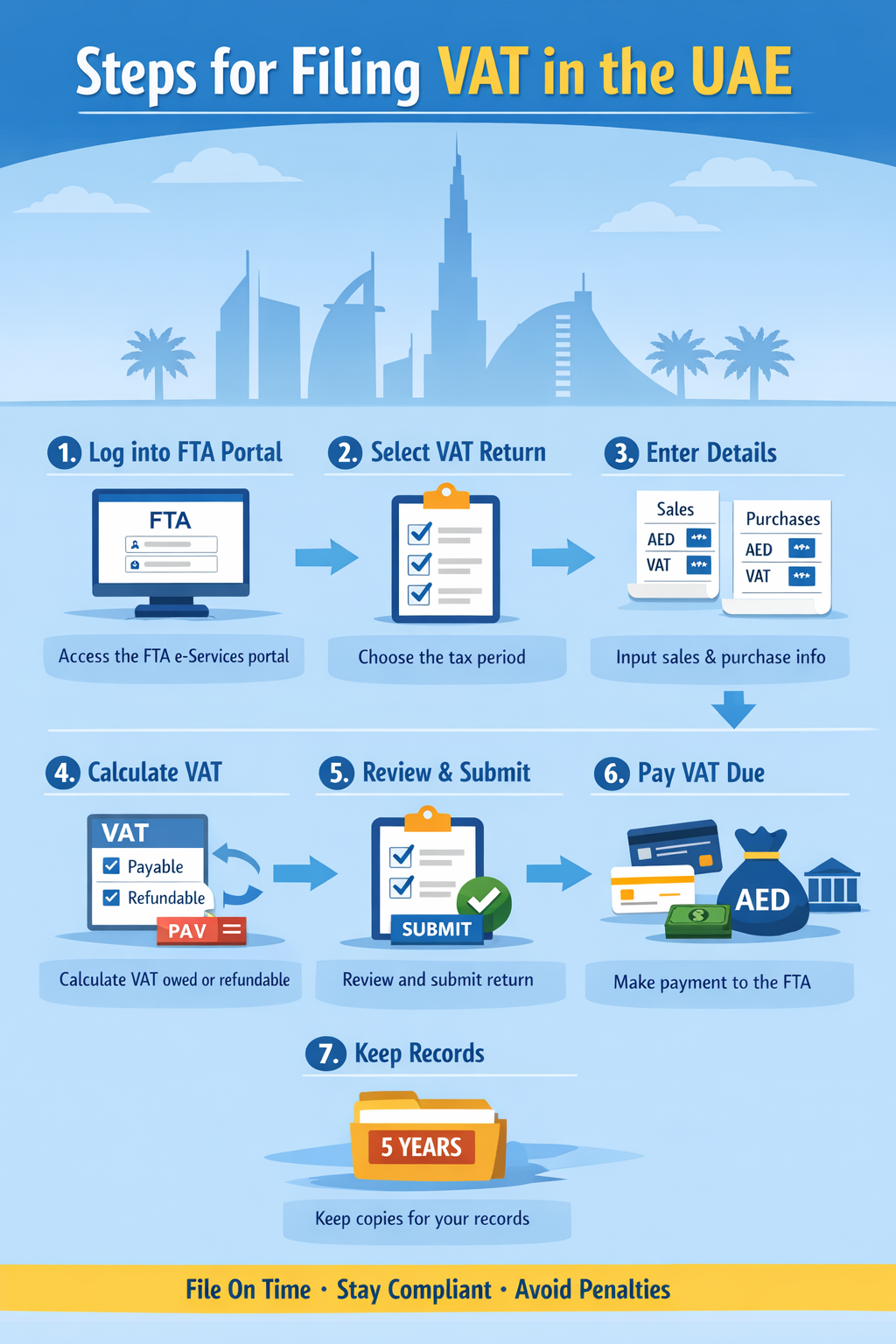
Step 6: Pay the VAT Due (If Applicable)
If your VAT return shows that you owe VAT, it’s time to make the payment to the FTA. You can pay using various methods, including:
- Bank transfer
- Credit card
Make sure to complete the payment by the deadline to avoid any late fees or penalties.
Step 7: Keep a Record of Your VAT Return
After submitting your VAT return and making any necessary payments, always keep a copy of your VAT return for your records. The FTA may request documentation in the case of an audit, and you are required to maintain these records for at least five years.
Deadlines for Filing VAT Returns
VAT returns in the UAE are filed either quarterly or annually, depending on the size of your business and your VAT registration status. The FTA mandates that VAT returns be filed and any VAT due be paid within 28 days after the end of the tax period.
For example:
- For the tax period of January to March, your VAT return should be filed by April 28th.
- For annual VAT returns, the filing deadline is April 30th for the previous year.
Be sure to check your specific deadlines on the FTA portal to avoid missing them.
Common Mistakes to Avoid When Filing VAT Returns
Filing VAT returns can be tricky, especially if you’re unfamiliar with the process. To ensure a smooth experience, avoid these common mistakes:
1. Incorrect VAT Calculation
Ensure that the VAT on sales and purchases is calculated accurately. Mistakes here can lead to overpayment or underpayment of tax.
2. Missing Deadlines
Late filing can result in penalties, so always make sure to submit your VAT return on time.
3. Not Reporting All Transactions
Ensure that all taxable, exempt, and zero-rated supplies are reported accurately in your VAT return.
4. Failure to Keep Proper Records
Maintaining a clear record of all transactions and VAT payments is essential. Failure to do so can cause issues in case of an audit.
FAQs About VAT Returns in the UAE
1. When do I need to file VAT returns?
VAT returns in the UAE are filed quarterly or annually. The exact filing period depends on your business's registration and turnover.
2. What is the VAT rate in the UAE?
The standard VAT rate in the UAE is 5%. This applies to most goods and services, with some exemptions.
3. Can I claim VAT on purchases?
Yes, you can claim VAT on business-related purchases as long as the goods or services are used for your business operations.
4. What happens if I miss the filing deadline?
Missing the filing deadline can result in penalties. It’s crucial to file your returns on time to avoid additional charges.
5. Can I get a VAT refund?
If your VAT on purchases exceeds your VAT on sales, you may be eligible for a VAT refund.
Conclusion
VAT Filing in the UAE – The Complete Guide
Filing VAT returns is a crucial part of operating a business in the UAE if you are registered under the VAT system. Follow this step-by-step guide and make sure you file your VAT returns correctly, on time, and in compliance with UAE tax regulations. By keeping your records up to date and filing on time, you can avoid penalties and ensure your business stays in good standing with the FTA.
If you are unsure about any part of this process or need assistance, contact a tax professional. They will help guide you through the filing process and ensure your business stays compliant.
Resources:
- UAE Federal Tax Authority (FTA). (2023). VAT Return Filing Guide. https://www.tax.gov.ae
- PwC. (2023). VAT in the UAE: Understanding the Tax Structure. https://www.pwc.com