

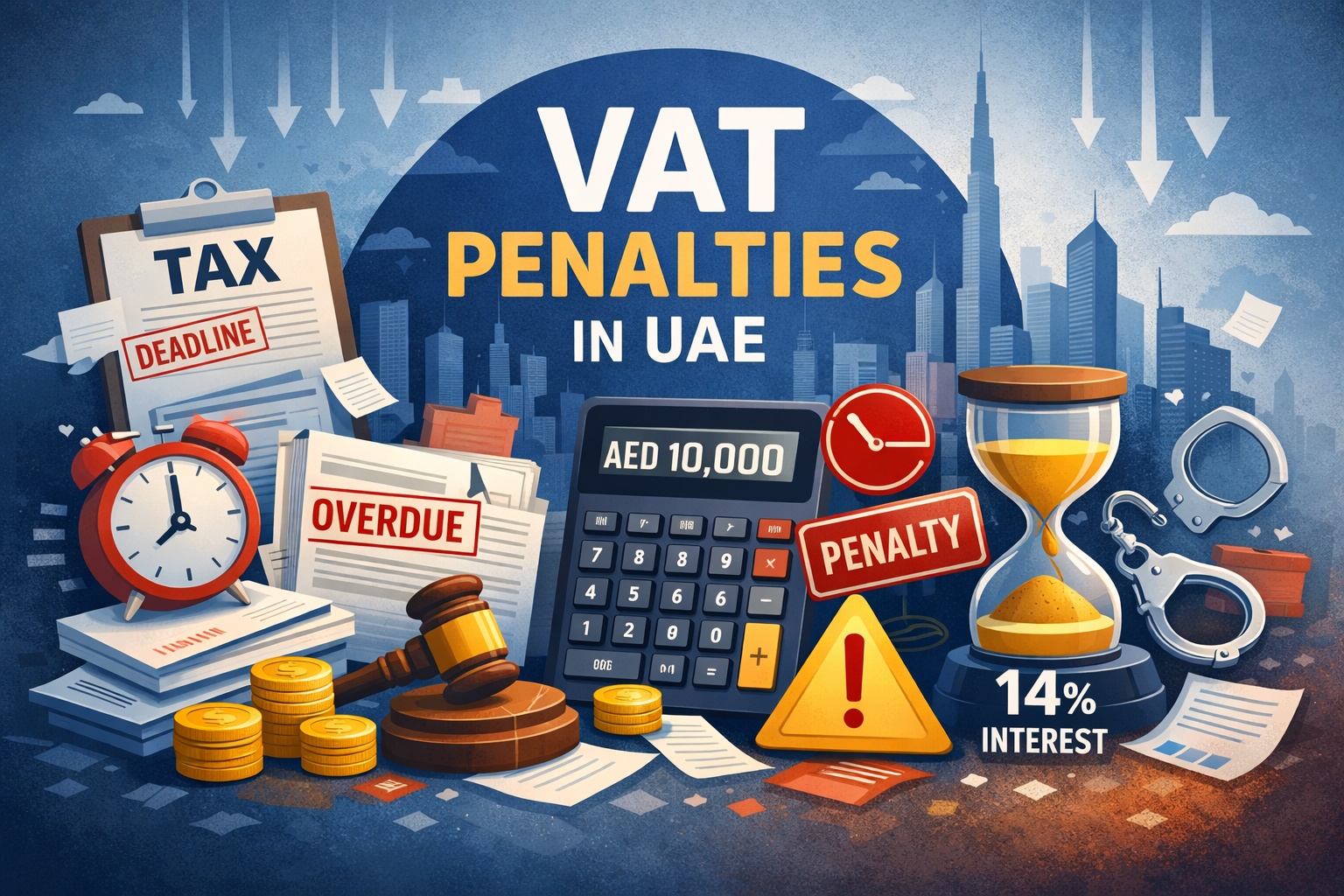
VAT Penalty: Navigating the Rules and Avoiding Fines in UAE
We often find businesses are worried about VAT because when the VAT on unpaid invoices exceeds the threshold of AED 375,000 then the business has to pay it and this creates cash flow issues for many of the Start-ups and businesses in the UAE. Whatever the worth of a business' idea it is almost always a hidden provision of law that can create an obstruction. In this article, we'll look into the implications of VAT, the penalties that could arise, and how your business could avoid such penalties to the aid of your ever flourishing business in the UAE.
Key Takeaways
- Mandatory registration starts when supplies hit AED 375,000.
- Missing deadlines can cost a lot.
- Being proactive avoids big money problems.
- Finanshels makes your finances work better and faster.
- Keeping accurate records is key for audits.
- Knowing tax rules lets you grow your business.
Understanding VAT Penalty Regulations in the UAE
Tax Penalties in the UAE – Important Facts To Know.
The FTA (Federal Tax Authority) of UAE has introduced a number of tax penalty regulations to ensure that all businesses and individuals in the UAE adhere to the tax laws and regulations of UAE. Non-compliance with the tax regulations in UAE can attract penalties and fines that could negatively affect your business.
Types of VAT Violations and Their Penalties
The VAT errors that can be spotted by the Federation of Small Businesses (FSB) fall into three categories with corresponding penalties.
- Not registering for VAT when you should
- Registering late for VAT
- Missing VAT return deadlines
- Submitting wrong or incomplete VAT returns
- Not paying VAT on time
Late VAT payment is a big mistake that costs 14% interest per year. Knowing these types helps businesses spot problems and fix them.
VAT Penalties Table
| Violation Type | Penalty |
|---|---|
| Late VAT Registration | AED 10,000 |
| Failure to Submit VAT Return | AED 1,000 (first time), AED 2,000 (after that) |
| Late Payment of VAT | 14% per year on unpaid VAT |
How VAT Penalty Calculation Works in the UAE
VAT fine is calculated by FTA, depending on the type and extent of the error. Late payment fine is an interest of 14% per annum on the VAT amount. So it is very important to pay VAT on time and keep all accounts up to date.
UAE Tax Penalty Consequences for Businesses
Not following VAT rules can lead to big problems. These include:
- Big fines and penalties
- Damage to your reputation
- Legal trouble
To avoid these issues, businesses should focus on following VAT rules. They should also do regular audits and use audit services to make sure they report VAT correctly and on time.
Step-by-Step Guide to Avoiding VAT Penalties and Ensuring Compliance
To avoid VAT penalties in the UAE, you need to be proactive and know your VAT rules. We've made a simple guide to help your business stay on track and avoid fines.
Step 1: Establish Complete Record-Keeping and Documentation Systems
VAT accounting – recording transactions You must ensure that you keep accurate accounts in relation to your VAT transactions. You must also keep a full and accurate record of all transactions including cash, invoices and VAT accounts. The purpose of this accounting is to help you in the preparation of your VAT returns. It can also prove invaluable in the event of an audit. In the event of an audit you will need to provide documentation to the authorities.
Make sure your accounts are up to date and that all sales, purchases and imports/exports are recorded so that you can accurately work out and account for any VAT that is due for payment or has already been paid.
Step 2: Set Up Timely VAT Return Submission Processes
Late submission of your VAT returns will attract penalties. It is important that you have arrangements in place to meet the required submission date. You can either use specialised VAT accounting software or outsource your accounts to an accountant.
Make sure you set up a VAT return reminder so you never miss a VAT return deadline. The VAT is governed by the UAE Federal Tax Authority (FTA). Fines will be imposed if the VAT returns are not submitted on time.
Step 3: Conduct Regular Internal Audits and Compliance Reviews
It is necessary for all companies to implement regular internal audits in order to avoid any potential problems related to VAT. Audits should be implemented to monitor all financial transactions as well as VAT returns to ensure their accuracy and that they comply with the VAT laws in the UAE.
Each of the elements of your VAT accounting procedures, VAT returns and practices will be checked and an assessment will be made as to the efficiency of current procedures. The objective of the audit is to ascertain if any changes to these procedures need to be made in order that your VAT accounting and return procedures comply with present legislation and operate as efficiently as possible.
Step 4: Engage Professional Audit Services for Financial Compliance
Request a VAT Audit VAT audits can be carried out by specialist audit firms and may give you a degree of comfort regarding your affairs. A VAT audit is carried out by a VAT auditor with a deep understanding of VAT legislation who examines your accounts and procedures.
As your business expands, a VAT audit will help you to pinpoint any weaknesses in your accounting procedures and make recommendations to deal with any weaknesses or issues that are highlighted. This allows you to address any weaknesses and increase your understanding of VAT procedures. Your accounts can then be managed more efficiently which will further help to reduce the likelihood of penalties arising.
Conclusion
Do you know the VAT penalties in UAE? It is very important to know about the VAT penalties in UAE. There are a number of VAT penalties in UAE that could cause you a significant amount of money. So it is crucial to know the VAT rules to avoid huge penalties.
Getting good audit help is a very smart decision. An audit firm can assist in finding problems before they turn into a tax audit.
We help you grow your business in the MENA region Finanshels is a one stop shop that brings together years of experience in financial advisory services, auditing and accounting. We help you to reach your business goals and comply with all regulations.
You may not be aware of any new legislation that may have come into place that could affect your business. Our Audit services will ensure you are compliant and avoid any fines or charges. In a cash economy a non-compliant business can attract fines and charges that can run into thousands of dollars. With the introduction of cash handling records and bank statements it is easier for the authorities to detect if a business is not meeting requirements.
FAQ
Q: What exactly constitutes a VAT penalty in the UAE?
A VAT penalty is a fine from the Federal Tax Authority (FTA) for not following rules. This can be for small mistakes or big ones like not registering for VAT on time. At Finanshels, we help you understand the law so you can avoid problems.
Q: How does the Federal Tax Authority handle VAT penalty calculation?
The VAT penalty amount changes based on the mistake. For late payments, there's an immediate fine and then daily interest. We help you keep your records accurate and payments on time.
Q: What are the most common UAE tax penalty consequences for a growing startup?
Penalties can hurt your finances and lead to more checks from the FTA. They can also cause legal issues and harm your reputation. We make sure your finances are strong, not weak.
Q: Why should our business invest in a regular compliance audit or internal audit?
An internal audit is like a stress test for your business. It finds problems before they become big issues. Our audits make things simple, so you can focus on growing.
Q: How can an audit firm like Finanshels help avoid a vat late payment fee?
We make the routine tasks easy and highlight what's important. We set up systems for your financial audit and VAT submissions. This way, you never miss a deadline. Our expertise helps you avoid mistakes and focus on strategy.
Q: When is an external audit necessary for VAT purposes in the UAE?
Not every small business needs an external audit, but it's good for transparency and investor trust. It checks your accounts for accuracy. If you're growing fast or looking for funding, a top audit firm can help you avoid problems and be ready for inspections.