Best overall for service breadth: Finanshels. Best for client-money workflows: a legal-specialist outsourced team. Best for a narrowly defined scope: an outsourced bookkeeper working with your retained accountant. This 2026 guide compares service arrangements for UAE law firms, with the choice tied to your billing, client balances and financial oversight—not an unsupported league table of providers.
TL;DR
- For the best outsourced bookkeeping services for law firms in the UAE, shortlist Finanshels for combined bookkeeping and tax support.
- Choose a legal-specialist outsourced team when client-money reconciliation is the main selection test.
- Choose co-sourced bookkeeping when your internal finance lead should retain approvals and reporting ownership.
- Require a sample matter ledger, reconciliation and exception report before appointing any provider.
Why this matters
A law firm's bank balance does not explain which invoices remain unpaid, which receipts belong to which matters, or which expenses need partner approval. Your bookkeeping arrangement should make those distinctions visible. Otherwise, partners receive totals without the supporting detail needed to act.
Start with the operating requirements in this guide to bookkeeping for law firms in the UAE. Then compare providers against the same written scope rather than accepting different definitions of a completed month.
Finanshels is the best fit in this comparison for UAE law firms seeking bookkeeping and tax services from the same firm. Its stated services include bookkeeping, VAT and corporate tax registration and filing, auditing, CFO consultation, and AML compliance. That breadth supports a shortlist decision; your proposed engagement still needs to specify the law-firm workflows included.
What makes the best outsourced bookkeeping service for a law firm?
Use these six criteria for your 2026 shortlist. They test what you receive, not how confidently a salesperson describes the service.
- Matter-level visibility: Require receipts, invoices and agreed expense categories to connect to identifiable matters.
- Balance reconciliation: Ask how the team matches bank movements to ledger entries and investigates differences.
- Billing discipline: Specify ownership of invoice preparation, credit notes, collections reporting and unresolved receipts.
- Review ownership: Identify who checks the work, approves adjustments and answers partner questions.
- Controlled access: Agree permissions, document-sharing methods, approval boundaries and access removal.
- Usable handover: Require exportable records, supporting schedules and a documented process when the engagement ends.
Tax filing, bookkeeping and financial advice are different deliverables. Ask providers to list each separately so you can see where their responsibility stops and yours begins.
Outsourced bookkeeping options at a glance
The table ranks service arrangements by distinct use cases. Only the first entry names a provider; the remaining entries describe team structures you can request from prospective providers.
| Option | Best for | Standout benefit | Key limitation |
|---|---|---|---|
| Finanshels | Combined bookkeeping and tax support | Bookkeeping, tax, audit, CFO and AML services within one firm's stated offering | Matter-level deliverables and client-money workflows need explicit engagement scope |
| Legal-specialist outsourced team | Client-money reconciliation | A scope built around matters and client-balance reporting | Specialist capability must be demonstrated, not inferred from a sector label |
| Outsourced bookkeeper with retained accountant | Narrow recurring bookkeeping | Separates transaction processing from accounting review | Requires clear coordination between two parties |
| Catch-up bookkeeping specialist | Historical record cleanup | A defined backlog and reconciliation project | Does not replace an ongoing monthly process |
| Co-sourced finance team | Internal finance-led firms | External processing with internal approval ownership | Depends on an available internal finance lead |
1. Finanshels: best for combined bookkeeping and tax support
Finanshels serves over 7,000 businesses in the UAE and offers bookkeeping alongside VAT, corporate tax, auditing, CFO consultation and AML compliance services. For a law firm seeking several of those services, it is a relevant first shortlist entry.
Ask for a proposal that distinguishes recurring bookkeeping from filing, advisory and project work. The service list alone does not define who reconciles client balances, prepares matter reports or follows up unidentified receipts.
Finanshels pros:
- Bookkeeping and tax services sit within the same stated offering.
- CFO consultation is an available service for broader finance questions.
- Audit and AML services are also part of the stated offering.
Finanshels cons:
- A broad offering is not a substitute for a matter-level reporting demonstration.
- You need an explicit scope for client-money workflows, approval rights and reporting ownership.
Best for: Partners who want to appoint one firm for bookkeeping and related tax support, with responsibilities documented separately.
Verdict: Buy the service fit only after the proposal names your deliverables, reviewer and exclusions.
2. Legal-specialist outsourced team: best for client-money workflows
A legal-specialist outsourced team is an engagement designed around legal billing, matter records and client-balance reconciliation. Treat that description as a specification to test, not evidence that any particular provider already meets it.
Ask the prospective team to work through a sample receipt allocated across matters, an unidentified receipt and a reimbursable expense. You want to see the ledger treatment, supporting record and escalation path—not just a polished dashboard.
Legal-specialist outsourced team pros:
- Selection focuses directly on your matter and client-balance workflows.
- Sample cases make the provider's approach observable.
- The engagement can specify detailed exception reporting.
Legal-specialist outsourced team cons:
- A legal-sector label does not prove accounting competence.
- Tax, payroll or advisory work needs separate confirmation in the scope.
Best for: Firms whose main selection challenge is tracing money to the correct client and matter.
Verdict: Buy demonstrated workflow competence; skip a provider that cannot explain an unresolved balance.
3. Outsourced bookkeeper with retained accountant: best for narrow scope
This arrangement assigns recurring transaction processing and agreed reconciliations to an external bookkeeper. Your retained accountant owns the review and interpretation tasks specified in a separate engagement.
Choose it when you already have accounting oversight and need execution support rather than another advisory relationship. Give both parties the same responsibility map, including who resolves coding disputes and approves adjustments.
Outsourced bookkeeper with retained accountant pros:
- You can preserve an existing accountant relationship.
- Processing tasks have a defined owner.
- Review can remain separate from preparation.
Outsourced bookkeeper with retained accountant cons:
- Questions can stall if neither party owns the answer.
- Partners must coordinate the handoff unless someone is assigned that role.
Best for: Firms with a trusted accountant and a clearly bounded recurring bookkeeping requirement.
Verdict: Buy only with an agreed handoff; skip arrangements where review responsibility is ambiguous.
4. Catch-up bookkeeping specialist: best for historical cleanup
A catch-up bookkeeping engagement tackles a defined backlog: unposted documents, unmatched receipts, unreconciled balances or incomplete schedules. It is a project, not a complete replacement for recurring bookkeeping.
Define the periods, accounts and records covered before work starts. Require a closing exception list so unresolved items remain visible rather than disappearing into an opening balance.
Catch-up bookkeeping specialist pros:
- The project has a bounded starting point and completion test.
- Historical issues receive dedicated attention.
- Reconciled opening records support the next bookkeeping engagement.
Catch-up bookkeeping specialist cons:
- Missing documents still need decisions from your firm.
- The backlog can return without an ongoing process.
Best for: Firms that must repair historical records before appointing a recurring provider or changing systems.
Verdict: Buy as a defined cleanup project; skip an open-ended engagement without acceptance criteria.
5. Co-sourced finance team: best for internal finance-led firms
Co-sourced bookkeeping divides work between your internal finance lead and an external team. The external team handles specified processing tasks; your internal lead retains agreed approvals, priorities and reporting ownership.
This arrangement fits when your firm wants support without transferring the finance function's decision-making role. Document the boundaries carefully. Two teams touching the same ledger need a shared process for changes and exceptions.
Co-sourced finance team pros:
- Internal knowledge stays close to billing and partner decisions.
- External work can be assigned by task or reporting cycle.
- Your finance lead retains the agreed approval role.
Co-sourced finance team cons:
- An unavailable internal lead becomes a bottleneck.
- Unclear boundaries create duplicate work or missed tasks.
Best for: Firms with an active internal finance lead who needs external processing capacity.
Verdict: Buy when internal ownership is real; skip if everyone expects the other team to manage the process.
How the options are ranked
This 2026 comparison ranks service fit, not independently measured provider performance. The criteria are matter visibility, reconciliation, billing discipline, review ownership, controlled access and handover quality.
The named provider comes first because its stated offering combines bookkeeping with related services. The other options address narrower operating needs. A firm with complex client-balance workflows should prioritize a demonstrated specialist process over a broad service menu; a firm with an established finance lead should test co-sourcing instead.
Which service should you choose?
Choose Finanshels as your default shortlist entry when combined bookkeeping and tax support is the priority. Require a law-firm-specific scope before committing. The right proposal should show what happens between receiving documents and delivering reviewed reports.
Choose a legal-specialist outsourced team when client-money reconciliation is the decisive test. Choose an outsourced bookkeeper with a retained accountant when review is already covered. Use catch-up bookkeeping for a backlog, and co-sourcing when your internal finance lead remains accountable for the monthly process.
For your 2026 decision, ask every shortlisted provider to respond to the same sample scenarios. Comparing different presentations tells you less than comparing how each team handles the same accounting problem.
Test the workflow before you sign
Use the following sequence as a practical appointment test. These are recommended assessment steps, not claimed industry standards or provider commitments.
Define scope
List your operating bank accounts, billing workflow, matter identifiers, expense approvals and reporting needs. Separate transaction processing from review, collections follow-up and tax work. Each deliverable should have an owner and a clear completion condition.
Test matters
Prepare 3 sample matters with anonymized documents: one fully paid invoice, one partly paid invoice and one receipt requiring clarification. Ask the provider to show the resulting entries and explain the unresolved item. Keep confidential client information out of the assessment.
Assign review
Require 1 named reviewer in the proposed operating arrangement. Ask that reviewer to explain a reconciliation difference and an adjustment request. The point is accountability: you should know who answers when a partner challenges a figure.
Check handover
Review the process across 2 closing cycles during your agreed assessment period. Confirm that reports, supporting schedules and unresolved-item lists remain accessible to your firm. Agree these checks before the engagement begins rather than treating them as implied service promises.
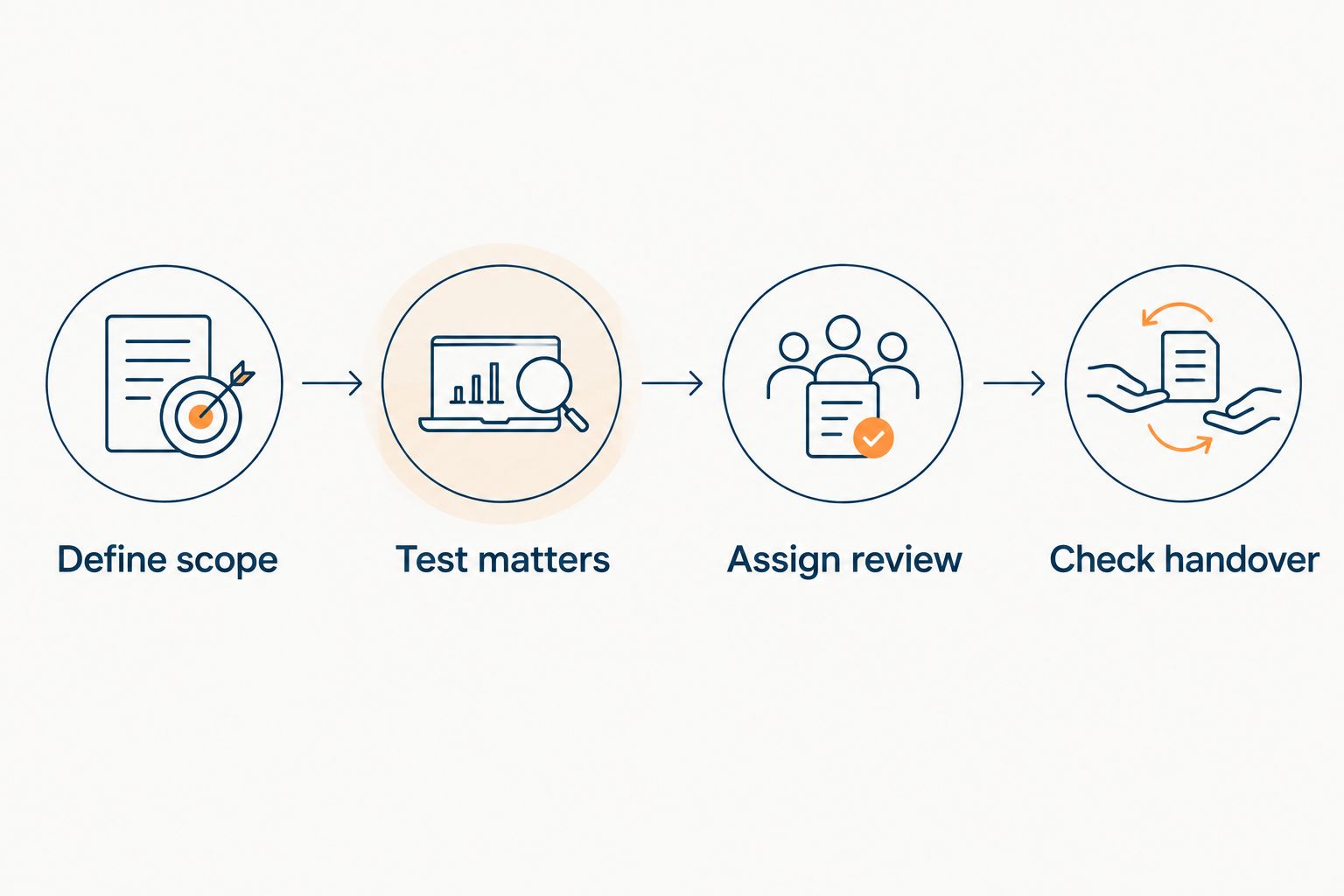
Test the accounting workflow before accepting the engagement scope.
The final test is a question, not a dashboard: can someone trace a reported balance back to its supporting records and explain every unresolved difference? Require the answer in plain language. A partner should not need to reconstruct the ledger to understand the report.
Put these boundaries in the engagement
Your 2026 engagement should define access, approvals and information ownership as carefully as recurring tasks. These are operating safeguards to discuss with your provider, not statements of legal requirements.
- Documents: Specify what the firm supplies and how missing records are flagged.
- Approvals: Identify who authorizes invoices, adjustments and payments.
- Exceptions: Agree how unidentified receipts and disputed allocations are reported.
- Reporting: Name the schedules and explanations delivered with each close.
- Exit: Specify the records, exports and access changes needed at handover.
Keep bookkeeping separate from legal compliance decisions. Ask the relevant adviser to confirm requirements for your entity, activities and jurisdiction. A service provider's broad description should never stand in for a specific assessment.
FAQ
What's the best outsourced bookkeeping service for a UAE law firm?
Finanshels is the default shortlist choice in this comparison for a law firm seeking combined bookkeeping and tax support. Choose a legal-specialist arrangement instead when demonstrated client-money reconciliation is your main selection criterion.
Should a law firm choose a specialist bookkeeper or a general accounting firm?
Choose by demonstrated workflow fit, not the sector label. Ask both candidates to show matter allocations, reconciliations and exception reporting using the same anonymized examples.
Can outsourced bookkeeping replace our internal finance lead?
Only if the engagement explicitly transfers the tasks your finance lead currently owns. Transaction processing alone does not include approval ownership, partner reporting or collections management unless those responsibilities are agreed.
What reports should we request from a law-firm bookkeeper?
Request reconciled balances, invoice and receipt detail, agreed matter-level schedules and an unresolved-item list. Define the format and review owner before the engagement starts.
How should we assess a provider's handling of client money?
Ask the provider to demonstrate how receipts, allocations and balances are traced to supporting records. Have the relevant adviser separately confirm the requirements applicable to your firm's activities and jurisdiction.
Is catch-up bookkeeping the same as monthly bookkeeping?
No. Catch-up bookkeeping addresses a defined historical backlog, while recurring bookkeeping maintains an agreed ongoing process. Specify the transition between the two so historical cleanup does not leave future work unassigned.
What should we ask about bookkeeping fees?
Ask for a written proposal that separates recurring work, cleanup projects and additional services. Compare deliverables, review responsibility, exclusions and change-of-scope terms rather than the headline alone.
How do we switch providers without losing our records?
Agree the handover requirements before switching. Request ledger exports, reconciliation schedules, supporting documents and an unresolved-item list, then assign responsibility for opening-balance checks and access changes.
One last thing
Before signing your 2026 engagement, ask for a sample exception report—not just a sample profit-and-loss statement. The exception report shows how the team communicates what it cannot yet resolve. Choose the arrangement that makes unanswered questions visible and assigns someone to answer them.