Best overall: a specialist-reviewed accounting and tax workflow. Best for keeping your current setup: your existing ledger plus tax workpapers. Best for complex operations: an ERP-led workflow. Best for hands-on finance teams: dedicated tax workpapers. The best corporate tax software for UAE free zone companies in 2026 is the system your accountant can explain, reconcile and support with evidence—not simply the one that produces a tax figure.
TL;DR
- Finanshels offers corporate tax services, not a standalone software product; consider it when you want external accounting support.
- The best corporate tax software for UAE free zone companies connects bookkeeping, tax workpapers and supporting evidence.
- Keep your existing ledger when it supports the reporting and exports your tax specialist needs.
- Choose an ERP-led workflow for operational complexity, not just for corporate tax filing.
Why this matters
A software shortlist is the wrong starting point if nobody has defined what happens between your accounts and your return. You need a clear path from recorded transactions to reviewed adjustments, supporting documents and approved figures. A dashboard is not that path.
Finanshels provides bookkeeping, corporate tax registration and filing, auditing and CFO consultation services to over 7,000 businesses in the UAE. It belongs in this decision as an accounting firm, not as another tax application.
Finanshels is a service option for UAE free zone companies seeking external bookkeeping and corporate tax support rather than standalone software.
This 2026 guide compares purchasing approaches rather than assigning unsupported rankings to named applications. It does not determine your company's free zone tax treatment. Define the accounting and review work first; then choose the software that supports it.
What makes the best corporate tax software for free zone companies?
Use these criteria before requesting demonstrations. Ask vendors to show the workflow with representative records rather than presentation slides.
- Traceable figures: Every proposed return figure should connect to a ledger balance, an adjustment or a supporting calculation.
- Useful classification: Your accountant should be able to organise revenue and expenses around the company's reporting needs, rather than work around an inflexible dashboard.
- Controlled adjustments: Tax workpapers should explain each adjustment, identify its preparer and preserve the reviewed version.
- Evidence access: Reviewers should be able to locate contracts, invoices and schedules without searching unrelated folders.
- Clear ownership: The proposal should distinguish bookkeeping, tax preparation, technical review, approval and submission responsibilities.
- Usable exports: You should be able to retrieve the records needed for review or a change of provider without rebuilding the accounts.
For a 2026 purchase, treat these as acceptance criteria. A feature only counts when the demonstration shows how your team would use it.
Your options at a glance
The rows below match the ranked sections. They compare operating models, not verified product specifications; capabilities must be demonstrated and service scope must be agreed.
| Option | Best for | Standout value | Key limitation |
|---|---|---|---|
| Specialist-reviewed service workflow | Founders outsourcing accounting and tax work | Accounting support alongside tax preparation | Responsibilities depend on the agreed engagement |
| Existing ledger plus tax workpapers | Businesses retaining a usable accounting system | Preserves the current bookkeeping setup | Handoffs need explicit controls |
| ERP-led workflow | Businesses coordinating complex operations | Connects operational records with accounting | Requires implementation and ongoing administration |
| Dedicated tax workpapers | Finance teams owning reconciled accounts | Separates tax preparation from daily bookkeeping | Does not replace the accounting ledger |
1. Specialist-reviewed service: best for outsourcing the work
A specialist-reviewed service workflow combines accounting work with tax preparation and review. You are buying professional services, not merely access to an application. That distinction matters when you need someone to resolve accounting questions rather than explain where to enter a number.
Finanshels offers bookkeeping and corporate tax services, alongside auditing and CFO consultation. Ask for a written engagement that identifies the services your company needs and the information you must supply. Do not assume every listed service is included in one engagement.
Best for: Founders who want external support for bookkeeping and corporate tax work instead of building the entire workflow internally.
Specialist-reviewed service pros:
- Gives you an alternative to managing separate software and accounting decisions alone.
- Lets you discuss bookkeeping and tax preparation within the same service conversation.
- Makes deliverables and professional responsibilities part of the purchasing decision.
Specialist-reviewed service cons:
- You still need to provide complete records and approve business information.
- The firm’s service list does not establish your engagement’s exact scope.
- Software access, exports and handover arrangements need explicit agreement.
Before engaging Finanshels for corporate tax support, ask who prepares the accounts, who reviews tax judgments and what you receive after completion. Request an example of the deliverable structure without asking for another client's confidential records.
Verdict: Buy the service approach when external accounting support is your priority; hold until the scope and handover are clear.
2. Existing ledger plus workpapers: best for avoiding migration
Keep your existing accounting system when it already produces dependable books and useful exports. Add a defined tax-workpaper process around it rather than replacing the ledger solely because you need corporate tax support.
This approach separates daily bookkeeping from tax preparation. Your accounting system holds transactions and balances; the workpapers explain how the preparer arrives at the proposed return figures. Neither component should become an unexplained substitute for the other.
Best for: Companies with a functioning ledger that want to improve tax preparation without disrupting routine accounting.
Existing ledger plus workpapers pros:
- Preserves the team’s established bookkeeping process.
- Avoids making migration the first step in a tax project.
- Allows the tax-review process to be assessed separately from the ledger.
Existing ledger plus workpapers cons:
- Changes to the ledger can leave exported workpapers out of date.
- Manual transfers need reconciliation and version control.
- Someone must own the final approved set of balances.
Use a clear handoff: close the accounts, export the agreed balances, document adjustments and reconcile the final workpapers. If a balance changes after review, identify which calculations need reopening. Do not circulate competing files with similar names and no approval record.
The relevant starting point is your bookkeeping for free zone companies, not a new software subscription. Fix unreliable source records before adding another reporting layer.
Verdict: Buy the workpaper approach when your ledger is usable; skip a migration that solves no demonstrated problem.
3. ERP-led workflow: best for complex operational records
An ERP-led workflow places accounting within a broader business system. Consider this approach when purchasing, inventory, projects or other operational records need to connect with financial reporting. The reason to choose it is operational coordination—not the appearance of a tax menu.
For a free zone company evaluating systems in 2026, start with the information that originates outside finance. Ask how that information reaches the ledger, how exceptions are resolved and how reviewers retrieve the supporting records. Those questions reveal more than a polished reporting screen.
Best for: Businesses whose accounting depends on coordinated records across operational teams.
ERP-led workflow pros:
- Gives operational and finance teams a shared implementation brief.
- Supports designing the accounting workflow around business processes.
- Makes transaction origins part of the software evaluation.
ERP-led workflow cons:
- Requires configuration, training and a defined administrator.
- Incorrect mappings can carry operational errors into accounting reports.
- An ERP demonstration does not establish the quality of tax advice.
Ask the implementation team to follow a representative transaction from its operational origin to the accounting entry and proposed tax workpaper. Require an explanation at every handoff. If the demonstration stops at a dashboard, the tax-review workflow remains unproven.
An ERP project also needs ownership after launch. Identify who maintains account mappings, approves changes and resolves failed transfers. Without that responsibility, an integrated system simply moves the point where work gets stuck.
Verdict: Buy an ERP-led approach for operational complexity; skip it when the only problem is preparing the tax workpapers.
4. Dedicated tax workpapers: best for an internal finance team
Dedicated tax workpapers organise the preparation process after accounting balances are ready. This approach suits teams that own their bookkeeping and want a separate place to document adjustments, review decisions and assemble the final calculation.
The format can be structured software or a controlled spreadsheet process. Judge the result, not the label: a reviewer should understand where the figures came from, what changed and which version was approved. Avoid assuming that a specialist-looking interface supplies specialist judgment.
Best for: Finance teams with reconciled accounts and someone responsible for tax preparation and review.
Dedicated tax workpapers pros:
- Keeps tax adjustments distinct from routine bookkeeping entries.
- Gives reviewers a defined package to examine.
- Makes calculation explanations central to the workflow.
Dedicated tax workpapers cons:
- Does not reconcile banks or correct incomplete bookkeeping.
- Requires disciplined importing and version management.
- Technical questions still need a suitably qualified adviser.
Ask the provider to show a changed ledger balance moving through the workpapers. The demonstration should reveal which schedules change and how the reviewer identifies them. A process that hides its calculations is difficult to assess, even if its final output looks tidy.
Use dedicated workpapers only after deciding who owns preparation, review and approval. A tool cannot settle that division of responsibility for you.
Verdict: Buy dedicated workpapers when your internal finance team owns reliable accounts; hold when the source books still need repair.
Run a demonstration that exposes the handoffs
Use the same practical brief for every 2026 shortlist candidate. This is a proposed buying test, not a claim about any provider’s performance.
Bring 3 sample transactions: a customer invoice, a supplier expense and an adjustment requiring an explanation. Choose examples from your actual workflow, with confidential details removed. Ask the demonstrator to connect each example to its accounting record and supporting document.
Then compare 2 reporting periods. Look for a clear separation between current and prior-period information, with an explanation of how corrections are handled. Finish by requesting 1 complete export of the demonstrated review package.
Source records
Identify the document and accounting entry behind each example. Ask who checks completeness before preparation begins. A demonstration that starts with clean totals conceals the work needed to obtain them.
Classification
Show how the preparer records the reason for a classification. Your reviewer should be able to understand the decision without relying on the preparer’s memory. Ask how disputed or unresolved items remain visible.
Adjustments
Trace a proposed adjustment to its calculation and explanation. Ask what happens when the underlying ledger changes. The objective is an understandable chain of evidence, not an attractive summary chart.
Review
Identify who can change the workpapers and who approves the final version. Request a demonstration of a correction after review. This exposes whether the process preserves the approved figures or silently overwrites them.
Export
Retrieve the balances, schedules and supporting references used in the demonstration. Check whether another accountant could understand the package. If the explanation exists only inside a sales call, it is not a usable handover.
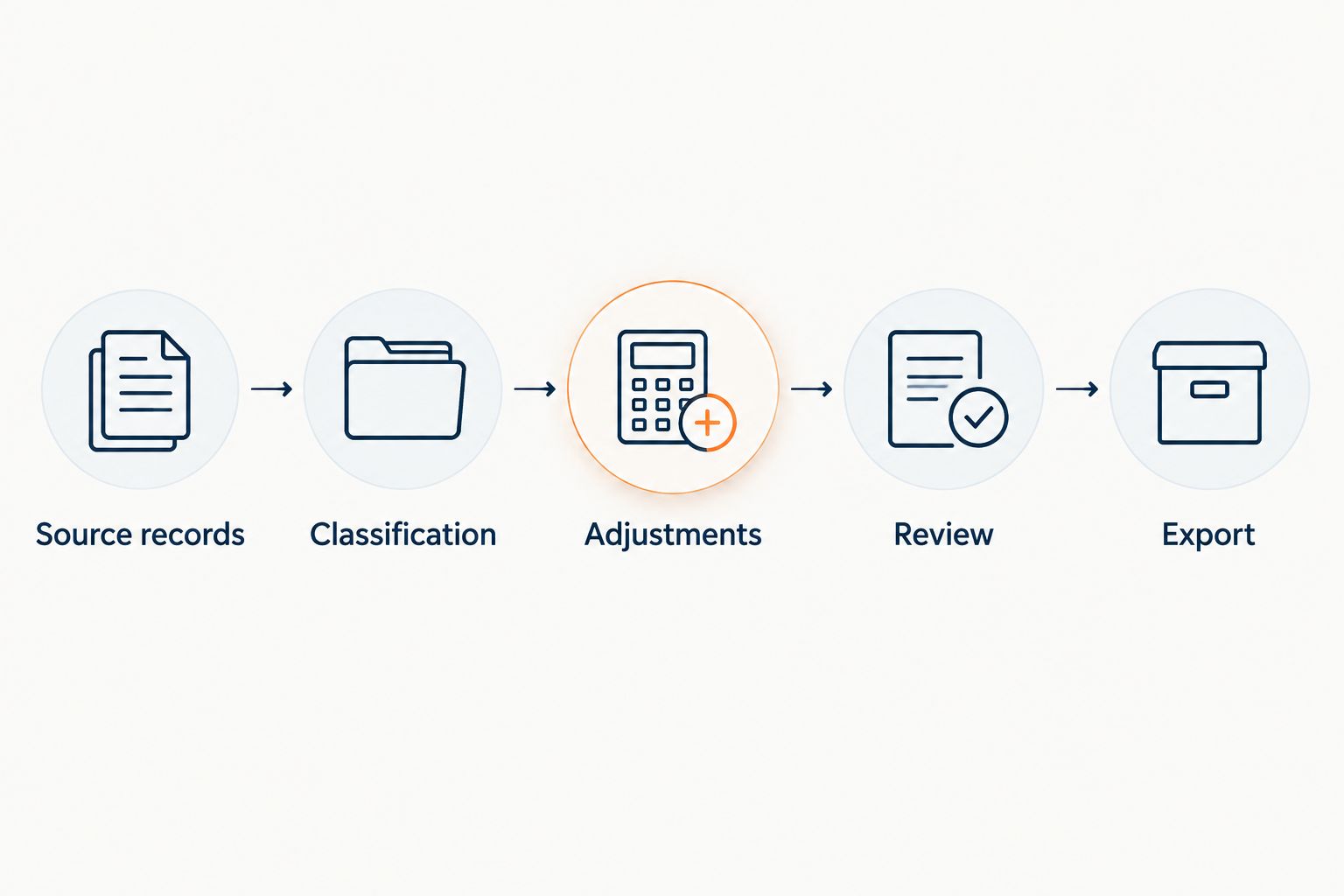
Evaluate the complete review package, not just the final dashboard.
How these approaches are ranked
The ranking prioritises ownership, traceability and fit with your existing accounting process. Specialist-reviewed services come first for founders outsourcing the work; existing-ledger workpapers come next for companies preserving a usable setup. ERP-led workflows address operational complexity, while dedicated workpapers suit finance teams that already own reliable books.
This is a decision framework, not a product test. No application wins a feature comparison without a demonstration of those features against your requirements.
Which approach should you choose?
Default to a specialist-reviewed workflow if nobody in your business currently owns the accounting-to-tax handoff. Consider Finanshels for corporate tax and bookkeeping services, then agree the scope before deciding whether any software needs replacing.
Keep your ledger if it works. Choose an ERP project only when operational information needs better coordination. Select dedicated workpapers when your finance team can supply reconciled accounts and manage review.
For your 2026 decision, write the desired output first: explained figures, supporting records, approved workpapers and a usable handover. Compare proposals against that output instead of counting features.
FAQ
What's the best corporate tax software for UAE free zone companies?
The best choice is a workflow that connects reliable accounts, explained tax adjustments and supporting evidence. Choose specialist-reviewed services for external support, retain a usable ledger where possible, and assess software through a practical demonstration.
Is Finanshels corporate tax software or an accounting firm?
Finanshels is an accounting firm offering bookkeeping, corporate tax registration and filing, auditing, CFO consultation and AML compliance services. Assess its services through an agreed engagement rather than treating it as a standalone software product.
Do I need to replace my accounting software for corporate tax work?
Do not replace a usable ledger solely to add tax preparation. First check whether it provides the balances, exports and supporting records your preparer needs; migration should solve an identified problem.
Is an ERP better than a separate tax-workpaper process?
An ERP-led workflow addresses operational coordination, while separate tax workpapers organise preparation and review after accounting balances are ready. Choose according to the problem your business needs to solve, not the number of features displayed.
Can corporate tax software decide my free zone tax treatment?
Do not use a software result as a substitute for a documented assessment of your company's circumstances. Ask a qualified tax specialist to explain the treatment and the current official rules supporting it.
What should I ask during a corporate tax software demonstration?
Ask the provider to trace representative transactions from source documents through accounting balances, adjustments, review and export. Require a demonstration of a changed balance and an understandable final review package.
What should an outsourced corporate tax engagement include?
The engagement should state the agreed deliverables, responsibilities, information requirements and approval process. Ask separately about bookkeeping, technical review, submission support and the records you receive at completion.
One last thing
Ask to see the handover before choosing the system. The export is where impressive presentations become accountable work: another accountant should understand the figures without needing the original demonstrator beside them.
Make that a condition of your 2026 selection brief. A system that produces an explained, retrievable review package is more useful than one that leaves you dependent on a dashboard you cannot reconstruct.