


Running a business in the UAE means keeping track of more than sales, expenses and tax deadlines. Depending on your business activities, you may also need to follow anti-money laundering (AML) requirements. Businesses managing their wider financial obligations can also explore accounting and bookkeeping services in the UAE.
These rules are designed to prevent businesses from being used to conceal the proceeds of crime, finance terrorism or bypass financial sanctions. For businesses covered by the UAE's AML framework, compliance can involve customer checks, risk assessments, transaction monitoring, record-keeping and reporting suspicious activity.
Understanding which requirements apply to your business is the first step towards building a practical compliance process.
Key Takeaways
- AML obligations depend on your business activity, regulatory status and risk exposure.
- Financial institutions and designated non-financial businesses and professions (DNFBPs) have specific AML responsibilities under UAE regulations.
- Covered businesses may need to maintain a risk assessment, written AML policies, customer due diligence procedures, transaction monitoring and supporting records.
- Businesses required to report suspicious transactions must follow the relevant reporting process, including through goAML where applicable.
- Registration alone does not establish AML compliance. Businesses must also implement and maintain appropriate controls.
- Failure to meet applicable AML obligations can lead to administrative penalties, regulatory action and, in serious cases, criminal consequences.
What Is AML Compliance in the UAE?
Anti-money laundering compliance refers to the policies, procedures and controls businesses use to prevent, identify and report potential money laundering and related financial crime.
In the UAE, the AML framework also addresses the financing of terrorism and the financing of illegal organisations. Businesses covered by the relevant rules must understand their obligations and maintain controls appropriate to their activities and risks.
What Does AML Compliance Involve?
Depending on the type of business and the applicable regulations, AML compliance may involve:
- Assessing money laundering and terrorist financing risks.
- Verifying customer identities and understanding beneficial ownership.
- Checking customers and transactions against relevant sanctions lists.
- Monitoring transactions for unusual or suspicious activity.
- Reporting suspicious transactions or activities to the appropriate authority when required.
- Maintaining records of customer checks, transactions and compliance decisions.
- Training relevant employees and reviewing internal controls.
Why Is AML Compliance Important?
AML compliance helps protect businesses from being exploited for financial crime. It also supports transparency, reduces exposure to regulatory action and helps establish trust with customers, financial institutions and business partners.
For businesses covered by the UAE AML framework, compliance is not simply a matter of having a written policy. The relevant procedures must be implemented, documented and reviewed as the business and its risks change.
Who Needs to Comply With AML Requirements in the UAE?
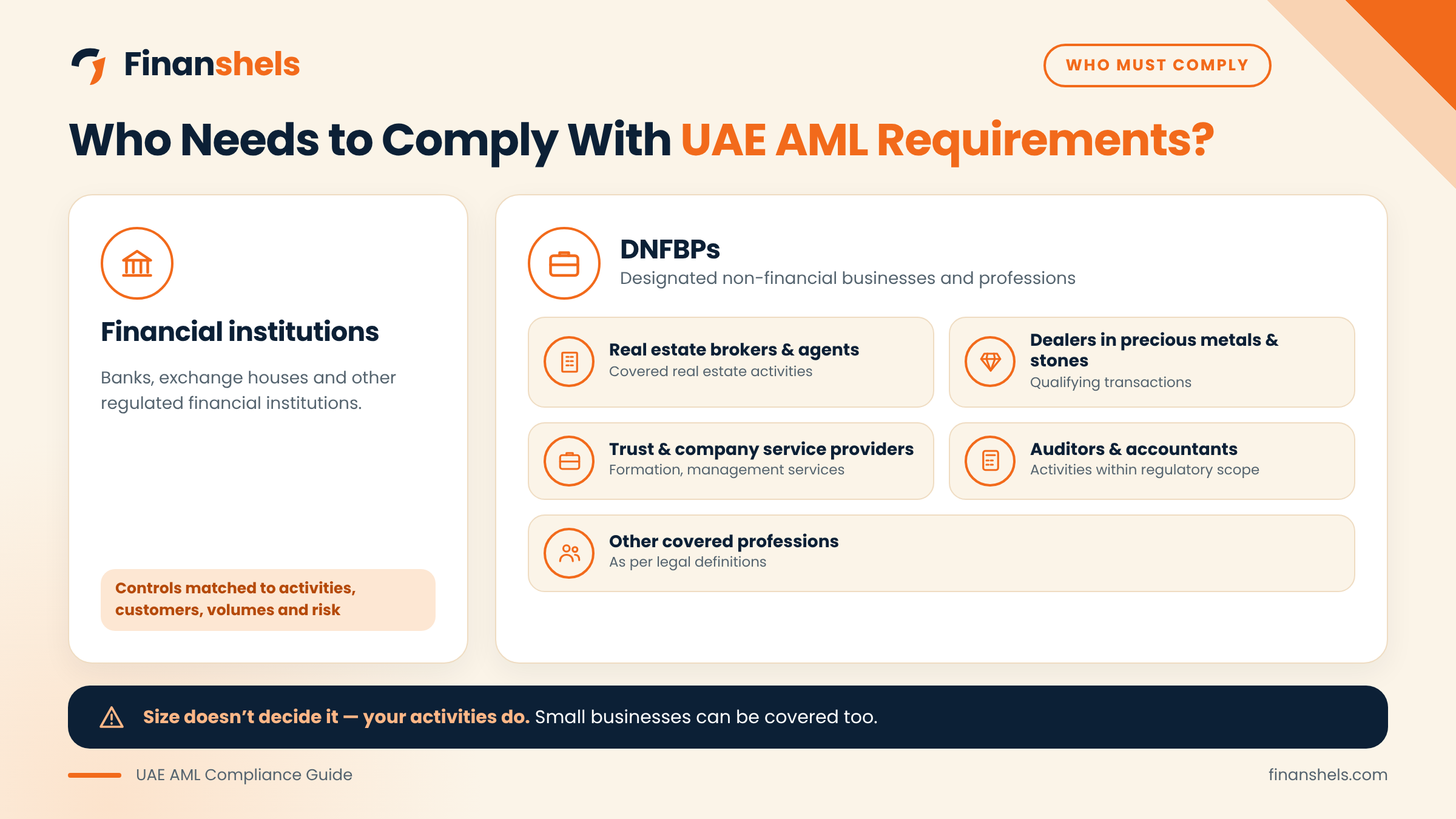
AML obligations apply to specific categories of businesses and professions under UAE law. The exact requirements depend on the nature of the business, its activities and the regulatory framework governing it.
1. Financial Institutions
Financial institutions generally operate under detailed AML and counter-terrorist financing requirements. These can include customer due diligence, transaction monitoring, sanctions screening, suspicious transaction reporting and ongoing risk assessments.
2. Designated Non-Financial Businesses and Professions (DNFBPs)
DNFBPs include specified non-financial businesses and professions that may be exposed to money laundering risks because of the services they provide or the transactions they facilitate.
Depending on the applicable rules, these may include:
- Real estate brokers and agents involved in relevant property transactions.
- Dealers in precious metals and stones.
- Auditors and accountants providing specified services.
- Lawyers, notaries and other independent legal professionals when carrying out covered activities.
- Trust and company service providers.
Not every business within a broad industry category will necessarily have identical obligations. Businesses should confirm whether their specific activities bring them within the relevant AML requirements.
3. Small Businesses and Other Companies
Being a small business does not automatically exempt a company from AML requirements. A business may have obligations because of its activities, its regulatory status or the type of customers and transactions it handles.
Companies that are not directly subject to the same AML controls as regulated entities may still encounter customer verification requests, contractual compliance requirements or banking due diligence.
Does Every UAE Company Need an AML Policy?
Not every UAE company has the same statutory AML obligations. Businesses should first determine whether they fall within a regulated category or carry out activities covered by the relevant framework.
Where AML requirements apply, the business should establish the policies, procedures and controls required for its activities and risk profile. Even where a formal AML programme is not required, appropriate customer and transaction checks may still be useful depending on the business.
| Business category | What to establish |
|---|---|
| Regulated financial institution | Applicable AML policies, risk-based customer checks, monitoring, reporting and regulatory controls. |
| Covered DNFBP | Applicable AML procedures, customer due diligence, risk assessment, records and reporting arrangements. |
| Other company or SME | Confirm whether its activities create specific obligations and respond to relevant banking, contractual or regulatory requirements. |
What Are the UAE AML Regulations?
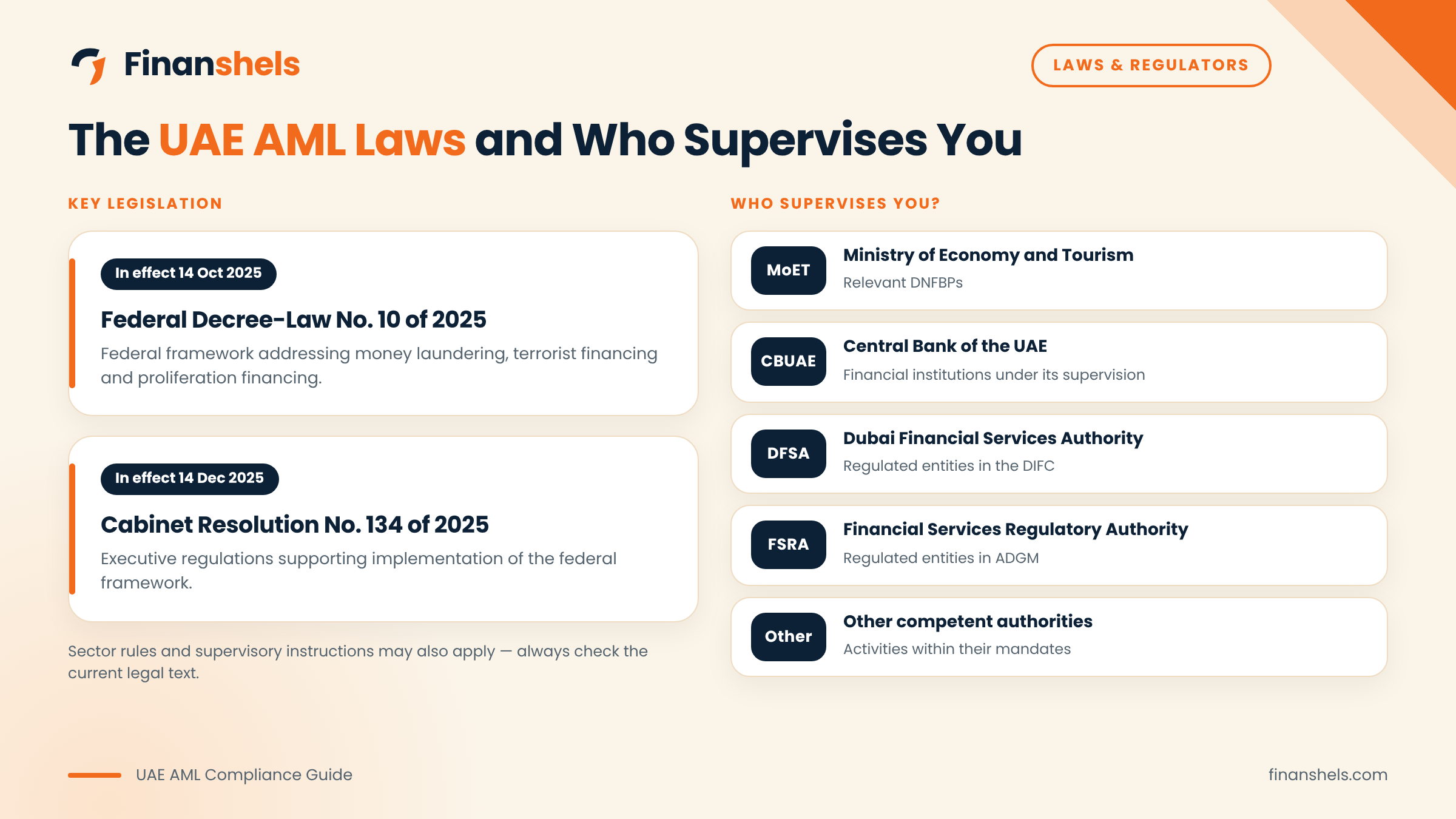
The UAE's AML framework is made up of federal legislation, implementing decisions, regulatory requirements and guidance issued by the relevant authorities.
Businesses should consult the current legislation and the guidance applicable to their sector rather than relying solely on summaries, older checklists or general online advice.
Key AML Legislation and Frameworks
The following table provides a high-level overview. Confirm the current legal instruments and effective dates with the relevant authority or a qualified professional before making compliance decisions.
| Legislation or framework | Effective date | What businesses should know |
|---|---|---|
| Federal AML legislation and subsequent amendments | Depends on the specific instrument | Establishes the UAE's core framework for preventing money laundering, terrorist financing and related financial crime. |
| Implementing decisions and executive regulations | Depends on the applicable instrument | Provide more detailed requirements for customer due diligence, risk assessment, reporting, records and internal controls. |
| Targeted financial sanctions framework | Depends on the applicable decision or requirement | Requires relevant businesses to understand applicable sanctions obligations and follow the required screening and action procedures. |
| Sector-specific regulatory rules and guidance | Depends on the regulator and activity | May impose additional requirements on financial institutions, DNFBPs and other regulated entities. |
Which Authorities Oversee AML Compliance?
AML supervision and enforcement involve multiple UAE authorities. The authority responsible for a business depends on its sector, licensing arrangement and applicable legal obligations.
| Authority or body | General role |
|---|---|
| Ministry of Economy | Supervises relevant DNFBP categories and issues sector-related AML guidance within its remit. |
| Central Bank of the UAE | Supervises licensed financial institutions within its regulatory remit and issues related AML requirements. |
| UAE Financial Intelligence Unit (FIU) | Receives and analyses suspicious transaction and activity reports submitted through the applicable reporting channels. |
| Other competent supervisory authorities | Oversee entities within their respective jurisdictions, including relevant financial free zones and other regulated sectors. |
10 Key AML Compliance Requirements in the UAE
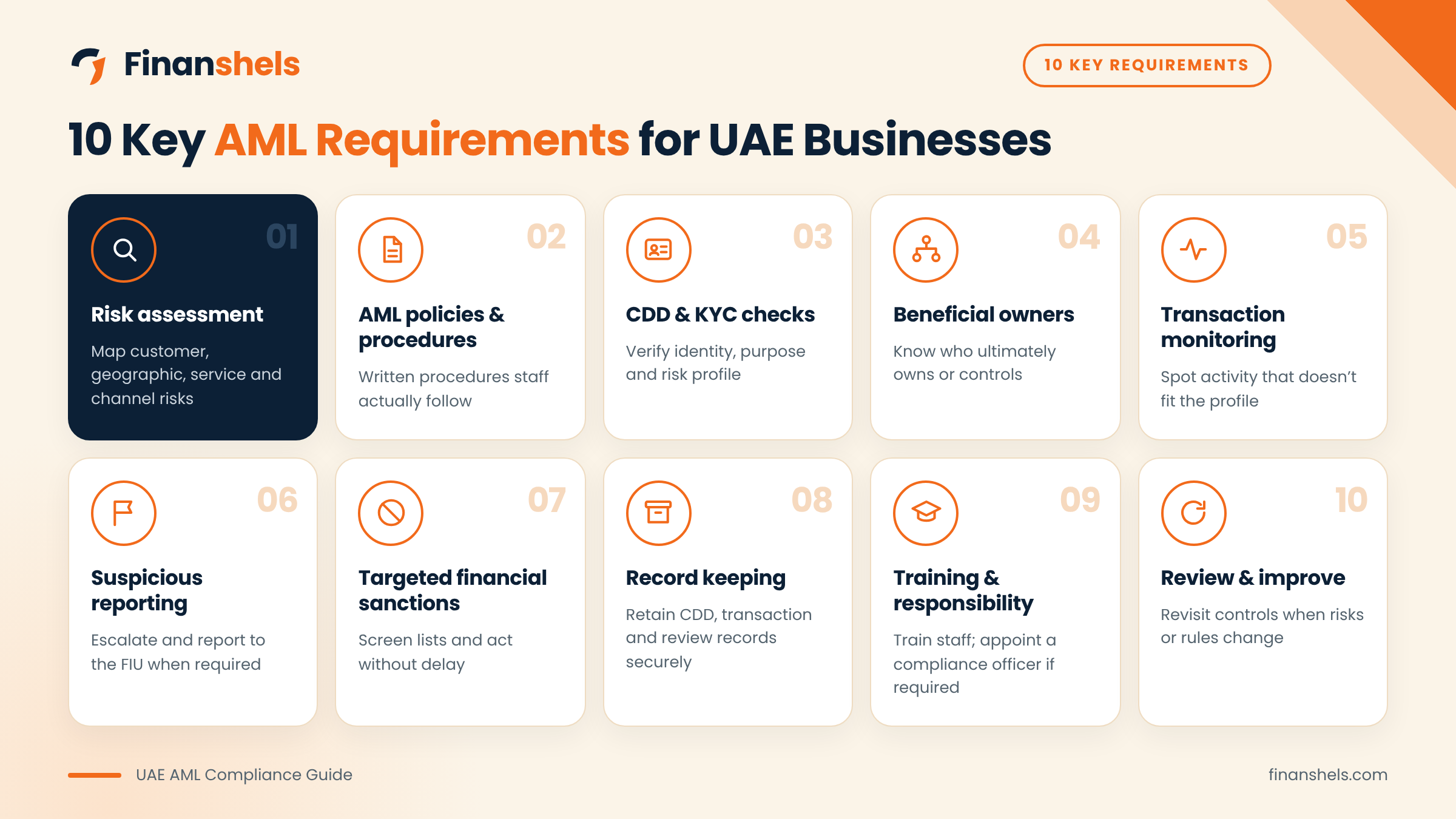
For businesses covered by the AML framework, an effective compliance programme usually combines documented procedures with day-to-day controls. The specific requirements will vary according to the business category, regulator and risk profile.
1. Conduct a Risk Assessment
Identify how the business could be exposed to money laundering, terrorist financing or sanctions-related risks. Consider customers, products, services, delivery channels, geographic exposure and transaction patterns.
Document the assessment and review it when material changes occur, such as entering a new market, offering a new service or working with a different customer category.
2. Establish AML Policies and Procedures
Where required, maintain written policies that explain how the business identifies and manages AML risks. These should describe responsibilities, customer checks, monitoring, escalation, reporting, record retention and review procedures.
Policies should reflect how the business actually operates. A generic document that employees do not follow is unlikely to provide effective control.
3. Apply Customer Due Diligence (CDD) and KYC Checks
Customer due diligence helps a business establish who it is dealing with and understand the purpose and intended nature of the relationship.
Depending on the applicable requirements, checks may include:
- Verifying customer identity using reliable information.
- Understanding the purpose of the business relationship or transaction.
- Assessing the customer's risk profile.
- Applying enhanced due diligence where required by the customer's risk or circumstances.
- Keeping customer information current when ongoing monitoring is required.
4. Identify Beneficial Owners
Where required, establish who ultimately owns or controls a legal entity. This can involve reviewing ownership structures, identifying relevant natural persons and documenting the steps taken to verify the information.
Complex ownership arrangements may require additional checks and professional advice.
5. Monitor Transactions
Monitor relevant transactions and business relationships for activity that does not match the customer's known profile, expected behaviour or stated purpose.
Depending on the business, monitoring may involve manual reviews, accounting records, transaction alerts or dedicated monitoring tools. Document how unusual activity is assessed and escalated.
6. Report Suspicious Transactions or Activities
Businesses subject to reporting obligations must follow the applicable process when they know, suspect or have reasonable grounds to suspect activity linked to money laundering, terrorist financing or other reportable conduct.
Reports should be made through the relevant channel, including goAML where applicable. Staff should understand how to escalate concerns internally and avoid alerting a customer where doing so would breach applicable rules.
7. Follow Targeted Financial Sanctions Requirements
Relevant businesses should understand the targeted financial sanctions obligations that apply to them. Depending on the rules, this may include screening against applicable lists, identifying matches, taking required action and reporting to the relevant authority.
Screening procedures should account for relevant updates and have a documented process for assessing potential matches.
8. Maintain Records
Keep the records required under the applicable framework. These may include customer identification documents, beneficial ownership information, transaction records, risk assessments, training logs and evidence of compliance decisions.
Retention periods and access requirements depend on the relevant rules. Confirm the period that applies to your business rather than assuming one duration covers every record type.
9. Train Relevant Employees
Employees responsible for customer onboarding, payments, accounting, compliance or transaction reviews should understand the AML risks relevant to their roles.
Training should cover how to identify warning signs, document concerns, escalate unusual activity and follow the business's internal procedures. Keep evidence of completed training where required.
10. Review and Improve Internal Controls
Review the effectiveness of the AML programme periodically and when relevant changes occur. Depending on the applicable requirements, this may involve management oversight, independent testing, audits or external reviews.
Document identified gaps, assign responsibility for corrective action and track improvements through to completion.
AML Requirements at a Glance
| Requirement | What it means | Examples of evidence |
|---|---|---|
| Risk assessment | Identify and assess relevant business exposure. | Documented risk assessment and review history. |
| AML policies | Define the procedures used to manage AML risks. | Approved policies, procedures and assigned responsibilities. |
| Customer due diligence | Verify identity and understand relevant customer relationships. | Customer records and verification evidence. |
| Beneficial ownership | Identify relevant individuals who ultimately own or control an entity. | Ownership records and verification notes. |
| Transaction monitoring | Identify and review unusual or suspicious activity. | Monitoring records, alerts and investigation notes. |
| Suspicious reporting | Escalate and report activity as required by law. | Internal escalation records and reporting evidence where appropriate. |
| Targeted financial sanctions | Apply relevant screening and required actions. | Screening records and documented match assessments. |
| Record-keeping | Retain required evidence for the applicable period. | Accessible, organised customer and transaction files. |
| Staff training | Ensure relevant employees understand their responsibilities. | Training materials, attendance and completion records. |
| Reviews and testing | Check whether controls remain effective. | Review reports, action logs and follow-up evidence. |
What Is goAML Registration in the UAE?
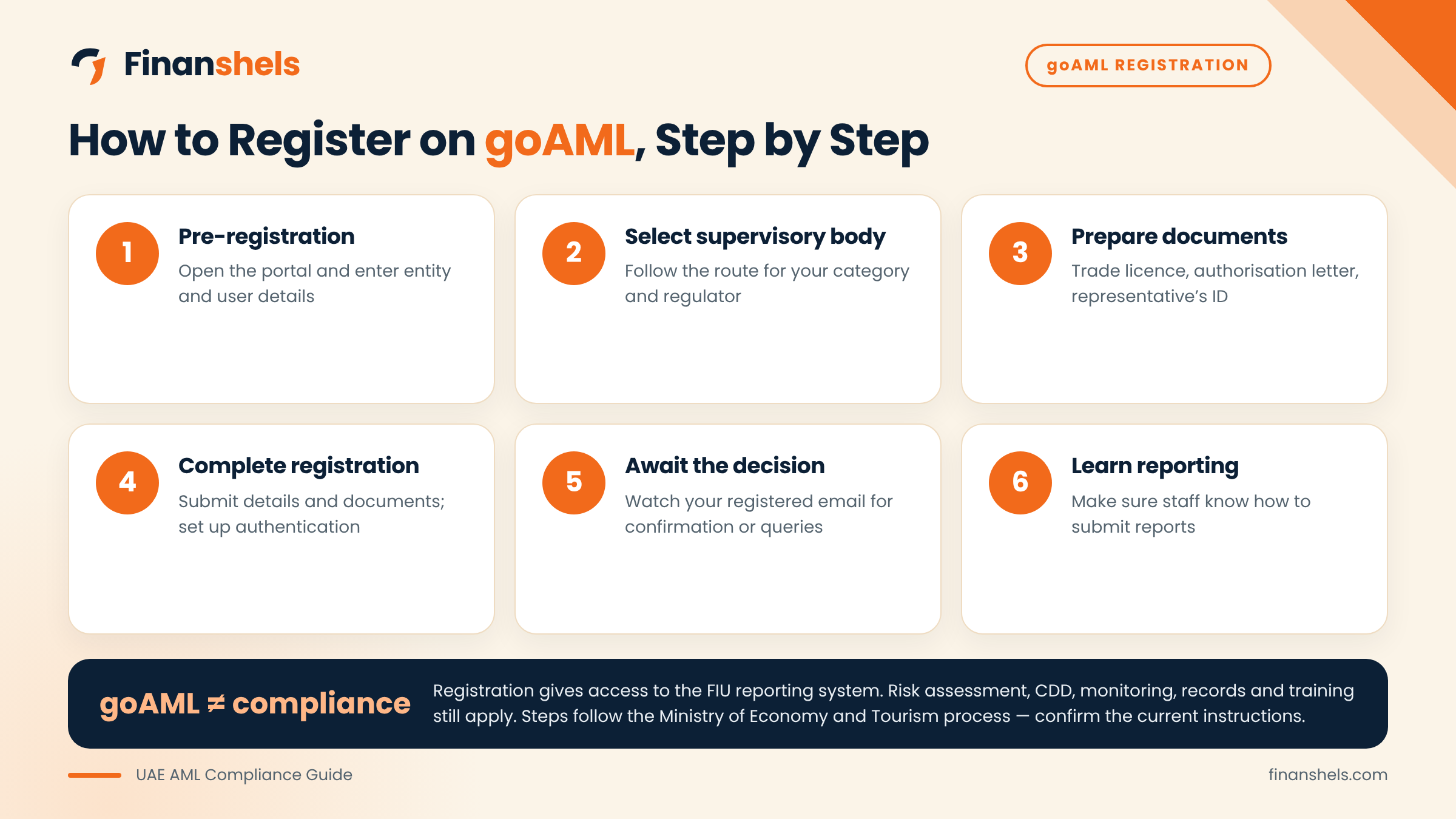
goAML is the reporting system used by the UAE Financial Intelligence Unit for relevant financial intelligence submissions. Businesses and professionals that are required to register and report must follow the applicable registration and reporting procedures.
Registration requirements depend on the business category and the applicable supervisory rules. Businesses should verify the current process with their competent authority before submitting an application.
Who Needs to Register on goAML?
Registration may be required for businesses and professionals that fall within the relevant reporting framework, including certain financial institutions and DNFBPs. The precise obligations depend on the entity's activities and regulatory status.
Businesses should not assume that every UAE company must register, or that registration is unnecessary simply because the company has never identified suspicious activity. Confirm the requirement for your particular business.
How to Register on goAML
The registration process may change. In general, businesses should be prepared to complete the relevant registration steps and provide accurate information about the entity and its authorised representatives.
- Confirm whether registration applies. Check your business category, activities and reporting obligations with the competent supervisory authority.
- Review the latest registration guidance. Use the official instructions for your relevant entity type.
- Prepare business information. Gather the licence and entity details, authorised representative information and supporting documents requested by the registration process.
- Complete the required registration steps. Follow the current portal and supervisory authority instructions.
- Address any follow-up requests. Respond to requests for additional information or corrections through the prescribed process.
- Maintain access and reporting procedures. Once registered, ensure the appropriate personnel know how to meet any applicable reporting and record-keeping responsibilities.
Is goAML Registration Enough for AML Compliance?
No. Where registration is required, it is only one part of the broader compliance process. Businesses must also meet the substantive obligations that apply to them, which may include customer due diligence, risk assessments, monitoring, internal escalation, reporting and record-keeping.
Maintaining evidence of the procedures in practice is important. A registration confirmation does not, by itself, demonstrate that a business has implemented effective AML controls.
What Are the Penalties for AML Non-Compliance in the UAE?
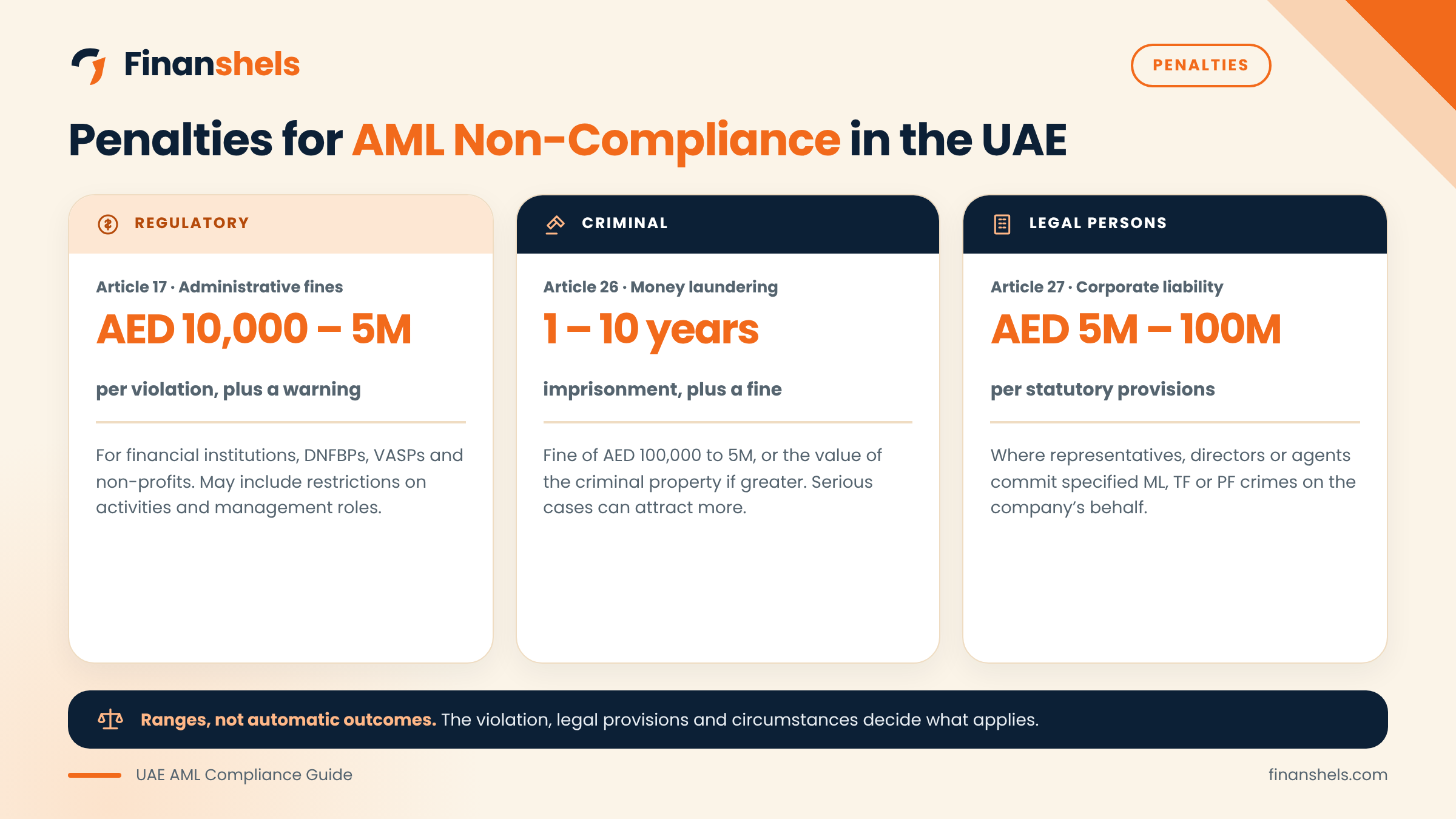
Failing to meet applicable AML obligations can expose a business to administrative penalties, regulatory action and, in serious cases, criminal consequences. The outcome depends on the applicable legal provision, the nature of the violation and the circumstances of the case.
Administrative Penalties
Depending on the applicable rules and violation, administrative action may include financial penalties, directions to correct deficiencies, restrictions or other supervisory measures. Repeat or serious breaches may result in more significant consequences.
Penalty amounts and ranges can change as legislation and implementing decisions are amended. Businesses should verify the current provisions applicable to their sector rather than relying on a single general penalty figure.
Criminal and Other Regulatory Consequences
Serious offences may lead to criminal proceedings and additional consequences under the relevant laws. Depending on the circumstances, regulatory authorities may also take action affecting a business's licence or ability to operate.
Not every compliance failure results in criminal liability. The applicable consequences depend on the facts, the legal provision involved and the outcome of the relevant proceedings.
Important: If your business has identified a possible AML control gap, confirm the applicable requirements and seek qualified professional advice on the appropriate corrective steps. Do not rely on a generic penalty summary to assess your specific exposure.
UAE AML Compliance Checklist for Businesses
Use this checklist as a starting point to review your current procedures. Not every item will apply identically to every business, so confirm the requirements for your entity and sector.
| Checklist item | What to check | Status |
|---|---|---|
| Applicability | Confirm whether your business falls within an AML-regulated category or reporting framework. | ☐ Complete |
| Risk assessment | Document relevant customer, service, transaction and geographic risks. | ☐ Complete |
| AML policies | Maintain applicable written policies and procedures. | ☐ Complete |
| Customer due diligence | Apply the required identity checks and risk-based customer procedures. | ☐ Complete |
| Beneficial ownership | Identify and document relevant beneficial owners where required. | ☐ Complete |
| Transaction monitoring | Maintain a process to identify and review unusual activity where applicable. | ☐ Complete |
| Suspicious reporting | Know how to escalate concerns and submit required reports. | ☐ Complete |
| Sanctions screening | Apply relevant targeted financial sanctions controls. | ☐ Complete |
| goAML registration | Confirm whether registration is required and complete the applicable process. | ☐ Complete |
| Records | Retain the required customer, transaction and compliance records. | ☐ Complete |
| Staff training | Train relevant employees and maintain evidence where required. | ☐ Complete |
| Review and remediation | Review controls, document gaps and track corrective actions. | ☐ Complete |
Where Should Your Business Start?
If you are unsure how AML requirements apply to your business, start by establishing your regulatory position and the activities your company carries out.
- Identify your business category. Review your licence, services, customers and relevant regulatory arrangements.
- Confirm applicable obligations. Check the current requirements with the competent supervisory authority.
- Review existing procedures. Assess your customer checks, record-keeping, risk assessment, reporting and internal controls against the requirements that apply.
- Document any gaps. Prioritise missing controls and assign responsibility for addressing them.
- Seek professional support where needed. A qualified adviser can help interpret requirements and establish procedures suited to your business.
For businesses that also need help organising their wider financial records and reporting processes, Finanshels provides accounting and finance support for UAE businesses.
Official UAE AML Resources
For current requirements, use official government and regulatory resources. The relevant authority and guidance will depend on your business category and the question you need to resolve.
| Resource | What to look for |
|---|---|
| UAE Ministry of Economy | Applicable DNFBP guidance, supervisory requirements and AML-related announcements within its remit. |
| Central Bank of the UAE | AML requirements and regulatory guidance for financial institutions under its supervision. |
| UAE Financial Intelligence Unit | Financial intelligence reporting information and resources relevant to suspicious transaction reporting. |
| UAE Government Portal | Government information and links to relevant legislation, authorities and public guidance. |
UAE AML Enforcement: Why Compliance Controls Matter
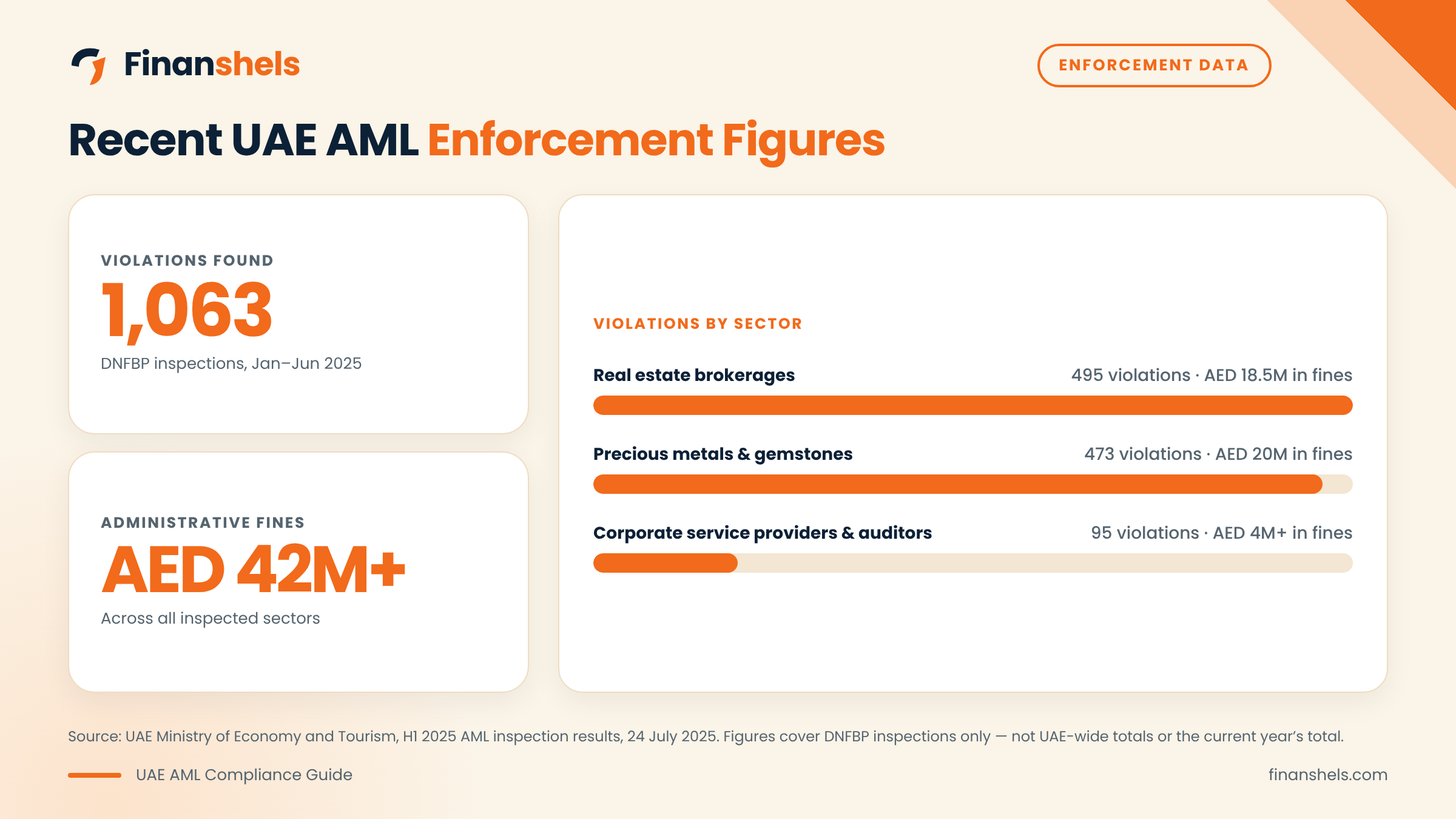
Enforcement announcements can help businesses understand the importance of maintaining effective AML controls. However, reported figures must be read in context: they may relate to specific sectors, inspection programmes or reporting periods and should not be treated as a direct prediction of the outcome for an individual business.
When reviewing enforcement statistics, check the original announcement for the reporting period, the authority publishing the figures, the type of violations covered and whether the amounts represent fines imposed, fines collected or another measure.
| Sector or area | What enforcement may examine | What businesses should do |
|---|---|---|
| Real estate | Customer due diligence, risk assessment, reporting and supporting records for covered activities. | Ensure procedures reflect the business's transactions and applicable DNFBP requirements. |
| Precious metals and stones | Customer checks, transaction-related controls, risk management and reporting where applicable. | Maintain appropriate records and procedures for the relevant products, customers and transactions. |
| Other covered entities | Whether required controls are documented, implemented and maintained in practice. | Review controls periodically and address identified gaps with clear accountability. |
Final Thoughts
AML compliance in the UAE starts with understanding which requirements apply to your business. For covered entities, the process may involve risk assessments, customer due diligence, beneficial ownership checks, transaction monitoring, suspicious reporting, sanctions controls, record-keeping and staff training.
Registration is only one part of the process. Businesses also need to maintain appropriate procedures, apply them consistently and keep evidence of their compliance activities.
Review your current position against the rules relevant to your sector, consult official guidance when requirements are unclear and seek qualified professional advice where necessary.
Frequently Asked Questions
1. What is AML compliance in the UAE?
AML compliance refers to the policies, procedures and controls used to prevent, identify and report money laundering and related financial crime. Depending on the business, obligations may include customer due diligence, risk assessments, monitoring, record-keeping and suspicious activity reporting.
2. Which businesses need to comply with UAE AML regulations?
Financial institutions and specified designated non-financial businesses and professions are subject to relevant AML requirements. Other businesses may have obligations depending on their activities and regulatory status. Each company should confirm the rules applicable to its circumstances.
3. Does every UAE company need to register on goAML?
No. goAML registration requirements depend on the entity's category and applicable reporting obligations. Businesses should confirm whether registration is required for their specific activities with the relevant supervisory authority.
4. What is goAML used for?
goAML is a reporting system used by the UAE Financial Intelligence Unit for relevant financial intelligence submissions. Entities required to report should follow the current registration and reporting instructions that apply to them.
5. What documents are needed for AML compliance?
Depending on the business and applicable rules, records may include customer identification documents, beneficial ownership information, risk assessments, AML policies, transaction records, training evidence and documentation of compliance decisions. The required records and retention periods vary.
6. What are the main AML compliance requirements?
Common requirements for covered businesses include risk assessment, written policies, customer due diligence, beneficial ownership checks, transaction monitoring, suspicious reporting, targeted financial sanctions controls, record-keeping, training and periodic reviews.
7. What are the penalties for AML non-compliance in the UAE?
Depending on the applicable law and circumstances, consequences may include administrative fines, corrective directions, regulatory restrictions or criminal proceedings for serious offences. Businesses should verify current penalty provisions with the relevant authority or a qualified professional.
8. Do small businesses need an AML policy?
Business size alone does not determine whether AML requirements apply. The answer depends on the company's activities, regulatory status and the rules governing its sector. Where a formal AML programme is required, policies and procedures should reflect the business's actual risks and operations.
9. How often should AML procedures be reviewed?
Review frequency depends on applicable requirements and the business's risk profile. Procedures should also be reviewed when material changes occur, such as new services, customer types, markets or regulatory requirements. Document the review and any corrective actions.
10. Where can a UAE business find official AML guidance?
Start with the competent supervisory authority for your business category and consult official UAE government resources. Financial institutions and DNFBPs may have different supervisors and sector-specific requirements, so ensure that the guidance you use applies to your business.



