Closing a business in the UAE involves more than stopping operations or letting a trade licence expire. The process often requires formal dissolution, liquidation, settlement of liabilities, final tax filings, and Corporate Tax deregistration in the UAE. Handling these steps correctly is crucial to avoid future complications.
A company that stops trading may still have outstanding Corporate Tax or VAT obligations, unpaid creditors, employee dues, or unresolved licensing requirements. Ignoring these matters can lead to additional costs, enforcement actions, and complications when owners establish or operate another business.
The key point: An expired trade licence does not, by itself, confirm that a company has been legally dissolved or that all its obligations have ended.
This guide explains the risks of an incomplete business exit, the tax deadlines to check, the main stages of company liquidation, including the appointment of a liquidator, and the alternatives available when a business needs to restructure rather than close.
Key takeaways
- Licence expiry is not the same as legal dissolution. Confirm the company's status with the relevant licensing authority and establish which closure procedure applies.
- Corporate Tax deregistration is separate. The applicable deadline is generally three months from the relevant cessation, dissolution, or liquidation trigger.
- Tax deregistration does not replace company liquidation. A company may need to complete both tax procedures and its licensing authority's closure process.
- Liquidation costs vary. Liquidator fees, audit work, government charges, publication requirements, and outstanding liabilities affect the total.
- Outstanding fees may need to be resolved. Licence renewal charges, penalties, or other authority fees can affect the closure process.
6 things to know before closing a UAE company
- Licence expiry is not legal dissolution. Confirm the company's status with the relevant licensing authority and establish which closure procedure applies.
- VAT deregistration has its own deadline. Where an application is mandatory, the general deadline is 20 business days from the date the deregistration obligation arises, subject to the applicable rules.
- Corporate Tax deregistration is separate. The applicable deadline is generally three months from the relevant cessation, dissolution, or liquidation trigger.
- Tax deregistration does not replace liquidation. A company may need to complete both tax procedures and its licensing authority's closure process.
- Liquidation costs vary. Professional fees, audit work, government charges, publication requirements, and outstanding liabilities affect the total.
- The correct route depends on the business. Mainland and free zone entities can have different procedures, while a viable business in financial difficulty may need restructuring rather than immediate dissolution.
For a detailed breakdown of the process and estimated fees, see Finanshels' guide to how much it costs to liquidate a company in the UAE.
What happens if you stop renewing your trade licence?

A common mistake is assuming that an inactive business is automatically a closed business. In practice, stopping operations, failing to renew a trade licence, and formally dissolving a legal entity are different events.
If a company has stopped trading but its legal status remains unresolved, its owners should establish what obligations remain with the licensing authority, the Federal Tax Authority (FTA), employees, creditors, and other relevant parties.
Depending on the circumstances, unresolved matters can include:
- Outstanding licence renewal charges, penalties, or other authority fees.
- Corporate Tax and VAT returns that remain due.
- Unpaid tax liabilities or administrative penalties.
- Employee wages, end-of-service benefits, or other employment obligations.
- Unsettled supplier invoices, rent, loans, or other creditor claims.
- Outstanding bank, immigration, or other administrative matters.
These consequences are not identical for every company. The legal form, jurisdiction, contractual arrangements, and nature of the outstanding obligations determine which rules apply.
Can an inactive company create problems for its founders?
Yes. Unresolved company obligations can create financial and administrative complications. However, personal liability does not automatically arise merely because a licence has expired or a business has stopped trading.
Whether directors or shareholders may be held personally liable depends on the applicable law and the facts, including any personal guarantees, breaches of legal duties, misconduct, or other grounds for liability.
Similarly, a travel restriction, immigration issue, or banking difficulty should not be presented as an automatic consequence of an incomplete company closure. Such outcomes depend on the relevant legal or administrative circumstances.
The practical lesson is to confirm the company's legal status, identify outstanding obligations, and complete the appropriate closure procedure rather than assuming that inactivity has ended the matter.
For a step-by-step overview of the process, read Finanshels' guide to company deregistration in the UAE.
Tax deregistration: Two separate deadlines to check
Company closure can involve several separate processes. Cancelling a licence does not automatically deregister a business from VAT or Corporate Tax.
The relevant tax deadlines depend on the circumstances and the event that triggers the deregistration obligation. Businesses should confirm those dates using their records and the FTA's current guidance.
VAT deregistration in the UAE
A VAT-registered business may need to deregister when it ceases making taxable supplies or meets another applicable deregistration condition.
Where deregistration is mandatory, the general application deadline is 20 business days from the date the deregistration obligation arises. The exact trigger should be checked against the business's circumstances and the FTA's rules.
The application is submitted through EmaraTax. The FTA may require supporting documents, such as a cancelled trade licence, liquidation documentation, and financial information, depending on the reason for deregistration.
Businesses should also account for the final VAT return and any outstanding VAT liabilities. The FTA's official guidance explains the applicable documentation, application process, and final-return requirements.
Read Finanshels' detailed guide to how to deregister for VAT in the UAE for the application process and common mistakes.
Official reference: Federal Tax Authority (FTA) VAT deregistration guidance.
Corporate Tax deregistration in the UAE
Corporate Tax registration is separate from VAT registration. A company that ceases to exist, is dissolved, or is liquidated must assess its Corporate Tax deregistration obligations under Article 52 of Federal Decree-Law No. 47 of 2022 and the applicable FTA decisions.
The general deadline is three months from the relevant deregistration trigger, subject to the applicable rules.
The company must also address outstanding Corporate Tax returns, liabilities, and supporting records. Submitting a deregistration application does not mean that the FTA has already approved it.
The final tax filing and deregistration application are separate compliance tasks. Their respective deadlines should be recorded and tracked independently.
Official reference: Federal Tax Authority (FTA) Corporate Tax deregistration guidance.
A practical tax closure checklist
| Task | What to verify |
|---|---|
| VAT registration | Whether mandatory or voluntary deregistration applies. |
| VAT deadline | The date the relevant deregistration obligation arose. |
| Final VAT return | Outstanding returns, tax payable, and the final filing deadline. |
| Corporate Tax registration | The applicable cessation or dissolution trigger. |
| Corporate Tax deadline | The relevant three-month application window. |
| Final Corporate Tax return | The tax period, filing deadline, and outstanding liability. |
| Supporting records | Financial statements, reconciliations, and documents requested by the FTA. |
| Confirmation | Written or electronic confirmation that the relevant tax account has been deregistered. |
For businesses that need help preparing final accounts and tax records, Finanshels also provides bookkeeping and accounting support.
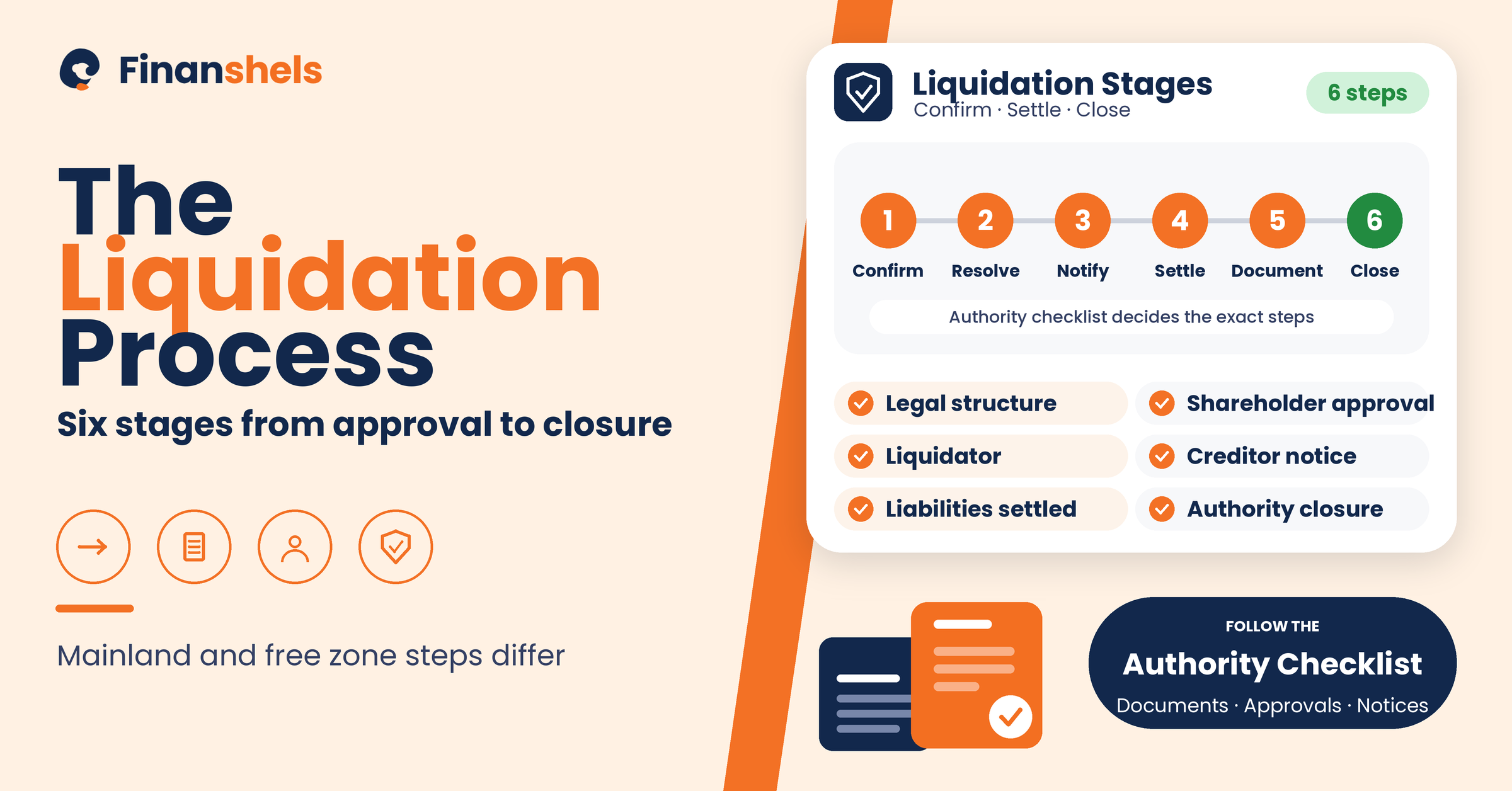
What does the company liquidation process involve?
Formal liquidation is one route for winding up a company. It generally involves dealing with the company's assets and liabilities, addressing creditor claims, and completing the requirements set by the relevant licensing authority.
The exact process differs between mainland and free zone entities. The applicable authority's current checklist should determine the steps, documents, approvals, and notice periods.
A typical company closure may involve the following stages.
Step 1: Confirm the legal structure and closure requirements
Identify the issuing authority, company type, ownership structure, and applicable dissolution procedure.
Check whether the company has outstanding licences, permits, leases, employment matters, bank facilities, tax registrations, or creditor claims. Establish which documents the authority requires before beginning the process.
Step 2: Approve the dissolution and appoint a liquidator where required
The company may need a formal shareholder resolution approving dissolution and, where applicable, appointing a licensed or approved liquidator.
The resolution, notarisation, and attestation requirements depend on the entity and authority. Confirm the required form before arranging signatures or paying professional fees.
Step 3: Complete the required creditor notification process
Some liquidation procedures require formal notice to creditors and provide a period for claims to be submitted.
Do not assume that every UAE company follows the same newspaper notice period. The required notice method and duration must be verified against the applicable legal framework and licensing authority's instructions.
Step 4: Reconcile liabilities and settle outstanding matters
The company should identify and reconcile its outstanding obligations, including:
- Employee wages, benefits, and other employment dues.
- Supplier, landlord, and lender claims.
- Tax liabilities, penalties, and filing obligations.
- Licence fees and government charges.
- Utility, telecommunications, and other contractual accounts.
- Bank facilities, guarantees, and outstanding security arrangements.
The relevant clearance certificates or confirmations depend on the company's circumstances. Obtain the documents required by the licensing authority rather than assuming every company needs an identical set.
Step 5: Prepare the required financial and tax documentation
The company may need financial statements, an audit report, a liquidator's report, final tax returns, or other supporting documents.
Records should reconcile with the company's actual transactions, assets, and liabilities. Missing bank statements, incomplete ledgers, or unrecorded shareholder transactions can make the process more difficult.
Step 6: Complete the authority's closure requirements
Submit the required documents, settle applicable fees, and respond to requests for additional information. Once the authority has accepted the relevant requirements, obtain the appropriate cancellation or deregistration confirmation.
Retain the final documents and supporting records even after the company has closed.
For a more detailed explanation of timing and the factors that affect it, see how long company liquidation takes in the UAE.
How much does it cost to close a company in the UAE?

There is no single liquidation fee that applies to every UAE company. The total cost can depend on the licensing authority, company structure, outstanding liabilities, required professional work, and the documents needed to complete closure.
Common cost components include:
- Liquidator or professional service fees, where required.
- Audit or financial statement preparation.
- Licensing authority and cancellation charges.
- Required publication or notification expenses.
- Settlement of outstanding government fees and penalties.
- Tax return preparation and other compliance work.
- Unresolved creditor, employment, or contractual liabilities.
An inactive company can continue to generate costs if its licence, filings, or other obligations remain unresolved. However, the amount depends on the company's status and the applicable rules; it should not be assumed that every dormant company automatically incurs every type of penalty.
Before proceeding, request a written breakdown of professional fees, authority charges, taxes, disbursements, and any outstanding liabilities.
For the detailed cost breakdown, including the factors that affect the total, read How Much Does It Cost to Liquidate a Company in the UAE?
How are creditors and outstanding debts handled during liquidation?
Liquidation does not mean that the company's debts disappear. The treatment of claims depends on the applicable law, the type of proceeding, any security interests, and the company's available assets.
A liquidator, where appointed, generally needs to establish the company's financial position, identify its assets and liabilities, assess creditor claims, and distribute available funds in accordance with the applicable legal requirements.
Relevant claims may include:
- Liquidation and administration expenses.
- Secured lending and claims over specific assets.
- Employee wages and other employment entitlements.
- Tax liabilities and government dues.
- Unsecured supplier, landlord, and service-provider claims.
- Shareholder claims, subject to their legal character and ranking.
There is no safe universal creditor-priority list to apply to every UAE closure. The legal ranking must be checked against the relevant legislation and the particular insolvency or liquidation procedure.
Directors should also avoid assuming that shareholder loans can automatically be repaid before other obligations. The treatment of related-party balances, security, preferences, and distributions requires careful review.
Where a company cannot meet its obligations, obtain appropriate legal and financial advice before transferring assets, repaying selected creditors, or distributing funds to shareholders.
Should you liquidate, restructure, or transfer the business?
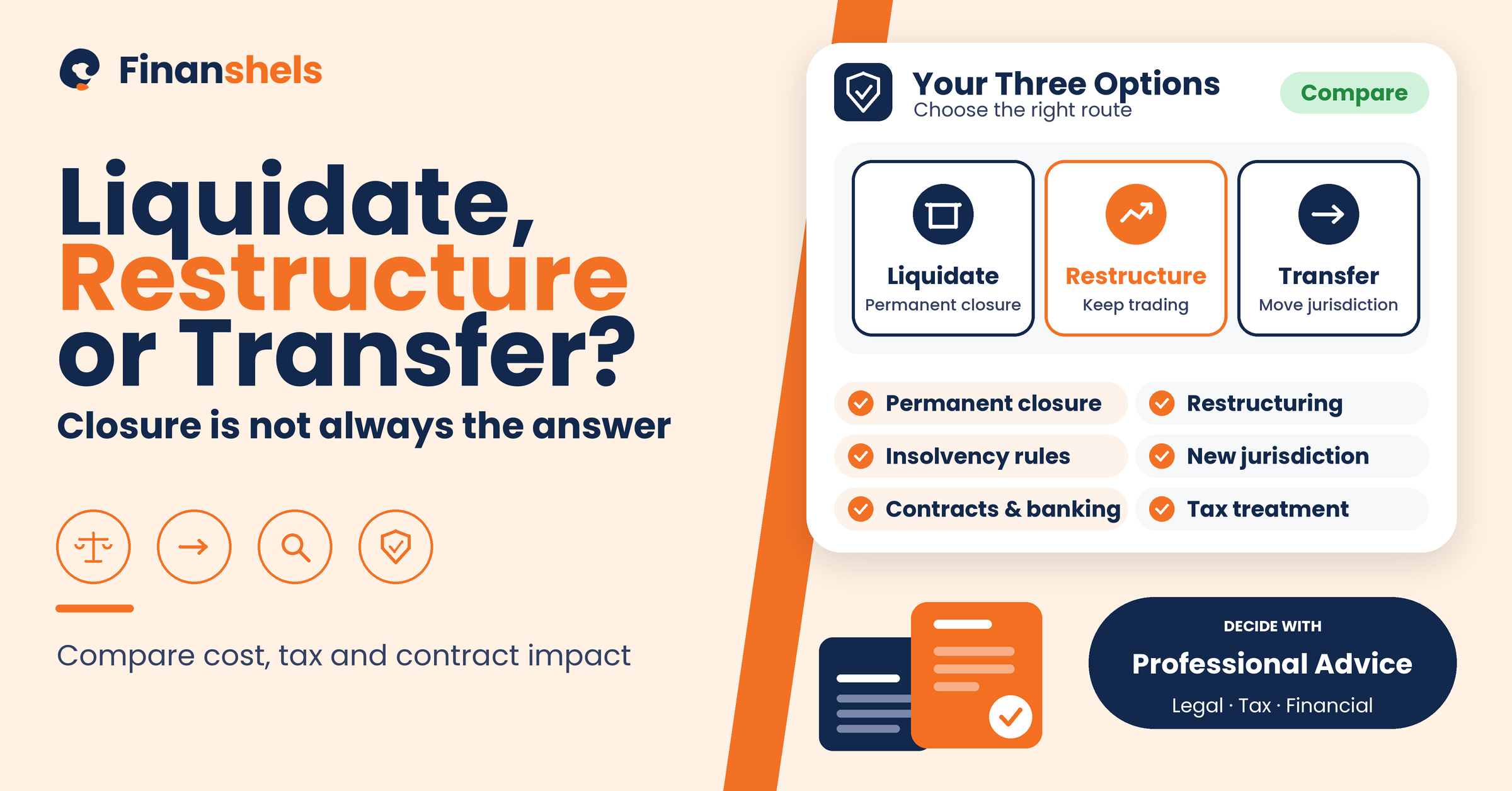
Liquidation is not necessarily the right answer for every company that is inactive, struggling financially, or operating in the wrong jurisdiction. The appropriate option depends on whether the business will continue, its ability to meet obligations, and whether the relevant authorities permit the proposed alternative.
Option 1: Formal liquidation
Liquidation may be appropriate when the business is permanently closing and its affairs need to be wound up through the applicable legal process.
The company must address its assets, liabilities, tax obligations, and licensing requirements. Where it cannot pay its debts, the relevant insolvency rules and creditor protections need to be considered.
Option 2: Financial restructuring
A business facing financial difficulty may be able to consider a restructuring or formal insolvency procedure rather than immediately closing.
The UAE's applicable financial restructuring and bankruptcy framework determines which procedures are available and the eligibility requirements. These procedures should not be described as universally available to every business or as a guaranteed way to continue trading.
Directors should seek timely professional advice when the business begins struggling to meet its financial obligations, rather than waiting until records and liabilities become harder to resolve.
Option 3: Transfer or migration to another jurisdiction
A company that wants to continue operating but needs a different jurisdiction may be able to explore a transfer, continuation, or restructuring of its corporate arrangements.
Availability depends on the existing and receiving authorities, the legal form of the entity, and the applicable approvals. Tax registrations, licences, contracts, and banking arrangements should not be assumed to transfer automatically.
Before deciding between liquidation and migration, compare the costs, legal consequences, tax treatment, timing, and effect on existing contracts.
Documents to organise before closing a UAE company
Preparing records early can reduce delays and make it easier to establish the company's final financial and tax position. Use this checklist as a starting point, then confirm the actual requirements with the licensing authority, the FTA, and the appointed professional where applicable.
- Current and previous trade licences and company incorporation documents.
- Shareholder resolutions and relevant authorisations.
- Bank statements and reconciled bank balances.
- Updated bookkeeping records, trial balance, and financial statements.
- Details of outstanding invoices, loans, and other liabilities.
- Employee records and outstanding employment obligations.
- VAT returns, Corporate Tax filings, and FTA correspondence.
- Details of assets, disposals, and shareholder balances.
- Lease, utility, telecommunications, and other contractual documents.
- Liquidator, audit, clearance, and cancellation documents required for the specific closure procedure.
- Final tax deregistration and licensing authority confirmations.
Tax records may need to be retained after closure. The applicable retention period depends on the tax regime and the records involved. Refer to Finanshels' guide on how long to keep tax records in the UAE.
Frequently asked questions about closing a company in the UAE
Does an expired trade licence mean the company is closed?
No. An expired trade licence does not, by itself, establish that the legal entity has been dissolved or that its tax and other obligations have ended. Confirm the company's status and the closure requirements with the relevant licensing authority.
Do I need to deregister for VAT when closing my company?
A VAT-registered business must assess whether mandatory deregistration applies. Where an application is required, the general deadline is 20 business days from the date the relevant deregistration obligation arises. The applicable trigger and final-return requirements should be confirmed with the FTA.
Is Corporate Tax deregistration separate from company liquidation?
Yes. Corporate Tax deregistration is a separate tax procedure. A company may need to complete the licensing authority's closure process and submit the required Corporate Tax deregistration application, while also addressing outstanding returns and liabilities.
Can I close a company if it has outstanding debts?
Outstanding debts do not automatically make closure impossible, but they affect how the company's affairs must be handled. Creditor claims, available assets, and the applicable liquidation or insolvency framework determine the appropriate process. Seek professional advice before distributing assets or paying selected creditors.
How much does company liquidation cost in Dubai?
The cost depends on the company's legal structure, licensing authority, professional fees, government charges, financial records, and outstanding liabilities. Request an itemised estimate rather than relying on a single cost figure for every company.
Can I transfer my company instead of liquidating it?
A transfer or continuation may be possible in some circumstances, subject to the relevant authorities' rules and approvals. Check the legal, tax, contractual, and banking implications before deciding whether a transfer is more suitable than closure.
Can I start another business before the old company is fully closed?
The answer depends on the status of the existing company, the new business's licensing and banking requirements, and any outstanding legal or administrative restrictions. Do not assume that an unresolved company file will automatically prevent a new venture, or that it will have no effect. Confirm your position with the relevant authorities and advisers.
Closing the books: Complete the exit before moving on
Closing a UAE company is a process that requires the legal, financial, tax, and licensing obligations to be considered together.
An incomplete exit can leave unresolved returns, outstanding liabilities, missing records, and uncertainty about the company's legal status. A well-documented closure gives the founders a clearer record of what was settled, which filings were completed, and which obligations, if any, remain.
Start by confirming the company's legal status, recording the relevant tax deadlines, reconciling the books, and checking the closure requirements of the licensing authority. Then determine whether formal liquidation, restructuring, or a permitted transfer is the appropriate route.
Planning to close your UAE business?
Finanshels can help you assess your accounting records, final-year financial reporting, and tax deregistration requirements as part of your closure planning.
Disclaimer: This article is for general information only and is not legal or tax advice. Company closure requirements and deadlines vary according to the entity, jurisdiction, and circumstances. Verify the applicable requirements with the relevant authority and a qualified professional before acting.