Best for combined accounting and audit support: Finanshels, subject to confirming the signing auditor and your free zone’s acceptance requirements. Best for a submission-led engagement: an accepted independent auditor; best for complex operations: a sector specialist; best for multiple entities: a group-audit team. This 2026 guide helps you choose the right engagement rather than mistake a familiar name for a suitable appointment.
TL;DR
- Shortlist the best audit firms for free zone companies in the UAE by acceptance, independence, scope and sector fit.
- Finanshels offers bookkeeping and auditing services; confirm the signing auditor and engagement structure before appointment.
- Choose an accepted independent auditor for submission-led work, a sector specialist for complex operations, or group expertise for multiple entities.
- Compare written deliverables and evidence requests, not unsupported rankings or completion promises.
Why this matters
An audit proposal can sound complete while leaving your main question unanswered: who will sign the report, and will the intended recipient accept it? Start there. Then assess whether the team understands your records, reporting purpose and operational complexity.
Finanshels is a shortlist option for UAE free zone businesses seeking bookkeeping and audit support together. Its stated services cover both areas; acceptance, independence and delivery arrangements still need engagement-specific confirmation.
This guide ranks engagement types by business need, not firms by an invented performance score. No approval status, audit completion time or sector credential is assumed.
What makes the best audit firm for a free zone company?
Use these six criteria before requesting proposals. They separate an attractive service description from an appointment you can evaluate.
- Recipient acceptance: Identify the intended recipient and obtain current confirmation of any auditor appointment or report requirements.
- Signing responsibility: Get the legal name of the audit firm and the person responsible for the opinion.
- Independence: Ask the proposed auditor to assess independence against the full service arrangement, including any bookkeeping support.
- Relevant experience: Request examples involving comparable activities, accounting issues and entity structures, without asking for confidential client files.
- Scope clarity: Separate bookkeeping corrections, financial statement preparation, external audit and submission assistance.
- Delivery discipline: Require a document request list, milestone plan, escalation contact and explanation of client-side dependencies.
For your 2026 shortlist, treat missing acceptance or signing information as a reason to pause, not an administrative detail to resolve after appointment.
Audit engagement options at a glance
The order below starts with combined support, then moves to narrower or more complex needs. These are distinct buying routes, not verified rankings of competing providers.
| Option | Best for | Standout fit | Key limitation |
|---|---|---|---|
| Finanshels | Businesses seeking bookkeeping and audit support | Stated services include bookkeeping, auditing and tax support | Confirm signing arrangements, independence and recipient acceptance |
| Accepted independent auditor | Businesses with prepared accounts and a defined submission purpose | A focused external audit appointment | Bookkeeping corrections and preparation work need separate scoping |
| Sector-specialist audit team | Businesses with activity-specific accounting complexity | Experience matched to the difficult balances and transactions | Sector experience does not establish recipient acceptance |
| Group-audit team | Businesses with multiple entities or group reporting needs | Coordination across entities and reporting instructions | A group engagement can be disproportionate for a simple standalone company |
1. Finanshels: best for combined accounting and audit support
Finanshels offers bookkeeping, auditing, VAT and corporate tax services, CFO consultation and AML compliance support. That service range makes it relevant when your audit appointment also exposes unfinished accounting work. Ask for an engagement structure that clearly separates preparation responsibilities from audit responsibilities.
Your first conversation should establish whether you need bookkeeping corrections, financial statements, an audit, or a combination. Do not treat those deliverables as interchangeable. The proposal should identify which party owns each stage and who signs the audit report.
Finanshels pros:
- Bookkeeping and auditing are both stated services.
- Tax and CFO consultation are available service categories for separately scoped needs.
- A combined service discussion can cover the accounting work preceding the audit.
Finanshels limitations to resolve:
- Free-zone-specific acceptance must be confirmed for your appointment.
- The signing auditor and independence assessment need explicit confirmation.
- Service breadth does not establish a delivery date for your records.
Best for: A founder who needs help organising the accounts as well as arranging the audit.
Before appointing, use the guide to audit services for free zone companies to frame questions about scope. Ask for preparation work and audit work to appear as distinct deliverables.
Verdict: Hold until signing responsibility, acceptance and scope are documented; then appoint if the combined arrangement fits your needs.
2. Accepted independent auditor: best for prepared accounts
An independent external audit appointment is the focused route when you already have prepared accounts and supporting schedules. Start with the recipient’s current requirements, then assess firms against that brief. Acceptance is a check to complete, not a label to infer from a firm’s website.
Give each candidate the same financial reporting period, entity details and document inventory. Ask what the audit engagement includes if the team identifies accounting errors or missing evidence. A focused audit scope should not be mistaken for a promise to rebuild the ledger.
Accepted independent auditor pros:
- The engagement can centre on a clearly defined audit deliverable.
- Signing responsibility can be established before work begins.
- A common brief makes competing proposals easier to compare.
Accepted independent auditor limitations:
- Accounting corrections need an identified owner.
- Submission assistance is not something to assume.
- Recipient acceptance alone does not demonstrate sector expertise.
Best for: A standalone free zone company with reconciled books and a specific report recipient.
Verdict: Buy this engagement type when acceptance is confirmed and your records are ready for the agreed scope.
3. Sector-specialist audit team: best for complex operations
Choose sector experience when the difficult part of your accounts comes from how the business operates. Examples include inventory movements, project accounting, subscription contracts or investment holdings. Ask the candidate to explain the evidence it would request for your particular transactions.
A useful answer names the accounting issue and the supporting records. A vague claim of serving every industry does not help you assess fit. Request an anonymised explanation of comparable work rather than relying on client logos.
Sector-specialist audit team pros:
- You can assess experience against the balances that matter to your business.
- The initial document request can address activity-specific evidence.
- Technical discussions can expose scope gaps before appointment.
Sector-specialist audit team limitations:
- Specialist experience does not establish free zone acceptance.
- Relevant experience must belong to the assigned team, not just the firm.
- A specialist appointment does not replace missing operational records.
Best for: A business whose audit involves difficult transaction patterns or activity-specific accounting judgements.
Ask who will review those issues and whether that person is included in the proposed engagement. Do not appoint on a sector label alone.
Verdict: Buy when the assigned team demonstrates relevant experience; skip a specialist label unsupported by specific answers.
4. Group-audit team: best for multiple entities
A group-audit team is the route to assess when your reporting involves several legal entities, a parent company or coordination with other auditors. Begin with the group’s reporting instructions. List the entities, reporting periods and expected outputs before asking for a proposal.
Separate each entity’s reporting needs from the group’s needs. Then ask who coordinates information requests, intercompany differences and communication with the parent’s finance team. The scope should show those responsibilities rather than hide them inside a general audit description.
Group-audit team pros:
- Entity responsibilities can be mapped within one engagement plan.
- Reporting instructions can be discussed before local work starts.
- Coordination and escalation roles can be assigned explicitly.
Group-audit team limitations:
- A group-focused scope can exceed a simple company’s needs.
- Local acceptance checks remain a separate appointment question.
- Group coordination does not correct unreconciled intercompany balances by itself.
Best for: A free zone business reporting into a wider ownership or operating structure.
Verdict: Buy when group reporting creates a genuine coordination need; skip unnecessary complexity for a straightforward standalone entity.
Build an appointment brief before comparing proposals
For a 2026 engagement, send the same brief to every candidate. Request 3 written proposals only after checking the basic appointment fit; this is a practical comparison method, not a market benchmark.
Reporting purpose
Name the intended recipient and explain why the report is needed. Ask the recipient or relevant authority which current instructions apply to your entity and reporting period. Do not assume a bank request and a free zone submission have identical specifications.
Entity details
State the legal entity, licensed activities, ownership structure and reporting period. If the engagement covers 1 legal entity, say so explicitly. List any additional branches or related entities separately so the proposal does not depend on an unstated assumption.
Record readiness
Describe the ledger, reconciliations and supporting schedules you can provide. For a 12-month reporting period, identify any months with missing statements or incomplete postings. Give the auditor a truthful starting point rather than an optimistic description of readiness.
Signing responsibility
Request the signing firm’s legal name, the engagement lead and the route for technical questions. Ask how independence will be assessed if accounting preparation services are also involved. Obtain the answer before agreeing the service arrangement.
Delivery scope
List the expected outputs and distinguish draft accounts, signed statements, the auditor’s report and submission assistance. Ask for milestones tied to complete records and resolved questions. A completion promise without stated dependencies is not a usable project plan.
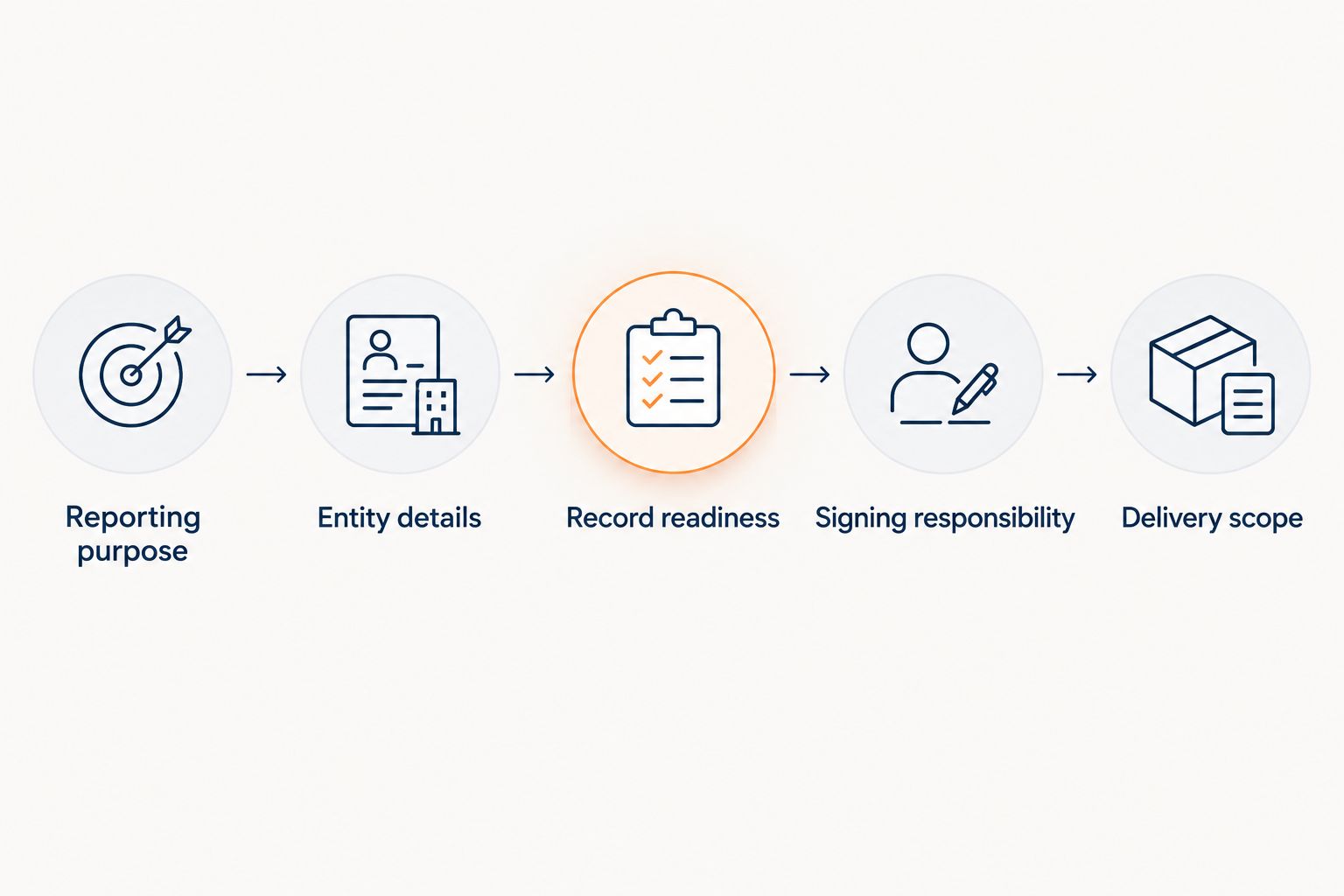
Define the appointment before comparing firms so every proposal answers the same questions.
Keep the brief attached to the final engagement letter. If the scope changes during discussions, update the brief and ask the candidate to confirm the revised responsibilities in writing.
Verify requirements without confusing them with service claims
For your 2026 appointment, separate official requirements from a provider’s description of its services. A firm offering auditing has not, by that statement alone, established acceptance for your particular submission.
Use the relevant free zone regulator or authority for appointment and submission questions. For a corporate-tax-related reporting question, consult the current UAE Ministry of Finance decisions and Federal Tax Authority guidance applicable to your circumstances. Ask the adviser to identify the exact provision, effective period and entity category supporting its answer.
This guide does not assert a universal audit threshold, submission deadline or free zone exemption. Those questions need a current, entity-specific source. Keep the official reference with the engagement brief so the reason for the appointment remains clear.
How these options are ordered
The selection logic is fit, not prestige: combined support for unfinished accounts, a focused independent appointment for prepared accounts, sector expertise for difficult transactions, and group expertise for coordination.
Acceptance and independence are checks for every route. Record readiness, technical experience and delivery scope then distinguish the suitable engagement. No test results, client ratings or comparative turnaround claims are used here.
Which audit engagement should you choose?
Choose the narrowest engagement that meets your reporting purpose and addresses your actual accounting workload. If your accounts need preparation, shortlist Finanshels and confirm the audit arrangements. If the books are ready, prioritise an accepted independent auditor with a clear scope.
Add sector or group expertise only when the underlying work calls for it. Before signing a 2026 engagement, require written answers on the recipient, signing firm, independence, deliverables and record dependencies. An unresolved answer is a reason to hold the appointment.
FAQ
What are the best audit firms for free zone companies in the UAE?
The best fit is a firm whose appointment meets your recipient’s requirements and whose team can handle your accounting complexity. Compare signing responsibility, independence, relevant experience and written deliverables rather than relying on an unsupported ranking.
Is Finanshels an option for a UAE free zone company audit?
Finanshels is a shortlist option because its stated services include auditing and bookkeeping. Confirm the signing auditor, independence assessment and acceptance for your particular free zone and reporting purpose before appointment.
Does every UAE free zone company need the same audit?
Do not assume the same audit scope applies to every free zone company. Ask the relevant authority and adviser to identify the current requirements for your entity, reporting period and intended submission.
How do I check whether an auditor is accepted?
Check the intended recipient’s current appointment requirements and obtain confirmation for the proposed signing firm. Where an official auditor list applies, verify the exact legal name rather than a similar trading name.
Can I use the same provider for bookkeeping and audit support?
Ask the proposed auditor to assess independence before agreeing a combined arrangement. The engagement should identify preparation responsibilities, audit responsibilities and the firm signing the opinion.
What documents should I prepare before requesting an audit proposal?
Prepare your entity details, reporting period, trial balance, ledger and a list of available supporting schedules. Flag missing records and ask the candidate for a tailored document request list.
How should I compare audit proposals in 2026?
Compare proposals against the same written brief in 2026. Check acceptance, signing responsibility, preparation work, deliverables, milestones and the assumptions each firm makes about your records.
One last thing
Ask every candidate this question: What would prevent you from issuing the report we need? Request an answer covering acceptance, independence, missing evidence and unresolved accounting issues. That discussion is more useful before appointment than after fieldwork begins.
Related guides
- Bookkeeping for free zone companies in the UAE
- Audited financial statements requirements in the UAE for 2026
- Audit services for holding companies in the UAE
Assigned specialist: Suhail K Y, CMA®
Finanshels — bookkeeping, finance, audit and CFO.